

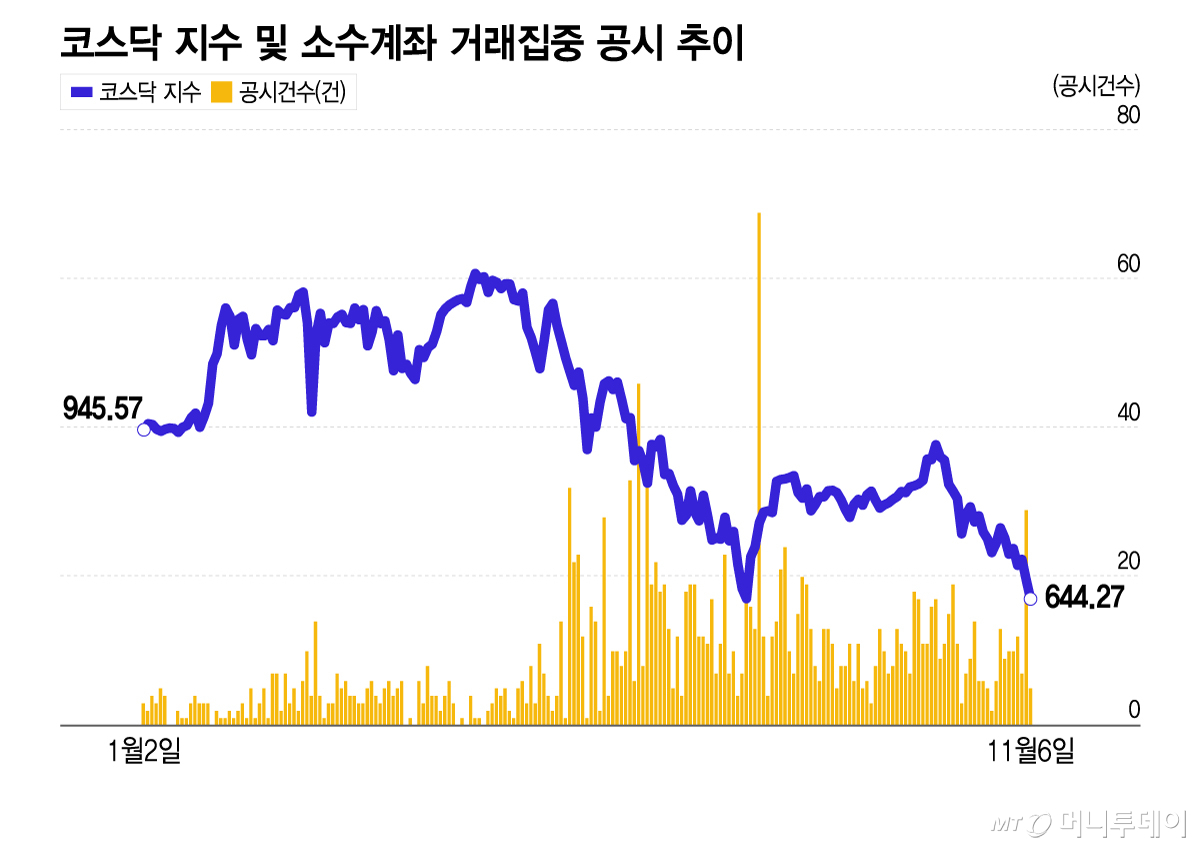
As the KOSDAQ Index struggles to escape weakness, hovering near its year-to-date low, a phenomenon where trading in specific stocks on the exchange is concentrated in a small number of accounts has continued recently. Amid a sharp decline in trading volume, supply and demand dynamics aiming for sudden price surges or drops appear to be increasing the difficulty of selecting stocks.
According to Korea Exchange's listed company disclosure system (KIND) on the 9th, the total number of "minority account trading concentration" investment warning disclosures issued in the KOSDAQ market this year stood at 1,766 cases (covering 638 stocks) as of the previous trading day. This disclosure, which averaged around 30 cases per month last year, jumped to an average of 72 cases from January to May this year before peaking at 361 cases in June.
Disclosures continued their high-altitude run with 282 cases in July and 309 cases in August. They also exceeded 190 cases in September (191 cases) and last month (199 cases). Since the start of this month, 63 cases occurred in just the first week (the 2nd to the 6th). It was revealed that on the 5th, when the index plunged 5.11%, a massive 29 disclosures were issued in a single day.
Despite the market slowing down in the second half, stock overheating continues. According to Korea Exchange statistics, the average daily trading value in the KOSDAQ market reached 14.9 trillion won in January and 15.6 trillion won in May, but it was cut by one-third to 6 trillion won in August and 5.4 trillion won in the first week of this month. In contrast, the average daily number of minority account trading disclosures jumped from 2.2 cases in January to 15.5 cases in August, then recorded 12.6 cases in the first week of November, showing no signs of subsiding.
The tendency for specific stocks to be repeatedly flagged and for a significant portion of disclosures to be occupied by theme-driven volatile stocks or stocks with market capitalizations below the threshold also fuels suspicions of irregular trading. Among the 638th KOSDAQ stocks subject to disclosure, 119 stocks (18.7%) that were disclosed five or more times accounted for 45.2% (799 cases) of all disclosures.
By stock, Chullip & Science (formerly Aptamer Science, 14 cases) took the lead in the number of disclosures, while Hanju ART and Vibe Company (13 cases each) tied for second place. There were also as many as 20 stocks with 10 or more disclosures, including Nexa Dynamics (12 cases) and Gwangjin Industrial, Barunson E&A, and Foodnamu (11 cases each).
Chullip & Science (market cap of 68.1 billion won) saw supply and demand concentrated in bio materials, while Vibe Company's market capitalization (18.5 billion won) is below the KOSDAQ listing maintenance minimum threshold (20 billion won). Hanju ART's stock price crashed to 599 won (market cap of 3.2 billion won), after which grounds for a substantive review of listing eligibility arose last month, leading to a trading halt.
In the market, suspicions continue that artificial attempts to prop up stock prices are ongoing as the implementation of delisting regulations for stocks with insufficient stock prices and market capitalizations in the second half has heightened concerns about delisting and designation as managed stocks. Although final delisting was postponed due to a court injunction last month, the designation as managed stocks is proceeding as planned, leaving motives to intervene in stock prices intact, according to opinions.
A financial investment industry official said, "Small-cap stocks with thin order books have always been classified as having high concerns over speculative supply and demand because they can be moved with small amounts of capital," adding, "It is necessary to pay special attention to marginal companies that experience sharp price fluctuations without being backed by performance."
Meanwhile, a total of 361 disclosures (covering 158 stocks) regarding minority account trading concentration have occurred in the KOSPI market since the beginning of this year. After 192 cases were concentrated from June to August, the frequency has been slowing down with 25 cases in September, 38 cases in October, and 7 cases in the first week of November.
By stock, minority account trading was flagged in small-cap stocks with insufficient market capitalization such as Coas (18 disclosures, market cap of 10.9 billion won), SUN&L (14 times, 12.2 billion won), and Taewon Industrial (10 times, 18.1 billion won), as well as rarely traded preferred stocks like Doosan Fuel Cell 1 Preferred.

 in STOCK
