

As the balance of margin investing in domestic stock markets dropped by more than 1.5 trillion won in a single day, the KOSDAQ index surged 10.35% over two days.
During the sharp decline, the rate of decrease in KOSDAQ's margin investing balance exceeded twice that of the KOSPI, indicating that leveraged investments were rapidly unwound, thereby reducing selling pressure. This was compounded by an influx of buying, which amplified the rebound.
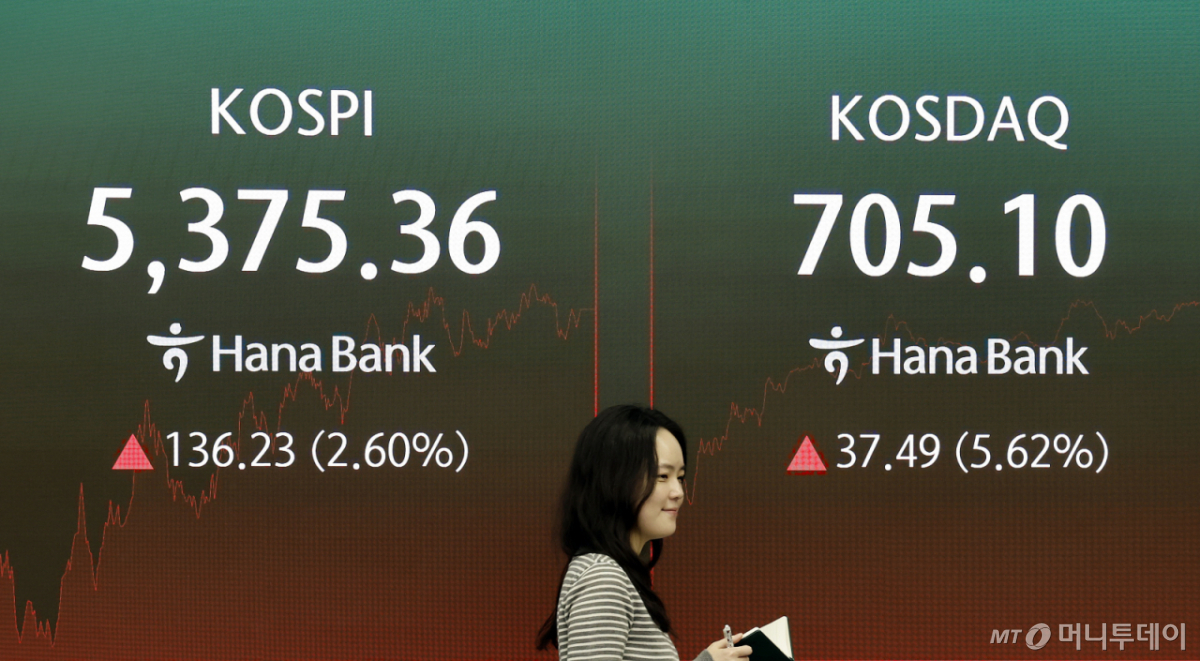
According to Korea Exchange on Wednesday, the KOSDAQ index closed at 705.10, up 37.49 points (5.62%) from the previous trading day. It rose significantly for the second consecutive day, following a 4.48% gain the previous day.
Over the same period, the KOSPI rose by 7.10%. As the KOSDAQ 150 cash and futures indices spiked, a buying sidecar (futures market circuit breaker) was triggered for the second straight day, and the index recovered the 700th mark for the first time in five trading days.
The securities industry cites the decline in margin loan balances as one of the factors behind the recent KOSDAQ rebound. According to the Korea Financial Investment Association, as of the 10th, the margin investing balance stood at 26.5494 trillion won, a decrease of 1.5211 trillion won (5.42%) from the previous trading day.
Compared with 29.2160 trillion won on the 2nd, it had fallen by 2.6666 trillion won (9.13%) over six trading days. Margin investing refers to transactions in which investors borrow money from securities firms to purchase stocks, and changes in the balance serve as an indicator of the scale of leveraged investment in the stock market.
Forced liquidations related to unsettled amounts arising from failure to pay short-term settlement funds after the sharp drop also increased. On the 10th, the amount of forced liquidation for unsettled brokerage accounts was approximately 63 billion won, a 66.3% increase from approximately 37.9 billion won the previous day.
Compared with approximately 7 billion won on the 6th, this represented an increase of about nine times. The ratio of forced liquidations to unsettled amounts also rose from 0.8% on the 6th to 4.2% on the 9th and 5.7% on the 10th.
In particular, the pace of reduction in leveraged investment in KOSDAQ was relatively fast between the 2nd and the 9th. The margin investing balance in the KOSDAQ market decreased from 6.6384 trillion won on the 2nd to 6.2074 trillion won on the 9th, a drop of 431 billion won (6.49%).
Over the same period, the margin balance in the Korea Exchange (KOSPI) market fell from 22.5776 trillion won to 21.8631 trillion won, a decrease of 714.5 billion won (3.16%). The rate of decline in KOSDAQ's margin balance was approximately 2.1 times that of the Korea Exchange market.
Na Jeong-hwan, a researcher at NH Investment & Securities, explained, "It appears to be the result of reduced selling pressure as margin balances decreased, combined with buying interest fueled by rumors that the government may introduce additional support measures for KOSDAQ."
However, securities industry experts advised against definitively determining the sustainability of the rebound based solely on supply and demand indicators, recommending instead that investors monitor whether additional buying continues.
Lee Kyung-min, head of the FICC Research Department at Daishin Securities, stated, "Large-scale margin forced liquidations can be a signal of bottom formation, but it is difficult to predict future stock price movements based solely on supply and demand indicators," adding, "It is necessary to confirm additional supply and demand flows to determine whether a trend reversal has occurred."

 in STOCK
