

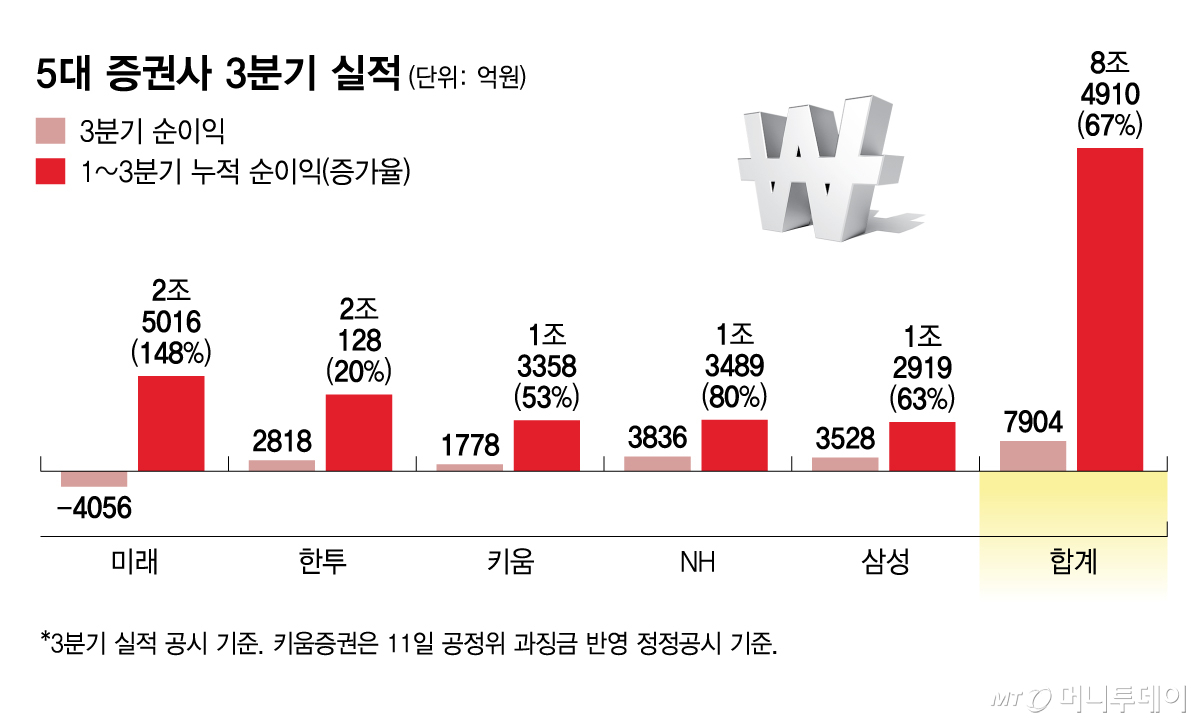
Domestic major brokerages posted sluggish results in the third quarter of this year, but their cumulative net profit for the first three quarters approached 8.5 trillion won, continuing a growth trend.
Following strong performance last year, cumulative net profit increased by approximately 67% compared to the same period last year. This is the result of substantial profits from the stock market boom in the first half offsetting the Q3 slump.
However, as quarterly results fluctuated significantly due to declining trading volume and changes in investment asset valuation gains and losses, securing a stable revenue base to sustain high profit growth has been identified as a challenge.
Cumulative performance grows despite Q3 profit decline
According to the financial investment industry on the 12th, the cumulative net income for the first three quarters of this year on a consolidated basis for five major brokerages—Mirae Asset Securities, Korea Investment & Securities, NH Investment & Securities, Kiwoom Securities, and Samsung Securities—was recorded at approximately 8.491 trillion won.
This represents a 67% increase compared to the same period last year. All five companies posted double-digit growth rates in cumulative net profit.
Mirae Asset Securities, which announced its earnings on the same day, recorded a net loss of 405.6 billion won in Q3, but its cumulative net profit rose 148% year-on-year to 2.5016 trillion won.
Large valuation gains from investments in SpaceX in the first half drove the cumulative performance. In Q3, pre-tax losses related to SpaceX amounted to 514 billion won.
The company explained that consolidated pre-tax profit, excluding losses from SpaceX and proprietary investment (PI), was approximately 380 billion won, indicating that its ability to generate recurring revenue was maintained.
Samsung Securities demonstrated stable performance. Q3 net profit increased by 14% year-on-year to 352.8 billion won, while cumulative net profit rose by 63% to 1.2919 trillion won.
Despite declining trading volume, the Wealth Management (WM) division supported performance. Financial product sales revenue increased by 57% compared to the same period last year. It was assessed that this demonstrated the importance of reducing reliance on brokerage and securing diverse revenue sources for defending performance.
Kiwoom Securities revised its Q3 net profit to 177.8 billion won after reflecting costs related to a fine from the Fair Trade Commission. Although this represented a 74% decrease from the previous quarter, cumulative net profit increased by 53% year-on-year to 1.3358 trillion won. Cumulative net profits for Korea Investment & Securities and NH Investment & Securities also rose by 20% and 80%, respectively, to 2.0128 trillion won and 1.3488 trillion won.
As major brokerages accumulated substantial profits this year, moves to expand shareholder returns have also emerged. Mirae Asset Securities announced on the same day that it plans to cancel 65 million shares of treasury stock immediately after next year's regular shareholders' meeting. Based on the closing price on the 11th, this amounts to approximately 1.4 trillion won.
Annual profit growth continues… Q4 trading volume and operating gains/losses are variables
The Q3 results showed that while the scale of profit generation for major brokerages has expanded, performance volatility due to stock market conditions is also significant. The combined Q3 net profit of the five companies was approximately 790.4 billion won, an 82.5% decrease from the previous quarter.
Brokerage revenue declined as the daily average trading volume in the domestic stock market fell by about 42% compared to Q2, and valuation gains/losses on investment assets and one-time costs also had an impact.
In particular, investment asset valuation gains, which significantly boosted first-half performance, can turn into losses depending on market conditions. On the other hand, WM, Investment Banking (IB), and interest income are revenue sources that can offset declines in brokerage revenue.
Experts pointed out that to judge the stability of future performance, it is necessary to look not only at the scale of cumulative net profit but also at which businesses generated the profits.
In Q4 as well, stock market trading volume, interest rate movements, and investment asset valuation gains/losses are expected to determine performance. If trading volume does not recover, it will be difficult to expect an increase in brokerage fees, and rising interest rates could burden bond operating gains/losses.
However, analysts noted that the extent to which diversification of revenue sources such as WM and IB can cushion performance declines may vary by brokerage.
For the full year, there is a possibility of recording higher annual net profit than last year based on the cumulative profits secured through Q3. However, given that stock market trading has contracted since Q3 and volatility in investment asset valuation gains/losses has increased, it remains uncertain whether the high profitability of the first half can be sustained.
For brokerages that have achieved high profits this year following last year, reducing reliance on brokerage and investment asset valuation gains while expanding a stable revenue base is cited as a key task to sustain growth going forward.

 in STOCK
