

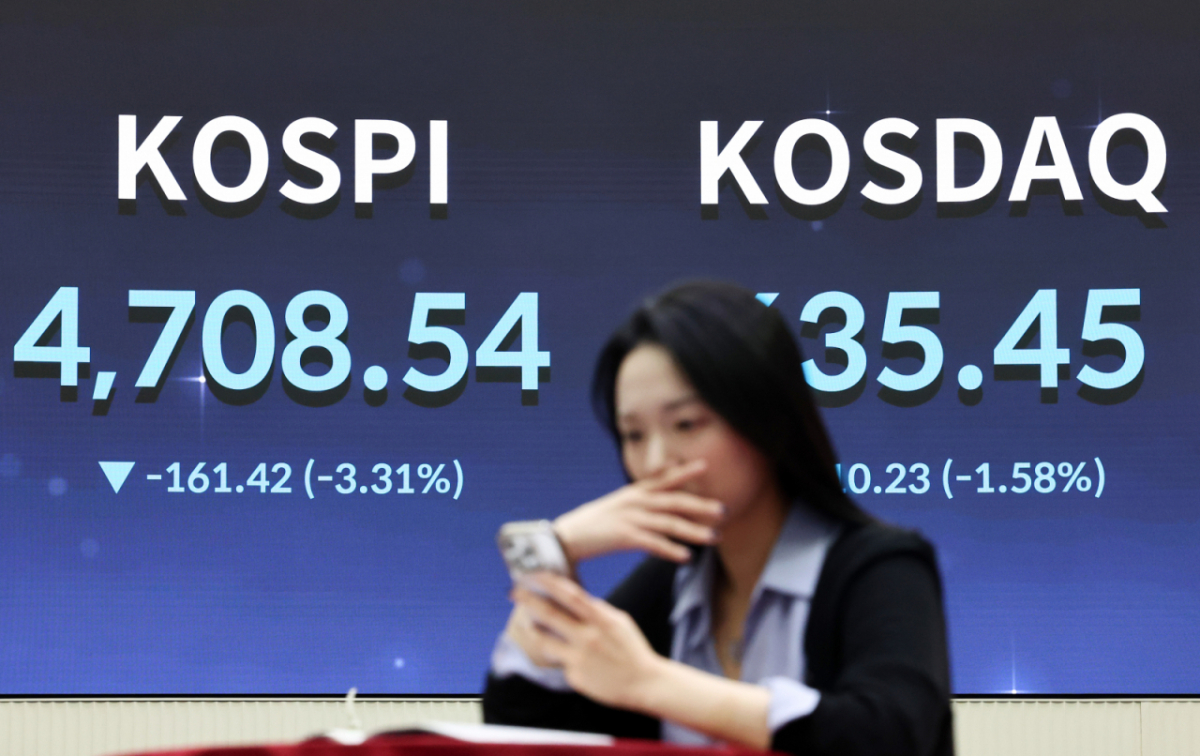
The KOSPI index fell below the 4,600 mark intraday, triggering the sell-side sidecar for two consecutive trading days. The securities industry is largely assessing that the preparation to activate the government’s Securities Market Stabilization Fund has had a minimal effect, while focusing on the direction of interest rates.
On the 23rd, the KOSPI closed at 4,708.54, down 161.42 points (3.31%) from the previous trading day. The index opened at 4,734.90, falling below the 4,800 mark. It plunged more than 5% during trading, triggering the 60th sidecar of this year. This is the 32nd time it has been triggered on the sell side. Among 824 stocks that declined in the KOSPI market, only 71 closed higher.
Major U.S. stock indices all fell on the 20th (local time), exerting downward pressure on domestic markets. On the New York Stock Exchange, the NASDAQ Composite Index fell by 5.28%, the S&P 500 Index by 3.70%, and the Dow Jones 30 Industrial Average by 1.93%. The Dow Jones Industrial Average and the S&P 500 Index dropped more than 10% from their previous highs, entering a correction phase. The NASDAQ Index gave back all of its annual gains for this year. The Philadelphia Semiconductor Index plunged by 10.7%.
Yang Hyeon-kyung, a researcher at iM Securities, said, “Suspicions of export control violations surrounding AMD’s transactions with sanctioned Chinese companies, concerns over slowing demand for Broadcom due to Google’s outlook of reducing shipments of its TPU (Tensor Processing Unit) 8i next year, and reports of an accounting treatment investigation by the U.S. Securities and Exchange Commission (SEC) into NVIDIA impacted the sharp decline in U.S. semiconductor stocks.”
Although the government held an emergency market situation review meeting (F4 meeting) the previous day and announced market stabilization policies, including preparations to activate the Securities Market Stabilization Fund, opinions suggest that this is limited in its ability to reverse the index’s decline. Decisions were made to implement market stabilization measures, including △commencing preparatory work for the Securities Market Stabilization Fund and △operating a special intensive monitoring period (3 months) for illegal short selling by entities such as the Financial Supervisory Service and the Korea Exchange. On this day, an additional policy was announced to relax the daily limit on listed companies’ acquisition of their own shares for three months starting from the 24th.
Jeong Da-un, a researcher at LS Securities, stated, “The Securities Market Stabilization Fund is not a fundamental solution, and its scale is not clearly defined, but a scale in the trillions of won range is not that large,” adding, “It appears necessary to find the significance of the Securities Market Stabilization Fund or the relaxation of share buyback limits in terms of defending against an expanded decline.” As of this day, the market capitalization of the KOSPI index was 3,860 trillion won, meaning the scale of the Securities Market Stabilization Fund corresponds to 0.26%.
Given that foreign selling has exceeded the trillions-of-won level, it appears difficult for the Securities Market Stabilization Fund to change the direction of the index. According to the Korea Exchange, foreign investors have sold an average of 1.028 trillion won per day since the beginning of this year, as of the previous day. On this day, in the KOSPI market (based on Korea Exchange data), foreigners made net sales of 237.2 billion won, continuing a streak of net sales for seven consecutive trading days since the 13th.
A researcher at a securities firm who requested anonymity also analyzed, “Empirically, when the Securities Market Stabilization Fund card is played, the index is often near its bottom, so it may recover from an investment ‘psychology’ perspective, but this too will likely be minimal,” adding, “Policies play a role in supporting the lower bound of the index, and ultimately, a rebound will only be possible if the global macro environment, such as interest rates, improves or skepticism regarding AI (artificial intelligence) subsides.”
The securities industry believes that for the stock market atmosphere to reverse, a message indicating a slowdown in the pace of rate hikes must come from the Federal Open Market Committee (FOMC) of the Federal Reserve System (Fed·Federal Reserve), scheduled next month. Yuanta Securities lowered its projected range for the KOSPI index next year to 4,000–7,300, pointing out that easing concerns over additional tightening by the Federal Reserve following a December FOMC rate hike is one of the factors for a short-term rebound.
Market attention is expected to focus on the release of the U.S. Personal Consumption Expenditures (PCE) price index this week, an indicator gauging inflation. Since the PCE is referenced by the U.S. Federal Reserve when deciding interest rates, attention is being paid to how the PCE results will impact the direction of interest rates ahead of next month’s FOMC and the November consumer price index (CPI). As the earnings season for AI technology stocks concludes, whether Dell can quell concerns over the profitability of AI investments with its earnings release is also cited as a factor to watch.
Im Jeong-eun and Tae Yoon-sun, researchers at KB Securities, forecasted that “toward year-end, rather than a meaningful rebound amid high volatility, the market will show a trend of groping for a bottom.”

 in STOCK
