

[For more diverse corporate information on the startups mentioned in this article, please visit the Unicorn Factory big data platform 'Data Lab'.]
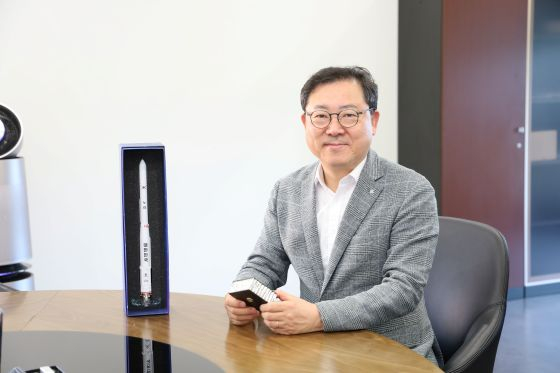
"In space, reducing weight by 1kg saves approximately 100 to 2 billion won. How lightweight and durable we can make launch vehicles, lunar exploration rovers, Mars landers, and radiation shielding materials for solar panels of space data centers is the core of global space competition."
Choi Won-guk of KIST Jeonbuk Branch Jeon Buk-bun (Director) recently emphasized the importance of developing space materials in an interview with MoneyToday startup media platform 'Unicorn Factory', stating this. He further warned, "Space materials are still a field where standard certification procedures have not been established domestically. If we do not lay this foundation now, the structure of having to rely on foreign countries for key materials will become entrenched."
KIST space materials technology recognized by NASA
The material that KIST Jeonbuk Branch is focusing on is carbon composite material. This material, which combines carbon fibers with polymer resins, is much lighter and stronger than iron and is already used in Boeing passenger aircraft fuselages and space rockets. Director Choi aims to further advance this material to create components for the structures of lunar or Mars exploration rovers, as well as materials for heat transfer and electrical conduction.
The space environment is harsh. The daytime temperature on the lunar surface reaches 120 degrees Celsius, while nighttime temperatures drop to minus 175 degrees Celsius. When colliding with cosmic radiation (protons, gamma rays, heavy particles, electrons, etc.) pouring from the sun, secondary neutrons are generated; these neutrons penetrate regardless of whether they hit metal or humans.
Director Choi stated, "The neutron shielding material held by our research institute was directly attached to NASA's space station solar panel structures and underwent a six-month exposure test in the space environment. It is the only verified material technology in Korea." This research, which has continued for nine years, aims ultimately to launch actual payloads on rockets into space.
Building 'Space Materials Verification Center'… Resolving startup heritage issues
The major task Director Choi is pushing hard on this year is the construction of 'space environment simulation test infrastructure'. This goal was formalized when the Space Composite Materials Research Team at KIST Jeonbuk Branch officially launched as KIST's "7th Mission-Centered Research Institute" in January this year. The target completion date is 2030.
Currently, to verify space materials in actual space environments within Korea, one must go abroad. Costs can reach hundreds of millions of won at once, and scheduling is also difficult. Director Choi said, "We need composite test equipment that can simultaneously implement radiation irradiation, extreme low/high-temperature environments, micro-particle fragment collisions, and active oxygen effects."
In actual space, all these conditions act simultaneously. This means it is difficult to properly verify the actual durability of space materials by testing them one by one on the ground. He explained, "We will create equipment that applies multiple conditions simultaneously, not just static single-condition tests, similar to the actual space environment."
With such facilities in place, domestic companies and startups related to the space industry will be able to verify the suitability of materials and components for space without going abroad. One of the biggest concerns for current domestic space startups is 'heritage', meaning the lack of verification history. To commercialize space materials and components, evidence that they can withstand actual space environments is needed, but there is a shortage of infrastructure and costs to accumulate such data.
Director Choi said, "If a government-funded research institution recognized overseas takes on the role of the verification center, it will be much easier for startups related to the space industry to grow and expand overseas." He confidently added, "There may come a day when people from foreign countries also visit Korea to use this infrastructure."
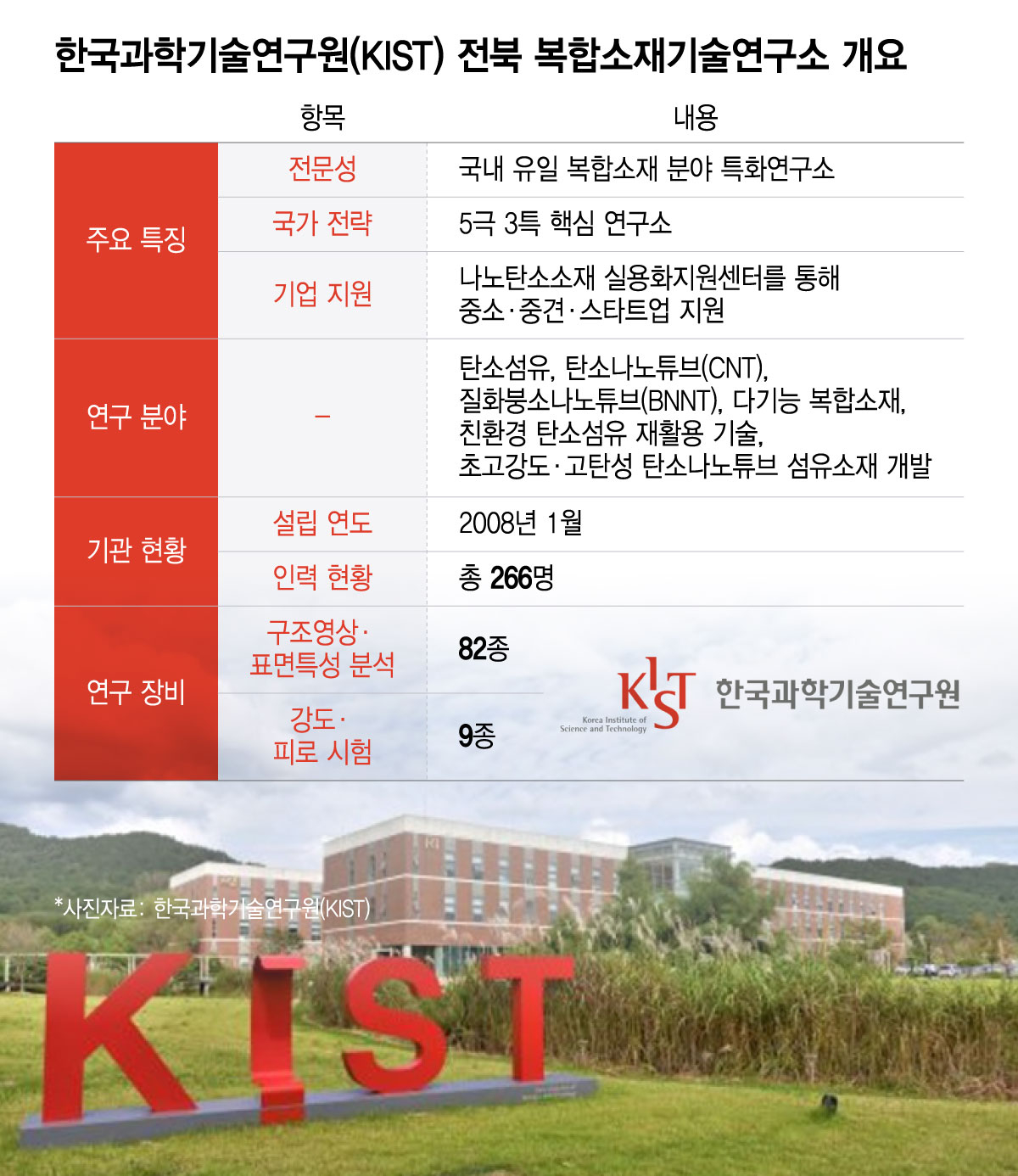
Meanwhile, established in 2008 in Wanju-gun, Jeonbuk Province, the KIST Jeonbuk Composite Materials Technology Research Institute researches advanced composite materials such as carbon fibers, carbon nanotubes (CNT), and boron nitride nanotubes (BNNT), promoting the development of application technologies for space, defense, mobility, and energy sectors as its core business. Starting this year, it has launched the 'Space Composite Materials Research Team' to transition into a mission-centered research institute system, focusing its capabilities on developing materials that respond to space environments. Through industry-academia-research cooperation with local universities and companies, it is also conducting technology transfer and personnel training, currently collaborating with 72 family companies.
The KIST Jeonbuk Composite Materials Technology Research Institute plans to unveil its plan for building space environment simulation test infrastructure and joint R&D cooperation methods with space startups at the K-Space Forum member general meeting to be held next month on the 7th in the main conference room on the 5th floor of Front One, Gongdeok-dong, Seoul.
[MoneyToday startup media platform Unicorn Factory]

 in TECH

