

A research team at KAIST has developed a strategy to treat 'cancer cachexia,' a complication that causes cancer patients' bodies to gradually waste away.
On the 2nd, KAIST announced that Professor Song Min-ho of the Graduate School of Medical Science and Kim Jin-guk (Prof.), along with their joint research team, in collaboration with faculty-founded company Tortera Therapeutics, have identified the principle of treating cancer cachexia by inhibiting the function of the protein 'GFRAL'. The research results were published online in the international academic journal 'Cell Reports Medicine' on the 27th of last month.
Cancer cachexia is a complication known to affect 50% to 80% of cancer patients. Cancer cells disrupt the body's metabolism, causing weight and muscle mass to continuously decrease regardless of how much food is consumed. As a result, the body weakens, reducing the effectiveness of chemotherapy. Although treatments exist, they only temporarily increase appetite, making it difficult to fundamentally prevent muscle loss and metabolic abnormalities.
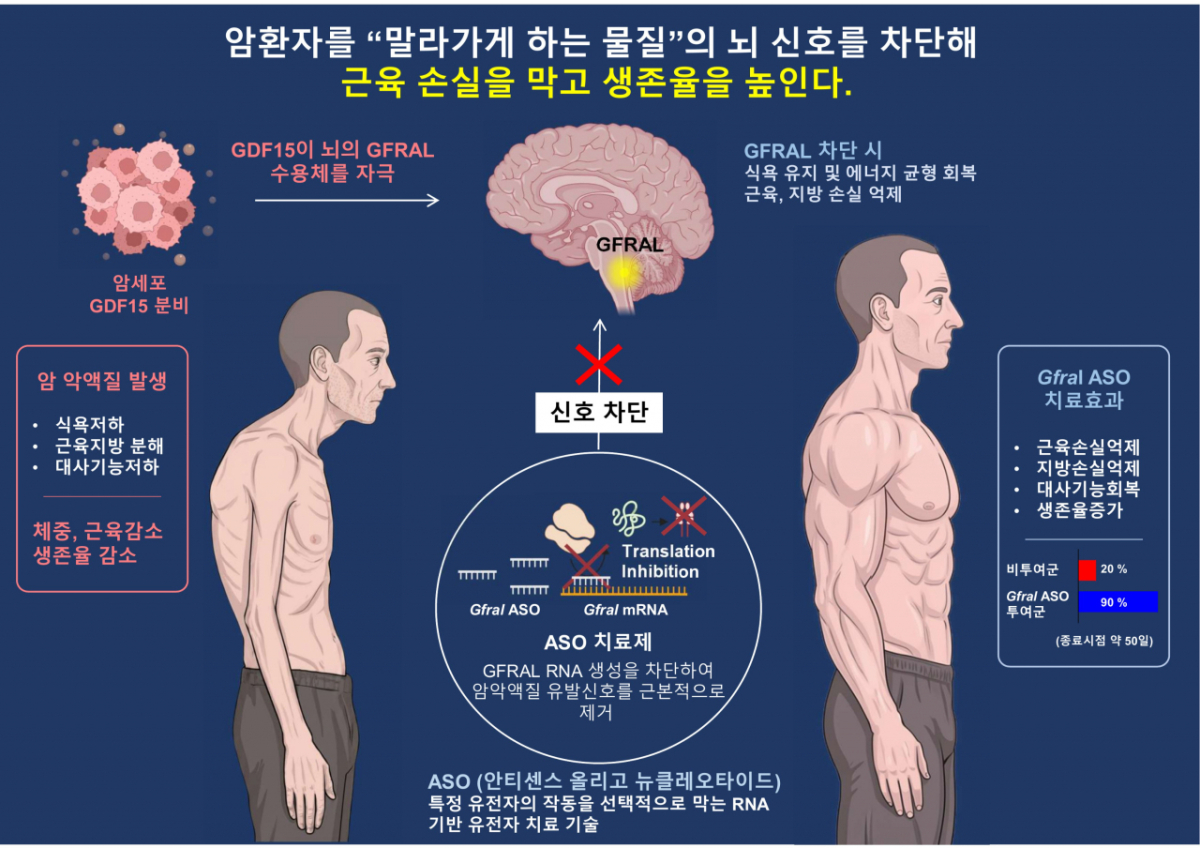
The research team focused on the fact that the cause of cancer cachexia lies in the brain. When 'GDF15' secreted by cancer cells binds to GFRAL in the brainstem, a signal is transmitted telling the body: "Do not eat; use stored muscle and fat instead."
The research team devised a method to block this command sent by cancer cells. It involves 'antisense oligonucleotide' (ASO), a gene therapy technology that selectively inhibits the function of specific genes. This treatment prevents the production of GFRAL at the RNA (ribonucleic acid) stage, which is the intermediate messenger that converts genetic information into proteins, thereby blocking the signal that causes cancer cachexia itself.
In an experiment where the treatment was administered to laboratory mice with progressing cancer cachexia, muscle and fat loss were significantly reduced, and collapsed metabolic functions were restored. As of the end of the study (approximately 50 days), survival rates were about 70% higher than in the non-treated group.
Professor Song stated, "This study is significant because it directly targets the core receptors in the brainstem at the RNA level to suppress the root cause of cancer cachexia." He added, "Our goal is to initiate clinical development targeting cancer patients by 2030 through follow-up preclinical studies and the establishment of drug production and quality control systems."

 in TECH
