

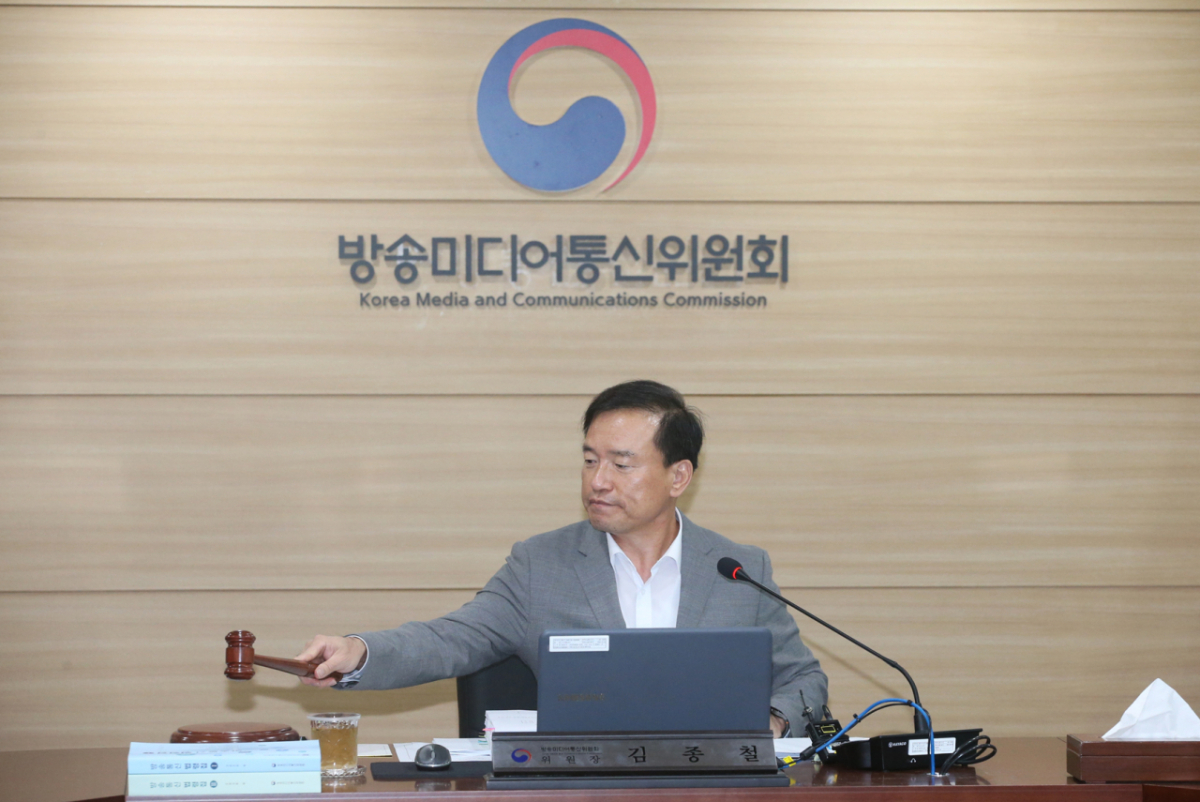
The Broadcasting, Media, and Communications Committee (BMCC) has launched its first discussion since its establishment regarding sanctions against Google and Apple over in-app payment practices but failed to reach a conclusion. It is interpreted that the committee proceeded cautiously because the two companies' sales volumes have grown during the period when the BMCC's activities were paused, and there was concern that the issue could escalate into a diplomatic matter.
The BMCC held its 27th committee meeting at 2 p.m. on the 12th to discuss sanctions against Google and Apple, two app market operators, for forcing in-app payments.
Specifically, the meeting addressed deliberation and approval of draft corrective measures for violations of prohibited acts under the "Telecommunications Business Act," including prohibitions on forcing specific payment methods, unjust delays in app reviews, and discriminatory fee imposition (by Apple). The committee also held a session to hear opinions from Google and Apple.
The BMCC investigated unfair practices by these app stores from August 16, 2022, to April 15, 2023. As a result, it was found that Google and Apple insisted on a 30% in-app payment fee structure, preventing participating companies from making "outlink" payments through external websites. Apps that did not comply were either prevented from updating or deleted, effectively forcing the use of in-app payments.
During this process, Google delayed reviews without reason for approximately 10,000 out of about 5 million apps subject to registration and review, while Apple delayed reviews for around 1,600 out of approximately 75,000 app review cases. No specific reasons were provided. Additionally, they imposed fees exceeding in-app payment rates by adding various costs to the base fee of 26% during external payments, effectively neutralizing external payment options. It was also revealed that Apple collected an additional 149.6 billion won, amounting to 10% of total revenue, from domestic developers only during the investigation period by applying a method of collecting fees on gross sales including value-added tax.
In overseas markets such as the United States and Europe, court rulings found violations of unfair competition laws, leading to fee reductions to 0% in the U.S. and 17% in Europe, along with permission for external payments. However, they have continued to discriminate against domestic companies compared to these regions.
Kim Jong-cheol Bang Mi-tong-wi (Chairman) stated, "We must strictly examine whether the app market ecosystem's fair competition and user rights were harmed," and added, "Please gather opinions on what effective alternatives exist corresponding to violations based on legal principles, regardless of the company's size or nationality."
Attention is focused on the scale of fines that may be imposed on these companies. Previously, in 2023, the Korea Communications Commission (KCC), the predecessor of the BMCC, had announced plans to impose fines of 47.5 billion won and 20.5 billion won on Google and Apple, respectively, but final sanctions were not implemented due to the two-person leadership structure at the time.
The two companies quickly responded to the pressure for sanctions. Google announced the previous day that it would reduce app market fees from the current maximum of 30% by 5 to 10 percentage points. Apple emphasized that it did not charge fees on 90% of the 2025 transaction volume (38 trillion won) in its Korean app store.
Meanwhile, on this day, the BMCC also approved a draft amendment to the "Enforcement Decree of the Broadcasting Act," which expands the total daily advertising time per channel to 20% and shortens the program duration threshold for allowing mid-roll ads from 45 minutes to 30 minutes. The revised decree is scheduled to take effect in October.

 in TECH
