

[More diverse corporate information on startups can be viewed at the Unicorn Factory Big Data platform 'Data Lab'.]
"I confirmed the scene where personnel directly remove foreign substances from pipes in semiconductor processes."
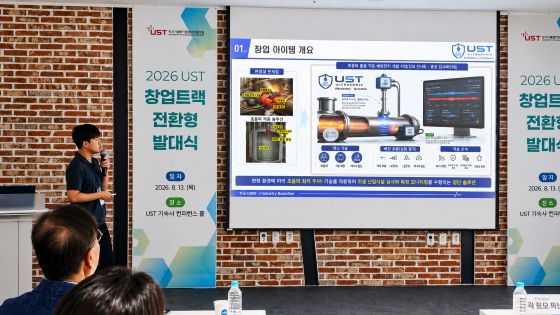
On the afternoon of the 13th, at the conference hall on the first floor of the dormitory at Daejeon University of Science and Technology (UST), a graduate student who introduced himself as part of the "UST Guardian" team took the stage. When asked about the initial market potential of his business idea, he responded as follows:
The presentation screen he displayed showed high-temperature industrial pipes and ultrasonic sensors placed side by side. It is a "non-contact ultrasonic diagnostic platform" that allows inspection of piping in hazardous industrial facilities such as nuclear power and oil refining plants without requiring personnel to approach closely.
As soon as the presentation ended, a flood of questions poured in. Starting with technical inquiries like "Will it measure accurately even if gaps form between the sensor and the piping?" the questioning turned sharp, probing business viability with queries such as "Where is the first market?", "What distinguishes this from existing technology?", and "Who will pay to buy it?" The visibly nervous student answered one by one in a trembling voice.
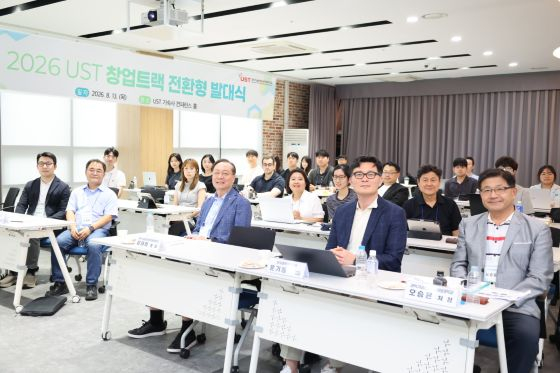
This is a scene from the kickoff ceremony for the "2026 UST Startup Track Conversion Program" held on this day. Graduate students who have demonstrated the potential of their technologies in laboratories are now taking their first steps to prove the value of those technologies in the market, transitioning from "researchers" to "entrepreneurs."
UST has officially launched the "Master-Apprentice Co-Entrepreneurship" program this year, in which researchers from affiliated institutes and students form teams to launch startups based on research achievements and technologies. In this model, students and professors leverage their respective strengths by dividing roles as either "Student CEO–Professor CTO" or "Professor CEO–Student CTO." Since the students who produced research outcomes such as papers and patents, along with the corresponding principal investigators (professors), possess the deepest understanding of the technologies involved, the initiative aims to have them lead technology commercialization directly. The launch ceremony was attended by 34 participants, including students transitioning to the entrepreneurship track.
Ultrasound, AI roads, new drugs, satellites, plasma... Research results and papers become "business items"
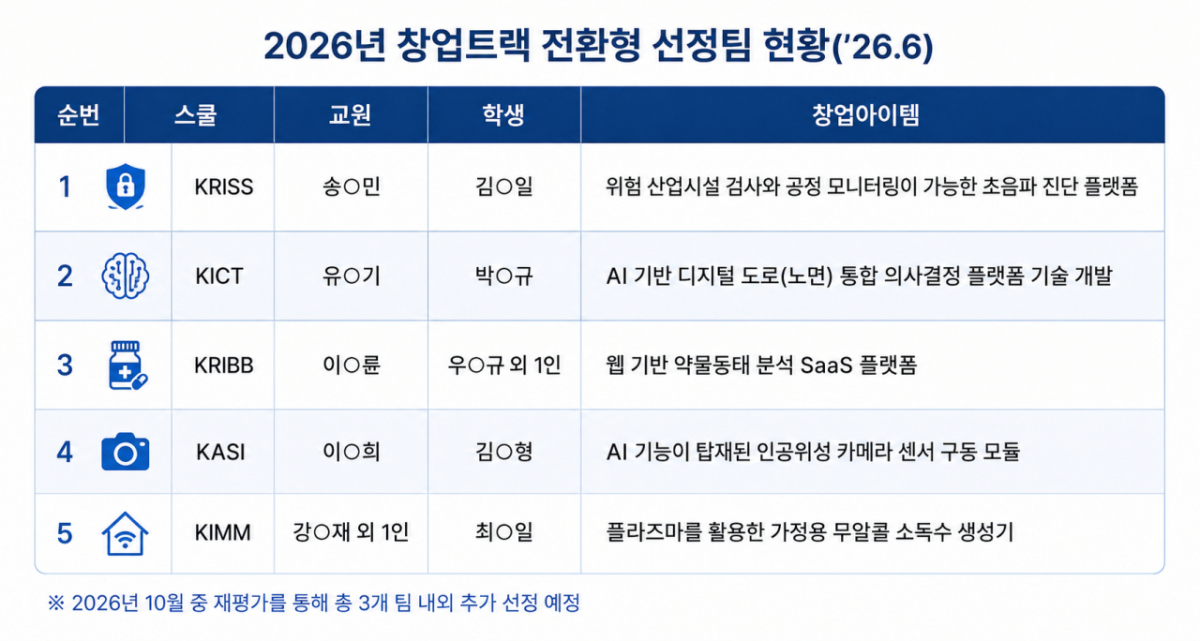
Five teams selected as finalists in the startup track conversion program on the 6th took turns to the stage today. UST ultimately selected five teams out of 15 applicants, classified five teams as preliminary selections, and designated the remaining five teams for ongoing management. Approximately three additional teams are expected to be selected through a re-evaluation scheduled for October.
The items presented by the selected team include: an ultrasonic diagnostic platform for inspecting hazardous industrial facilities and monitoring production processes; a digital road surface integrated decision-making platform based on artificial intelligence (AI); a web-based drug pharmacokinetic analysis software-as-a-service (SaaS) platform; an artificial satellite camera sensor drive module equipped with AI functions; and a household non-alcoholic disinfectant generator utilizing plasma. All of them represent attempts to commercialize technologies accumulated in research institutes of the Korea Research Institute of Standards and Science.
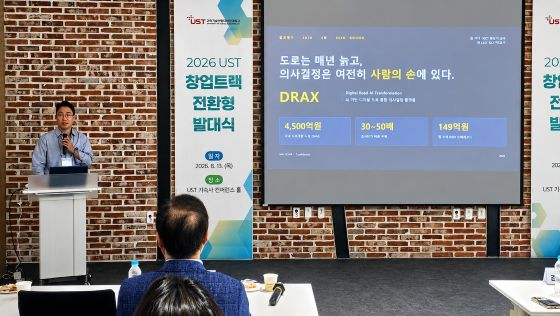
Following the appearance of 'UST Guardian' on stage earlier, the KICT School Team from the Korea Institute of Civil Engineering and Building Technology (KICT) unveiled a platform that uses artificial intelligence to analyze road surface conditions previously assessed manually by humans. The presenter stated, "We started with the problem that only a limited number of road sections across the country undergo actual condition analysis." Since equipment for detecting cracks or damage has already been developed in significant numbers, this team focused not on the equipment itself but on diagnosing and predicting collected data to assist in maintenance decision-making.
The team estimates that road surface inspection costs, currently ranging from 150,000 to 500,000 won per unit, could be reduced to between 3,000 and 10,000 won. They also presented experience from pilot projects conducted in Seoul, Daegu, and Gwangju.
However, the questions focused more on business models than technology. Questions followed such as: "Is the customer a local government or a road construction company?" and "While the technology is nationally needed, is the market size for companies to capture sufficient?" This was a moment that reaffirmed that while 'good technology' matters in the research and development stage, 'who will buy it' is the key issue in entrepreneurship.
The Korea Research Institute of Bioscience and Biotechnology (KRIBB) School's "Cloud Kinetic" has moved pharmacokinetic analysis, which examines how drugs are absorbed, distributed, metabolized, and excreted in the body, to a web service. It addresses the limitations of existing foreign software, which is expensive and requires direct handling of code and formulas, thereby reducing accessibility for non-experts.
The company also viewed the growing demand for "in silico" analysis using computer models following a regulatory change by the U.S. Food and Drug Administration (FDA) in 2022 as an opportunity. It is reported that the company confirmed the market by meeting with more than 50 domestic and foreign experts and even conducted on-site surveys in the United States.
However, the questions here were also sharp. Questions such as "How will you resolve issues regarding certification by the Ministry of Food and Drug Safety or the FDA?" and "What is the basis for supplying a product that existing companies sell for 200 million won at a lower price?" were raised. While continuing to provide answers, the presenter frequently wiped away sweat from areas he could not verify, stating he would conduct further review.
The Korea Astronomy and Space Science Institute (KASI) School Team proposed a camera sensor drive module for small satellites equipped with AI capabilities. The concept involves connecting various types of sensors to a single universal architecture, utilizing an FPGA (Field-Programmable Gate Array—a semiconductor chip that can be reconfigured by users after purchase to suit desired internal circuit arrangements) and onboard AI to selectively transmit only necessary data to the ground. The team highlighted shortened development periods, cost reductions, and improved data transmission efficiency as key competitive advantages.
KASI School Team's presentation was closely followed by UST President Kang Dae-im, who then posed a question. President Kang stated, "How many sensors are typically included in a single satellite? If there is an effect of reducing weight, that could certainly be highlighted as a competitive advantage," urging the team to present their business strengths more concretely.
Questions continued from the audience. One student asked, "What specific role does the AI embedded in the camera sensor play?" Direct criticisms were also raised: "Is integrating AI really that difficult?", "Does a company built on this technology truly have value?", and "The problem definition is not clear." Since students who have each conducted research in their respective specialized fields at various government-funded research institutes gathered in one place, the question-and-answer session delved into even the technical details.
Scientists speak the language of technology; investors speak the language of business.
Prior to the announcement, Kim Cheol-hwan of the Kite Entrepreneur Foundation, a venture entrepreneur with extensive experience in technology startups and company acquisitions who was appointed as the first special professor in UST's startup field, delivered a lecture on "The Reality of Deep Tech Startups."
Kim Lee (President) emphasized that technology alone is insufficient for a startup to survive. He stated, "There must be clear competitiveness, such as producing at the lowest cost, leading innovation, or building strong relationships with customers," adding, "If today's business and tomorrow's are the same, you have already lost your competitiveness." This underscores the need to continuously evolve the business model (BM) in response to changes in the market and customers.
He also advised that during the early stages of entrepreneurship, it is important to quickly create an MVP (minimum viable product) and validate its potential in the market. Kim Lee (President) emphasized, "A strategy is needed to identify and aggressively target customer segments that are best suited for the product."
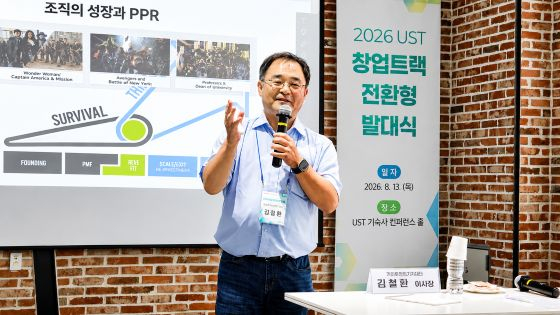
He also added that as the company grows, founders should not try to solve everything on their own but must instead possess the ability to recruit outstanding talent in each field—such as research, marketing, and finance—and guide them toward a common goal.
He emphasized that researchers must shift their mindset from a technology-centric approach to a market-centric one if they are to transform into entrepreneurs. He stated, "Unlike government research and development (R&D), the private investment market prioritizes efficiency and results, making it difficult to persuade investors by simply explaining the superiority of technology." He further added, "While scientists speak the language of technology, investors speak the language of business. Scientist-entrepreneurs should not stop at explaining how excellent their technology is; they must also demonstrate when and how they will generate revenue and deliver returns to investors."
From market exploration to investment... KST builds a "growth ladder" for researcher entrepreneurship: "People matter more than good technology"
A session was also held to introduce support programs for external startup professional institutional investors. Yoon Ki-dong, Deputy Representative of Korea Science and Technology Holdings (KST), presented a step-by-step startup support program on the day, covering everything from market exploration available to researchers at research institutes, to incorporation and investment.
KST currently holds stakes in 184 investee companies and has contributed 70.8 billion won out of a total managed fund of 126 billion won, thereby catalyzing follow-on investments totaling 639.6 billion won across these enterprises.
Deputy Director Yoon first introduced the market exploration program "TexCore," which identifies startup candidates based on outstanding research achievements from government-funded research institutes and validates their market viability. In October, the program plans to recruit participants for "Pre-TexCore," a preliminary stage of TexCore, targeting students and researchers at these institutes.
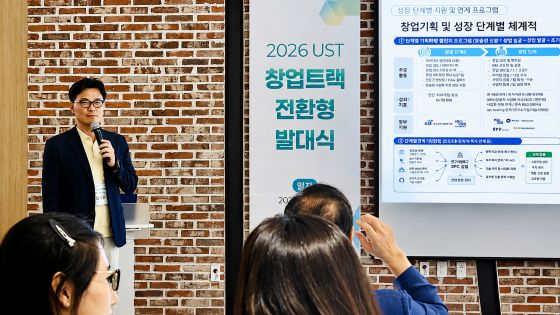
The 'National Research Council of Science and Technology (NST)-KST Deep Tech Startup Challenge,' which supports researchers with technology in actual entrepreneurship, is also being operated. This program provides support ranging from technology discovery to business model refinement and corporate establishment. It was explained that 10 teams have already launched startups through this initiative, while 40 other teams are preparing to establish corporations.
Deputy Director Yoon emphasized the importance of 'speed' and 'funding' in the growth of deep-tech startups. He advised, "The core of a technology company is speed, and speed comes from funding," adding that "a Jeonju-based funding plan must be established considering the funds needed at each stage from the early startup phase through to the growth phase."
When a student asked, "What is the most important thing you look for when investing?" Vice President Yoon replied, "People over items, accounting for 70%." He added, "The world is changing rapidly, and the lifespan of technology is getting shorter by the day, so it is difficult to decide on an investment based solely on current business items." He continued, "Ultimately, what matters is a person who can respond to changes, find new opportunities, and continue to develop their business." This explanation underscores that a founder's execution ability, problem-solving skills, and capacity to adapt to change are as critical as the initial completeness of the business item in making investment decisions.
Startups recognized instead of theses... Leave of absence, GPA, and degree systems also revamped
The reason UST established its startup track for the first time this year is to bridge the gap between laboratories and the market. According to a survey conducted by UST itself, 90 out of 341 students (26%) responded that they had an interest in starting a business; however, many expressed a desire to launch their ventures after obtaining their degrees. Obstacles included the difficulty of balancing academics with entrepreneurship, as well as insufficient regulations on leave and concurrent employment, along with a lack of startup spaces and funding.
UST has divided this into a "conversion type" for existing students and a "master type" for recruiting new students. The conversion type, starting in September this year, maintains the existing degree program while allowing students to pursue entrepreneurship concurrently. Selected teams will receive 500 thousand won per team as startup project funds to be used for prototype development and promotion until August next year.
It will hold boot camps twice, including practical entrepreneurship education and expert lectures, and connect teams with mentors suited to their respective stages as well as external support programs.
The bachelor's degree system will also be reformed to be more startup-friendly. Startup leave will be extended from the current four semesters to a maximum of six semesters, with extensions possible if necessary. Preparation for and participation in startups can be recognized as "field research" credits. For master's degrees, dissertations may be replaced by startup achievements, and doctoral candidates who meet certain requirements will be exempted from the obligation to publish in academic journals, among other flexibilities in degree acquisition conditions.
Next year, the university plans to further advance by recruiting new students based on their entrepreneurial capabilities and introducing a master's program that awards a "Master of Entrepreneurship" degree. UST surveyed 1,687 faculty members in June regarding promising deep-tech technologies that could lead to startups, identifying 31 such technologies, from which it selected 10 as priority candidates for review. The university has designed an educational curriculum totaling 32 credits and plans to revise relevant academic regulations to begin recruiting new students in 2027.
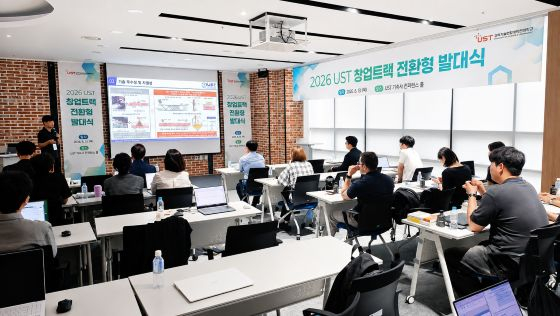
As the event drew to a close, students leaving the presentation hall wore varied expressions. Some had confirmed the potential of technology, while others had taken on new assignments in response to unexpected questions. President Kang stated, "We will spare no effort in providing expert training, mentoring, and startup support funds to enable numerous success stories where students and professors launch ventures based on technologies from national research institutes." He added, "We will continue our efforts to ensure that deep-tech startups from national research institutes allow technologies to be reborn anew in the market."
[Money Today Startup Media Platform 'Unicorn Factory']

 in TECH


