

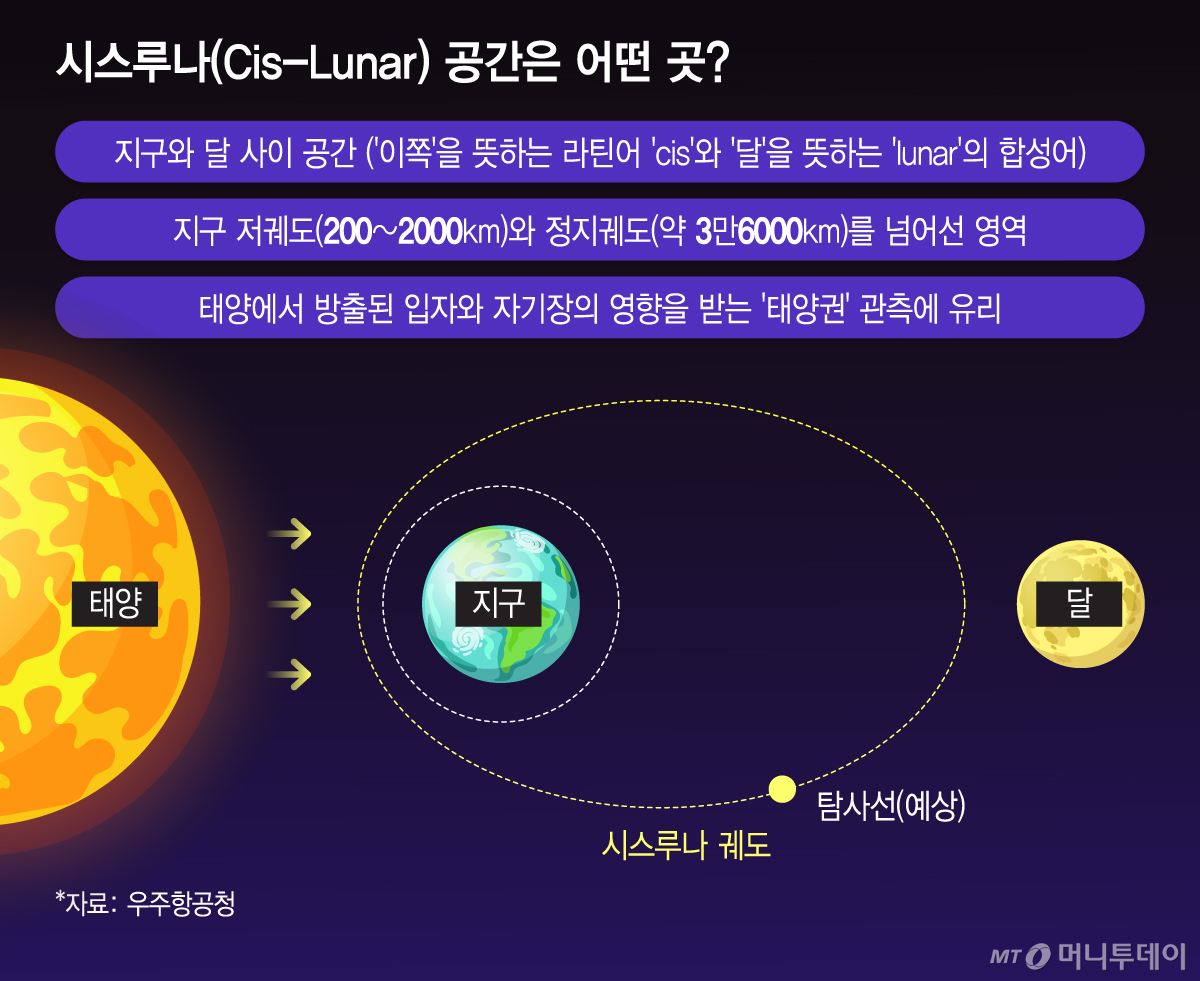
South Korea's space exploration project is accelerating with a revised target. Rather than heading to 'Lagrange Point 4 (L4)' approximately 150 million km from Earth in ten years, the nation will aim for 'Cis-Lunar' space — the region between Earth and the Moon, about 380,000 km away — within five years.
According to the aerospace industry on the 16th, the Korea Aerospace Administration (KASA) is shifting focus from developing an 'L4 Probe' to concentrating on a 'Cis-Lunar Probe'. The agency aims to begin development in 2028 and launch by 2031 while seeking cooperation opportunities with the international space community.
Earlier this month, KASA announced its exploration plan to send a scientific probe to Cis-Lunar space at the '2026 Committee on Space Research' (COSPAR 2026) held in Florence, Italy.
The 'Heliospheric Physics Probe' envisioned by KASA is designed to verify satellite technologies and observational capabilities required for the 'OSEL' (off-the-Sun-Earth-line) approach. OSEL refers to an orbit that departs from the Sun-Earth line. It is considered the optimal position for observing solar activity from the side of the Sun.
The new probe aims to establish a stable orbit in Cis-Lunar space. This region contains 'Earth-Moon resonant orbits' where satellites can maintain stable revolutions. It is also gaining attention as a hub for Earth-Moon communication. While probes orbiting low lunar altitudes inevitably lose contact with Earth when passing behind the Moon, those in Cis-Lunar orbits can almost always view both the Earth and the Moon simultaneously.
KASA places particular emphasis on the fact that this region is ideal for observing space environments such as solar wind and Earth's magnetic field. Solar wind consists of high-energy particles extending from the Sun's atmosphere into Earth's space, closely linked to our planet. When massive bursts of energy particles reach Earth due to sunspot explosions, they can disrupt Earth's magnetic field, directly impacting ground communications, power grids, and aviation operations.
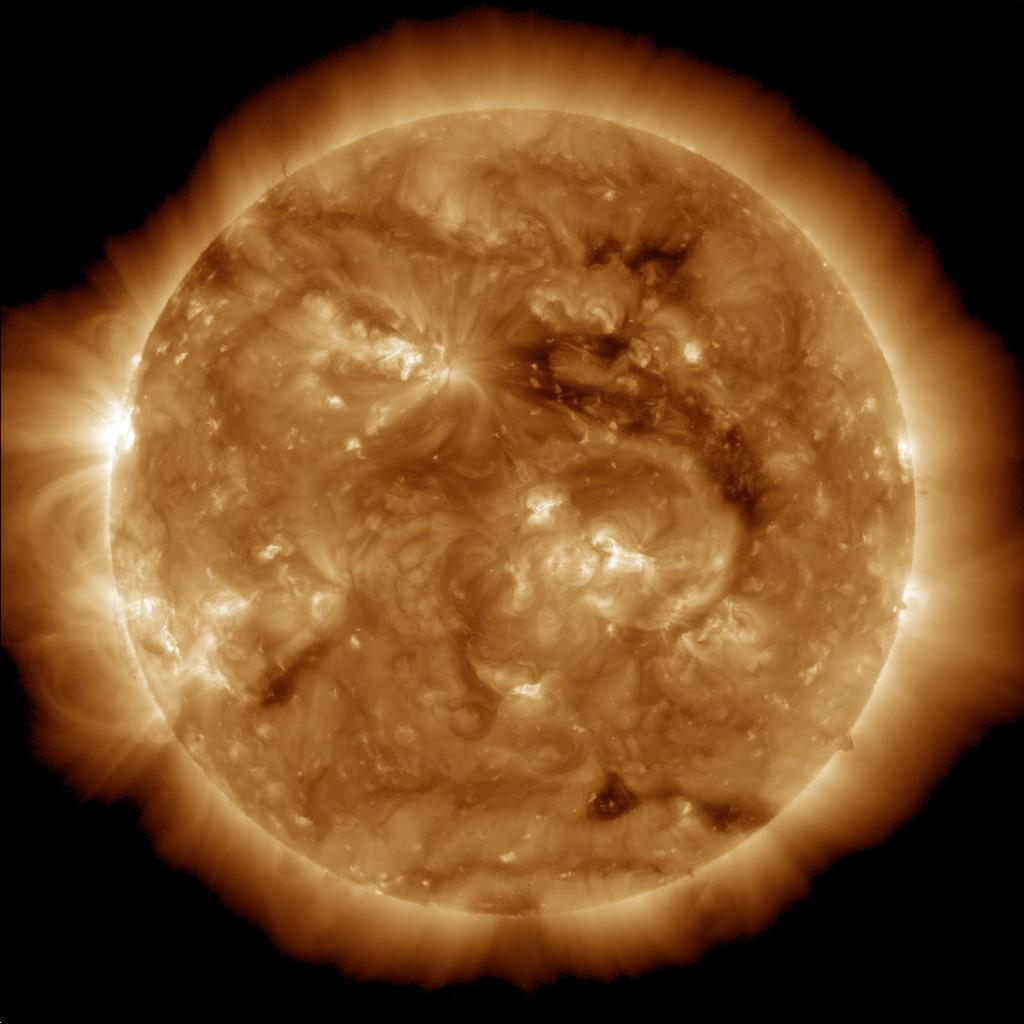
Solar wind can be observed from low Earth orbit or geostationary orbit; however, Earth's magnetic field partially blocks solar wind particles, potentially distorting data. In contrast, Cis-Lunar space allows observation of the magnetic field and high-energy particles in their original state. Another reason for choosing this region is its suitability for directly measuring 'Earth's magnetotail' — the location where Earth stores energy absorbed from solar wind. However, observational data from Cis-Lunar space remains scarce globally.
This explains why South Korea has adopted Cis-Lunar exploration as a new goal in space science and announced it at international forums attended by NASA, ESA, and other agencies.
The 'L4 Probe', once considered KASA's flagship project during its early years, will not be included in next year's agency initiatives. The original plan aimed to conduct the world's first exploration of Lagrange Point 4, located between the Sun and Earth. Although it had been rejected once during last year's preliminary budget review with plans to retry, the target was adjusted to align with rapidly evolving realities in international space development, such as lunar base construction.
However, the agency has not completely abandoned Lagrange Point exploration. Kang Kyung-in, Director of KASA's Space Science Exploration Division, stated, "In the long term, data obtained from Cis-Lunar space will be essential information for international Lagrange Point missions." He added, "But now is the time to more rapidly enhance South Korea's space observation capabilities and accumulate independent exploration experience." Upon project initiation, KASA plans to develop not only remote sensing instruments but also onboard payloads capable of directly measuring physical quantities, such as magnetometers and plasma detectors.
Meanwhile, alongside the Cis-Lunar probe, KASA is also pushing forward with launching a private-sector-led lunar probe in 2030. The agency intends to support domestic companies in developing a small-scale lunar probe weighing approximately 700 kg.

 in TECH

