


Jung Shin-a, CEO of Kakao, announced that 'people-centric AI,' which she introduced at the beginning of the year, is shifting from a slogan to a business model. The structure of Kakao, which grouped KakaoTalk with AI, advertising, and commerce into one company through a personnel split, does not aim to compete with a single massive AI model. Instead, it plans to embed an AI agent that understands each user's context within the 50th million-user KakaoTalk platform and connect these agents to revenue from advertising, commerce, and subscriptions.
Jeong (CEO), who has been appointed as the representative of the newly established company KakaoAI, stated, "We will create a new AI experience that drives action based on the relationships and contexts of 50 million individuals," adding, "We will allocate all resources to creating new growth opportunities centered on AI."
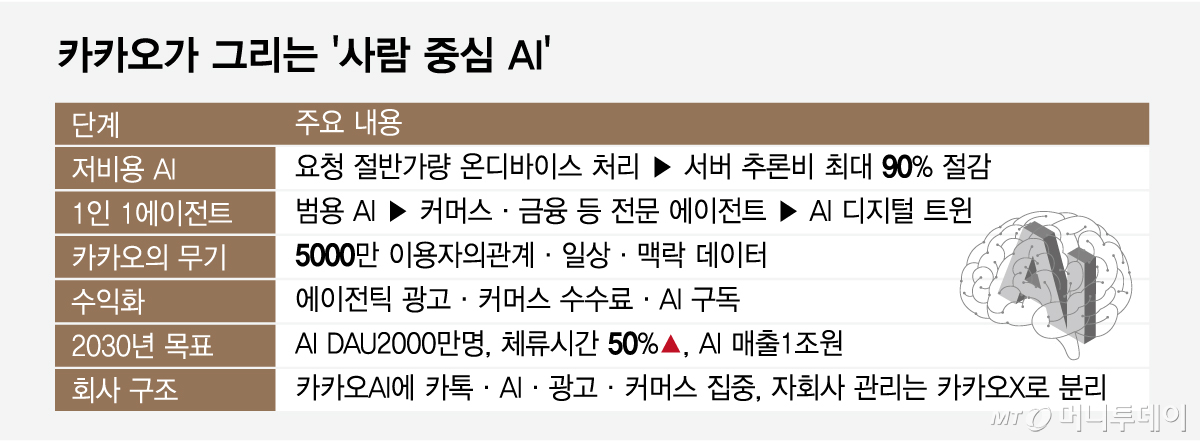
The first condition is running AI at a low cost. Kakao has designed its system so that the lightweight model 'Kakao Nano' handles about half of user requests directly within smartphones, while only complex requests are sent to server-based AI. The company also plans to implement an 'AI conductor' that selects models based on request complexity, aiming to reduce server inference costs by up to 90%. This approach is based on the judgment that a nationwide AI service is only possible if the structure where server costs skyrocket as users increase is broken.
The second strategy is transforming KakaoTalk into an AI interface. Under the belief that the AI era will bring 'one person, one agent' following the eras of 'one person, one PC' and 'one person, one smartphone,' Kakao plans to build a general-purpose assistant used by everyone, expert agents for commerce and finance, and an 'AI digital twin' that understands users and proactively makes suggestions within KakaoTalk. The weapon is not model size but context. Jeong (CEO) stated, "We need models that can understand my contextual data rather than those scoring 70 or 90 points on large big models." As AI becomes cheaper, more users will join; as more contextual data accumulates, recommendations become more sophisticated, leading to advertising and commerce revenue. This virtuous cycle is the ecosystem Kakao envisions.
The split is also a task for this competition. In the past five years, about 85% of the 23rd abnormal decisions made by the Kakao Board of Directors were related to problems with subsidiaries, and 84% of agenda items in the last year involved subsidiary matters. By transferring the burden of managing subsidiaries to KakaoX, KakaoAI can focus solely on AI.
The goal is aggressive. By 2030, the targets are over 20 million daily active users for AI, an expansion of time spent in KakaoTalk by more than 50%, breaking through 1 trillion won in AI revenue, and total corporate revenue exceeding 6 trillion won. The foundation lies with existing users. There are 30 million KakaoTalk users who actively converse daily, and 'Kakao Nano in KakaoTalk' has a stickiness level (indicating usage continuity relative to MAU) of 60-70%. Furthermore, the time AI users spend in KakaoTalk is more than 50% longer than that of non-users.
While Naver is investing heavily in large-scale AI factories and SK Telecom is expanding data centers, Kakao has prioritized a B2C battle to convert its 50 million KakaoTalk users into AI users. The strategy involves lowering costs through lightweight models and on-device processing, and connecting AI usage directly to transactions within KakaoTalk.
There is still a gap between the plan and market evaluation. On the day of the announcement, Kakao's stock price closed at 35,800 won, down 7.49%. Uncertainty regarding the split ratio and future corporate valuation was reflected first, ahead of expectations for the AI business. A Kakao official stated, "KakaoAI will be re-evaluated as an AI company in the market after the split."

 in TECH

