

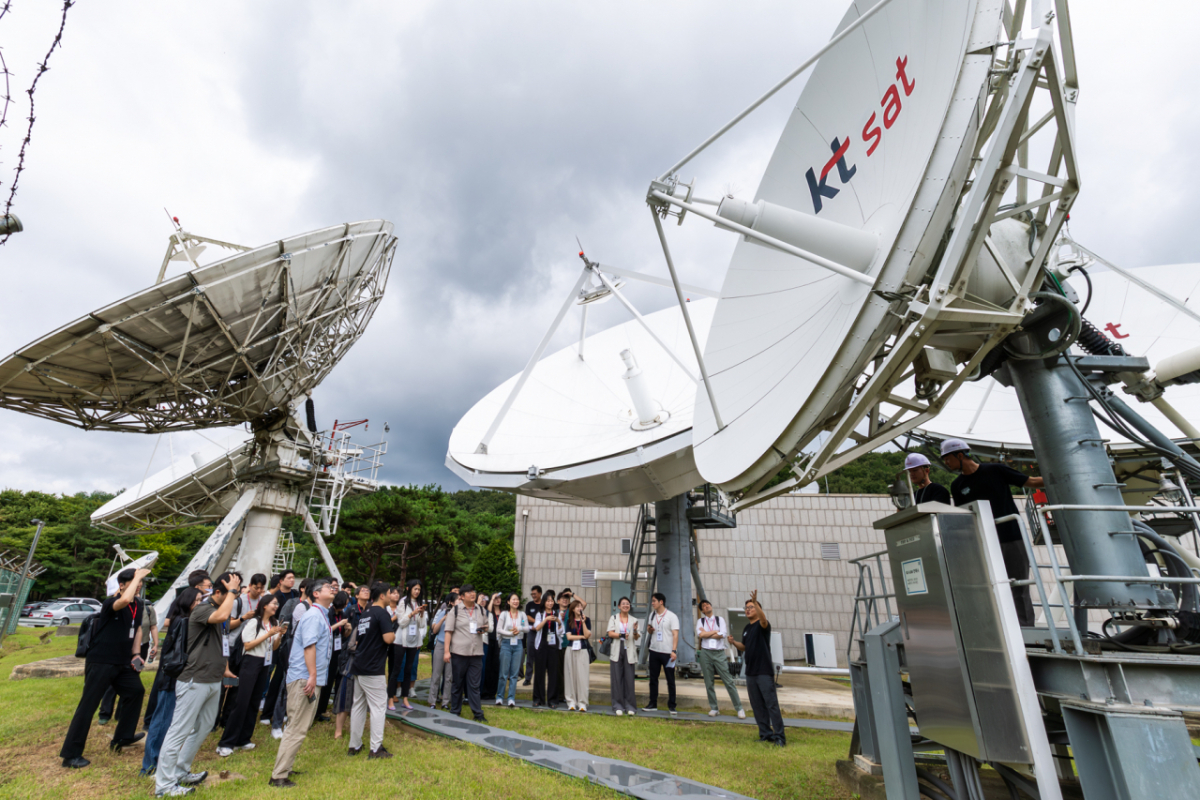
"Weeeng~" One of the four 4.6-meter dish antennas began moving toward the press team. The antenna used to monitor the "carrier signal" of the geostationary satellite 'K8' moved at a rate of 0.002 degrees per second, turning more than 40 degrees in an impressive display. Though it may appear as simple movement, this is a demanding task requiring precise calculation of azimuth angles to communicate with geostationary satellites and flawless execution without any margin for error.
Following light rain early on the 25th, we arrived at kt sat's Yongin Satellite Control Center along a forest path where greenery had grown even denser. Eight large white dish antennas stood majestically before us. Among them, one antenna's movement was a special demonstration designed to showcase satellite control expertise.
Kim Gyu-pil, deputy manager of the Satellite Technology Team at kt sat who led the demonstration, explained, "Normally, the antennas automatically track satellite signals and move accordingly," adding, "With an ACU (Antenna Control Unit), we can control the antenna's azimuth angle, automatically track satellite signals, and precisely adjust distances between satellites."
Using this satellite control expertise, kt sat successfully redeployed the Mangyongbong-6 satellite (K6), which was scheduled for decommissioning after its design life ended, thereby opening up new markets in Oceania. This achievement came after a complex operation involving rotating the satellite's orientation by 180 degrees around an Earth-pointing axis and repositioning its orbit to match service areas. The existing Northern Hemisphere market previously served by K6 is now handled by a new satellite (K6A). Satellites are connected through global alliances and provide services internationally.
Kim Ki-young, team leader of the Satellite Consulting Team at kt sat's Satellite Control Headquarters, stated, "Even after a satellite reaches its design life limit, proper control can leave remaining fuel for new applications." He added, "This was a high-difficulty engineering task requiring comprehensive analysis of satellite body and payload status, verification of power and thermal environments, attitude control, and orbital operation technologies."
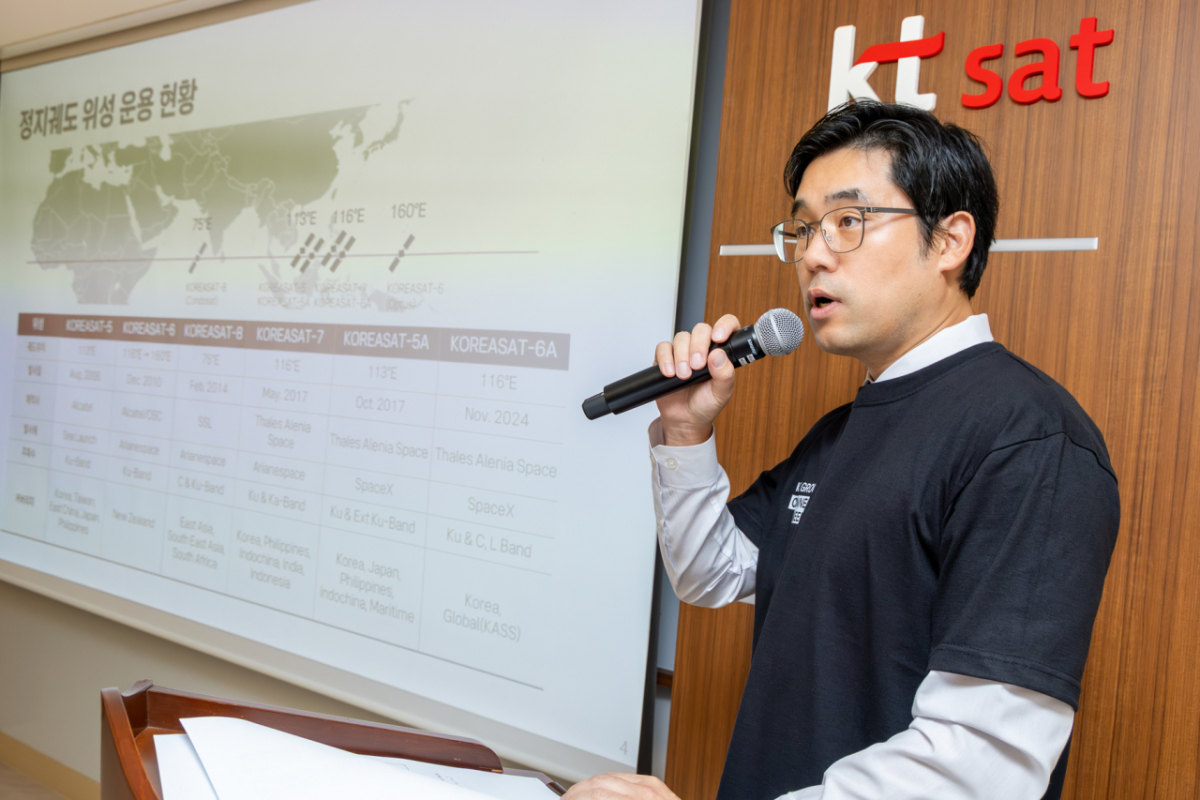
kt sat is South Korea's only private satellite operator possessing five geostationary Mangyongbong satellites. Since its establishment in November 1994, the company has directly operated five satellites without a single second of interruption over 32 years. Although geostationary satellites appear stationary from Earth, they must orbit at approximately 35,786 kilometers above the surface at speeds of about 3.075 km per second, matching Earth's rotation period. Therefore, continuous monitoring and precise positioning adjustments are crucial. Only about ten companies worldwide possess such exceptional control capabilities with a 32-year record of uninterrupted operations.
kt sat plans to further enhance its satellite control capabilities through automation and intelligence by incorporating AI (artificial intelligence). Following the emergence of 'Starlink,' the satellite industry is evolving into a 'multi-orbit' environment where low Earth orbit (LEO) and geostationary orbit (GEO) satellites form a single network. LEO satellites must move faster than geostationary ones due to their lower altitude, requiring thousands more satellites and corresponding software tools.
To secure operational capabilities for 'LEO Fleet' constellations, kt sat plans to develop large-scale automated operation systems and technologies in areas such as anomaly detection and collision avoidance. Subsequently, the company aims to integrate its control capabilities with KT Group's mobile communications, AI, and cloud ICT strengths to evolve ground and space into a unified network system aligned with the 6G era.
Choi Sung-ho, Gi Sul-chong-gwal (EVP) of kt sat, remarked, "The Yongin Center of kt sat, which has focused solely on space for 32 years, has received recognition for its global-level control capabilities." He further stated, "We will apply our unique control expertise to future satellite technologies including LEO and 6G NTN (non-terrestrial networks) to promote the status of K-satellites worldwide."

 in TECH


