

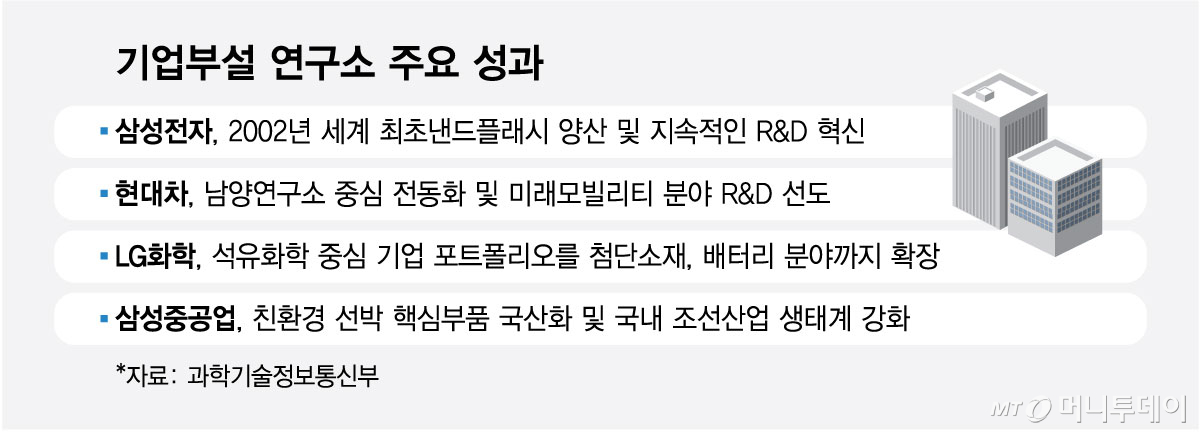
"World's First 3D Holographic Cell Microscope, Advanced Ultra-Precise Semiconductor Core Components via Nanotechnology, Bispecific Antibody Platform Technology…."
These are innovative achievements born from South Korea's corporate R&D institutes. Since the system was first implemented in 1981 and marked its 46th year this year, seven out of every ten domestic R&D personnel have been designated as R&D experts and are actively contributing. Innovations in South Korea's technology, including semiconductors, have emerged through this system.
According to the Ministry of Science and ICT on the 9th, as of 2024, among the country's total 610,000 R&D personnel, 450,000 (73%) work as R&D experts affiliated with corporate R&D institutes.
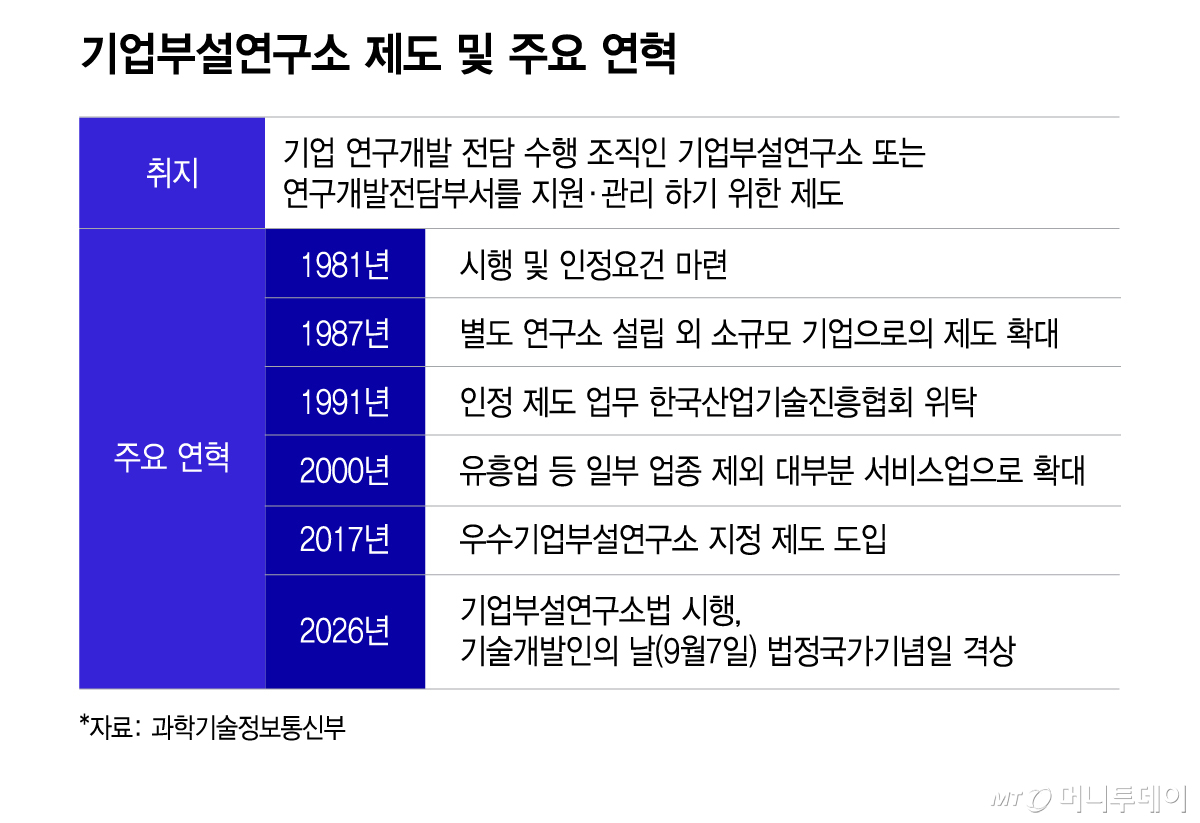
The Corporate R&D Institute Recognition System provides incentives such as tax deductions, participation in national R&D projects with bonus points, and support for utilizing specialized research personnel to companies that meet certain requirements, including securing dedicated research spaces and personnel. Shortly after its introduction in 1981, major corporations like Samsung Electronics, Hyundai Motor, Hanwha, and Korean Air began operating their own institutes. In 1987, when the establishment criteria were relaxed, corporate R&D institutes expanded to include small and mid-sized companies.
Notably, in 1991, the recognition system's operations were entrusted to the Korea Institute for Industrial Technology Advancement (KITECH), and during the Kim Dae-jung administration in 2000, restrictions on industry types were significantly reduced, allowing most service sectors (excluding entertainment venues) to establish research institutes. This led to a surge in the establishment of corporate R&D institutes. Currently, there are approximately 70,000 operating corporate R&D institutes.
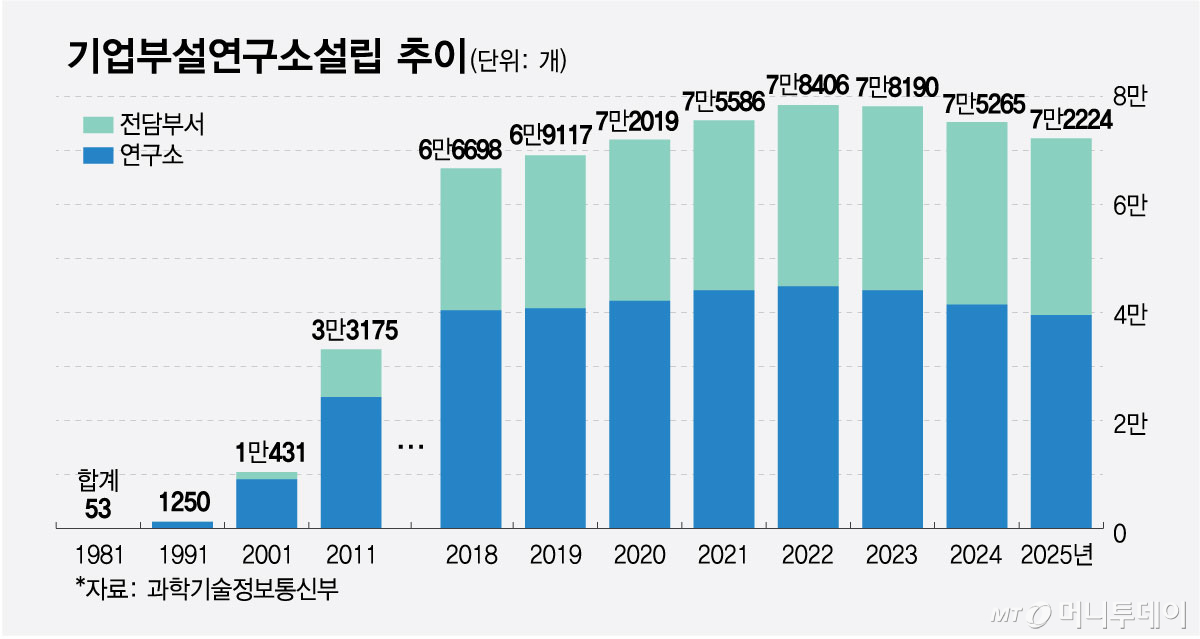
A Ministry of Science and ICT official emphasized, "The expansion of corporate R&D institutes has deeply rooted the importance of research and development across various industries, encouraging companies to build their own foundational capabilities for innovation. Furthermore, it has created a trend of change and leap that enables our key industries to secure a firm competitive advantage in the global market."
The Corporate R&D Institute System, which served as a catalyst for private R&D growth, has recently expanded significantly into advanced knowledge-based industries and service sectors such as software, AI (artificial intelligence), big data, and biotechnology. Recognizing that R&D activities are essential for corporate survival and growth, the government enacted a separate law last year titled "Act on Support for Research and Development of Corporate R&D Institutes" (Corporate R&D Institute Act) to strengthen the legal basis for the system. Additionally, 'R&D Personnel Day' (September 7), established to honor the hard work of corporate researchers, was designated as a national memorial day starting this year, firmly establishing respect and consideration for corporate researchers at the national level.
The government will continue providing policy support to ensure the sustained qualitative growth of corporate R&D institutes. To identify and nurture outstanding corporate R&D institutes with excellent R&D capabilities and superior technological innovation activities, the 'Outstanding Corporate R&D Institute Designation System' was introduced in 2017. Selected companies receive a designation certificate and a plaque, along with preferential treatment for three years regarding participation in national R&D projects and selection as designated military service exemption companies. As of this year, over 460 outstanding corporate R&D institutes have been designated, with approximately 170 currently operating.
In the early stages of the Outstanding Corporate R&D Institute Designation System, food and medical-related companies were primarily selected. However, the proportion of companies in the 12th national strategic technology fields has gradually increased. Currently, among the 170th outstanding corporate R&D institutes, over 130 companies are concentrated in national strategic technology areas such as advanced biotechnology, AI, semiconductors, and displays.
A Ministry of Science and ICT official stated, "Corporate R&D institutes, which embody the fierce innovation DNA of companies, have now become a core driving force that determines South Korea's future competitiveness beyond being mere assets of individual corporations. They will serve as the most powerful catalyst for leading South Korea's quantum leap in science and technology innovation over the next 100 years."

 in TECH


