

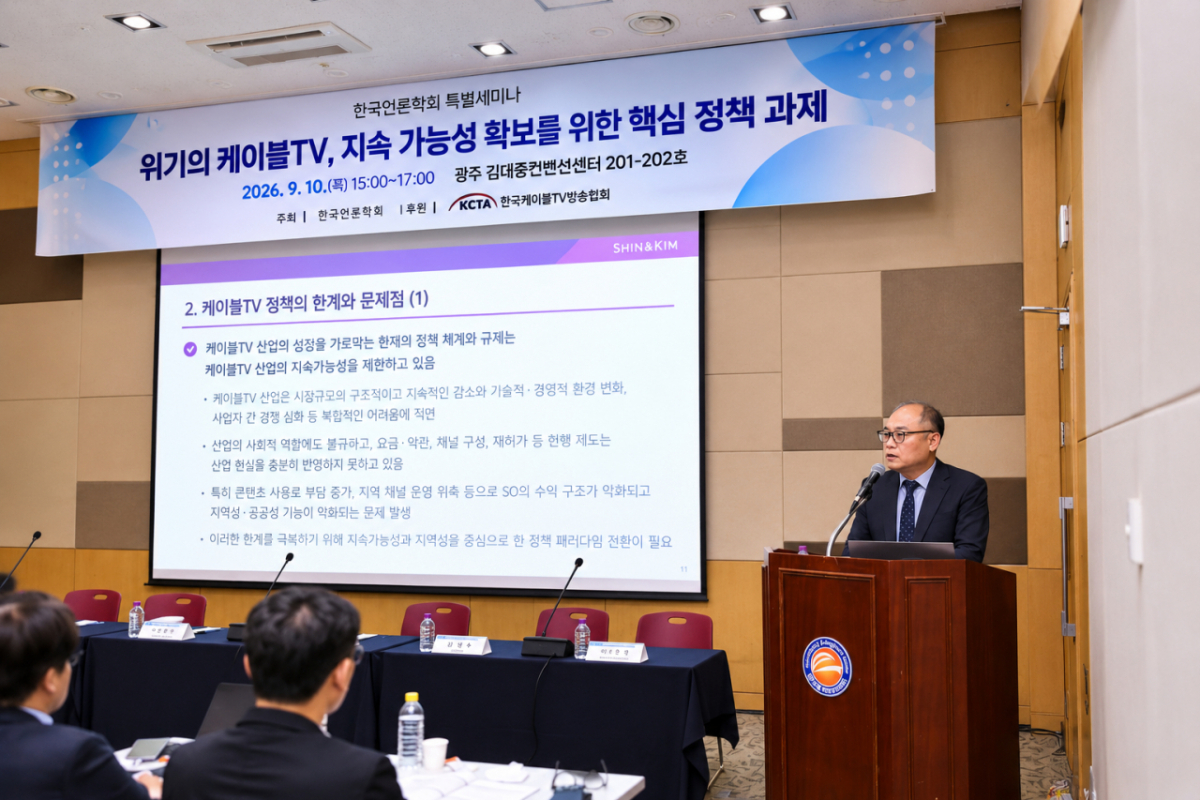
It was suggested that cable TV, which is responsible for one-third of the nation's right to broadcast access, should be prioritized in media policy to prevent its service foundation from being shaken due to deteriorating management. The argument calls for redesigning policies to match the industry's contraction phase, including rationalizing criteria for calculating content fees and expanding support for low-cost broadcasting via 8VSB (8-level Vestigial Side Band).
Lee Jong-kwan, senior specialist at Sejong Law Firm, stated on the 10th at the Gwangju Kim Dae-jung Convention Center during the seminar hosted by the Korean Academy of Journalism titled "Direction for Policy Paradigm Reform to Overcome Cable TV Crises and Ensure Sustainability," that "the media function and assigned public responsibility of cable TV are essential elements for realizing a basic media society." He added, "Cable TV policies must be reorganized around sustainability and regional characteristics."
Since 2013, cable TV SOs (Comprehensive Cable Broadcasting Operators) have seen continuous declines in total revenue, broadcasting business revenue, and operating profit, while the burden of content usage fees has increased. Regulations such as license renewal, fee structures, terms of service, channel composition, and mandatory regional channels still largely maintain systems established during the industry's expansion phase.
The senior specialist emphasized that "cable TV provides real-time broadcasting services at the lowest rates among paid broadcasting services based on local communities and is responsible for one-third of the nation's right to broadcast access." He further stated, "It has strong characteristics as a universal service by offering accessibility that broadly covers regions, generations, and social classes; minimizing economic burdens; and ensuring availability of content centered on real-time broadcasting channels."
Notably, 8VSB provides one-way high-quality broadcasting to elderly generations unfamiliar with two-way media usage. Based on 2024 subscriber revenue data, the ARPU (Average Revenue Per User) is 2,471 won, which is up to 81.4% lower than other paid broadcasting services.
Despite the spread of OTT (Online Video Services), real-time broadcasting usage time remains long. According to a 2025 Statistics Korea survey, average daily viewing time for real-time broadcasts on weekdays was 1 hour and 30 minutes—2.5 times longer than the 36th minutes spent using video media. The senior specialist noted that "cable TV plays an important role not only for domestic viewers but also within the real-time content ecosystem."
To enhance cable TV's sustainability, he proposed rationalizing criteria for calculating content fees, expanding universal broadcasting welfare support for 8VSB, reducing retransmission fees, and transitioning to a voluntary declaration system for terms of service. To strengthen regional characteristics, he suggested reducing contributions to the Broadcasting and Communications Development Fund, supporting investment in local channel production, and prioritizing advertising allocation by local governments and public institutional investors.

 in TECH
