

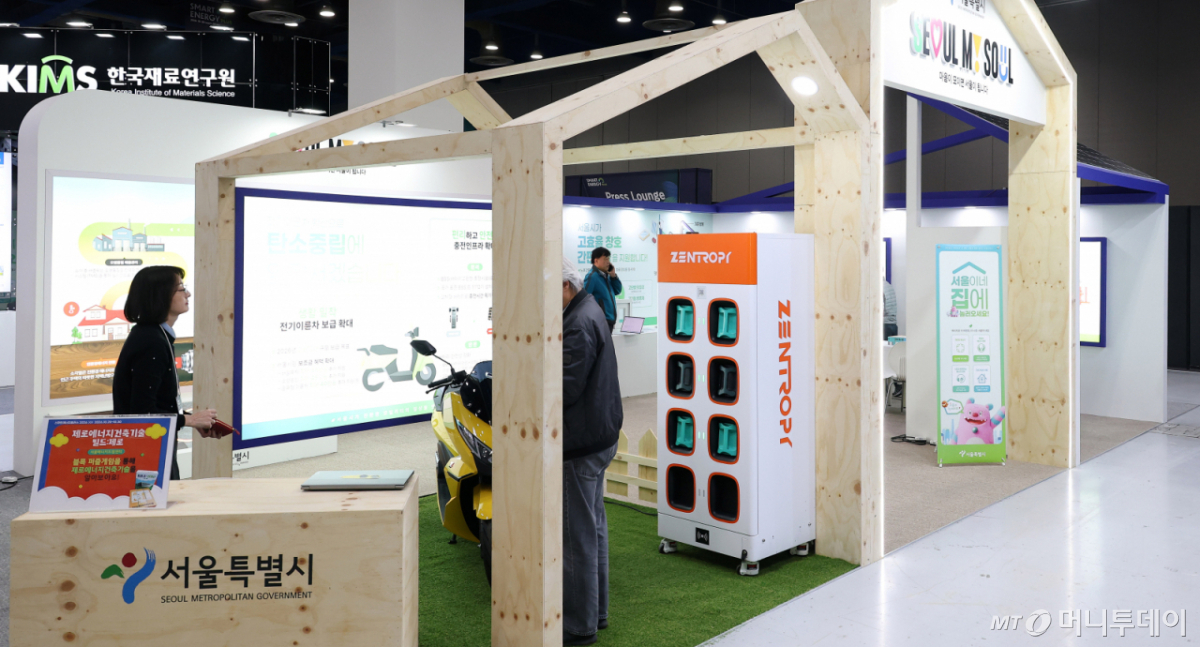
At "Smart Energy Plus (SEP) 2026," held at COEX in Seoul on Tuesday, showcased carbon-neutral policies and technologies, including waste heat for apartment heating and river water for building climate control.
Exhibits also featured next-generation energy technologies, such as ammonia fuel cell systems and a container ship model powered by a marine molten salt reactor (MSR).
First, the Seoul Metropolitan Government promotional pavilion introduced track records and expansion plans for the utilization of waste heat and geothermal energy. In fact, based on 2024 figures, Seoul recovered heating energy sufficient for approximately 170,000 apartments with a dedicated floor area of 85 square meters from four resource recovery facilities in Yangcheon-gu, Nowon-gu, Gangnam-gu, and Mapo-gu. The cumulative deployment of geothermal energy is also planned to expand by about 5.8 times, from 53 megawatts (MW) as of last month to 305 MW by 2030.
A project to reduce heating costs by installing secondary glazing and windbreak materials on the windows of aging housing was also featured at the exhibition stand. On one side of the promotional pavilion, an electric motorcycle capable of traveling approximately 80 kilometers on a full charge with two batteries and a battery swapping device caught the eye. A company official explained, "We have deployed approximately 300 battery swapping devices within Seoul."
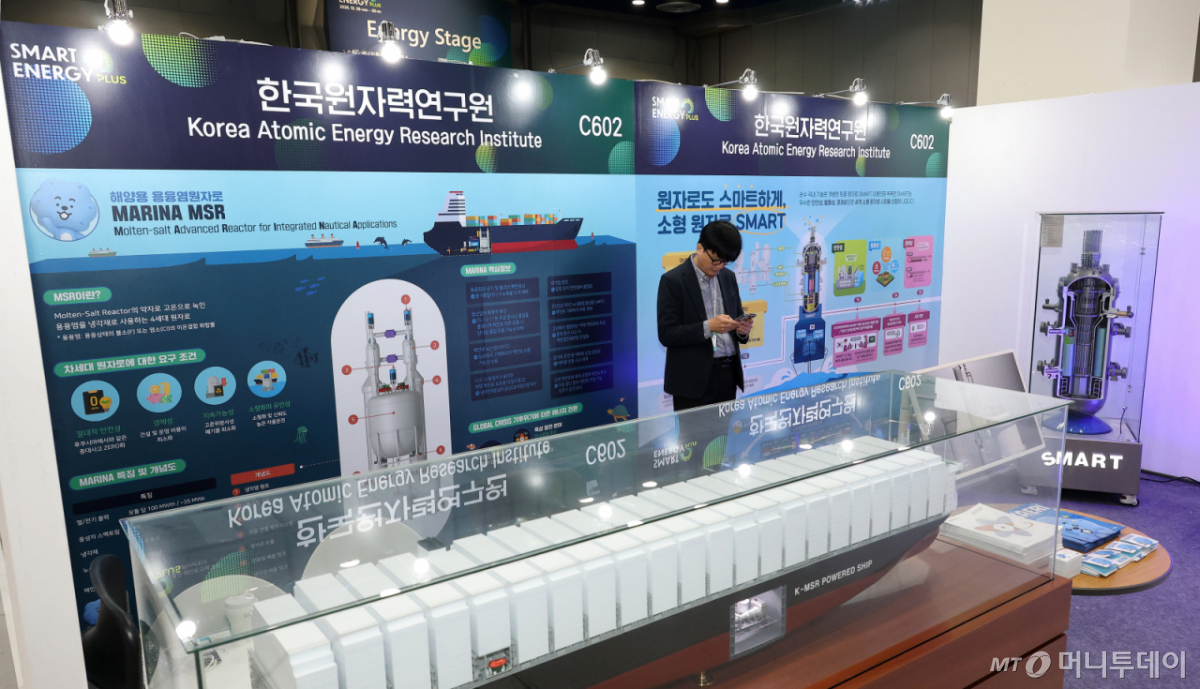
In the exhibition space of the Korea Atomic Energy Research Institute, a model container ship incorporating technologies related to shipborne MSR was placed. MSR is a nuclear reactor type that utilizes molten salt. An institute official stated, "This model was also exhibited at Cheong Wa Dae in August."
At the Korea Machinery Research Institute exhibition hall, a device with a gray metal box connected to red piping caught visitors' attention. It is a model showing the structure of a solid oxide fuel cell system that generates electricity using ammonia as fuel. The institute expressed confidence, noting that its 1.5 kilowatt (kW) integrated system recorded an efficiency of 48%, and its 20 kW high-temperature water electrolysis system has completed more than 5,000 hours of demonstration operation.
The Korea Institute of Energy Technology showcased technologies to treat nitrous oxide and tetrafluoromethane, greenhouse gases generated during semiconductor manufacturing, by more than 99% each, as well as a purification technology that produces hydrogen with a purity of 99.99% or higher from ammonia.
In addition, the Korea Institute of Materials Science (water electrolysis material technology), the Korea Institute of Civil Engineering and Building Technology (solar power generation and road traffic safety technologies through regional cooperation projects), the Korea Research Institute of Chemical Technology (automation technology for solar cell manufacturing utilizing AI and robots), the Electronics and Telecommunications Research Institute (digital twin technology for AI data centers), the Korea Research Institute of Standards and Science (quantum-related technologies), and the National Fusion Research Institute (superconducting fusion research device "KSTAR") revealed their core technologies through booths.

 in TECH

