

"For innovative technologies to move beyond the lab and take root in the market, they must be backed not only by technical capability but also by investment and follow-up R&D (research and development) projects."
The '2026 R&D Special Zone Deep Tech Startup Challenge' (hereinafter the Challenge), which identifies promising deep tech companies and connects them with stable investment and follow-up R&D projects, successfully concluded its journey on Thursday at GS Tower in Yeoksam-dong, Gangnam-gu, Seoul. Participants unanimously stated that "deep tech startups, which take a long time to commercialize, need support to continue advancing their technology even after receiving investment."
The Challenge, driven by the Ministry of Science and ICT and the Research and Development Special Zone Promotion Foundation (hereinafter the Special Zone Foundation), focused on a model in which private investors identify and select promising companies and make investment decisions, while the government provides linked support for follow-up R&D.
Unearthing deep tech 'gems'…6.5 billion won in investment commitments over two years
The Challenge began in 2022 and is now in its fifth year. It started as an IR (investment solicitation presentation) competition to identify promising deep tech companies within R&D Special Zones. Initially focused on evaluating companies' technical capabilities and commercialization potential, it underwent a shift starting in 2025.
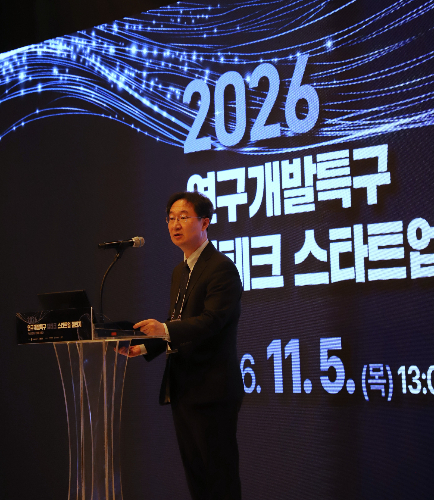
Beyond the previous approach of identifying excellent companies and holding competitions, the scope was expanded to support investment attraction and follow-up R&D for selected companies. Jung Hui-gwon, director of the Special Zone Foundation, explained, "Rather than placing significance on winning awards themselves, we aimed to support companies so they can continue growing even after the Challenge."
The Special Zone Foundation established the R&D Special Zone Fund (hereinafter the Special Zone Fund) to support the technology commercialization and growth of Special Zone companies, linking direct investment with government R&D. A key feature is that private investors participate from the company selection process through to actual investment, rather than companies being selected first and then separately tasked with raising investment. This led to concrete investment results. From 2025 over a two-year period, investments and investment commitments totaling 6.5 billion won were made for seven companies.
Private investors choose directly…Capital supplied to promising deep tech companies
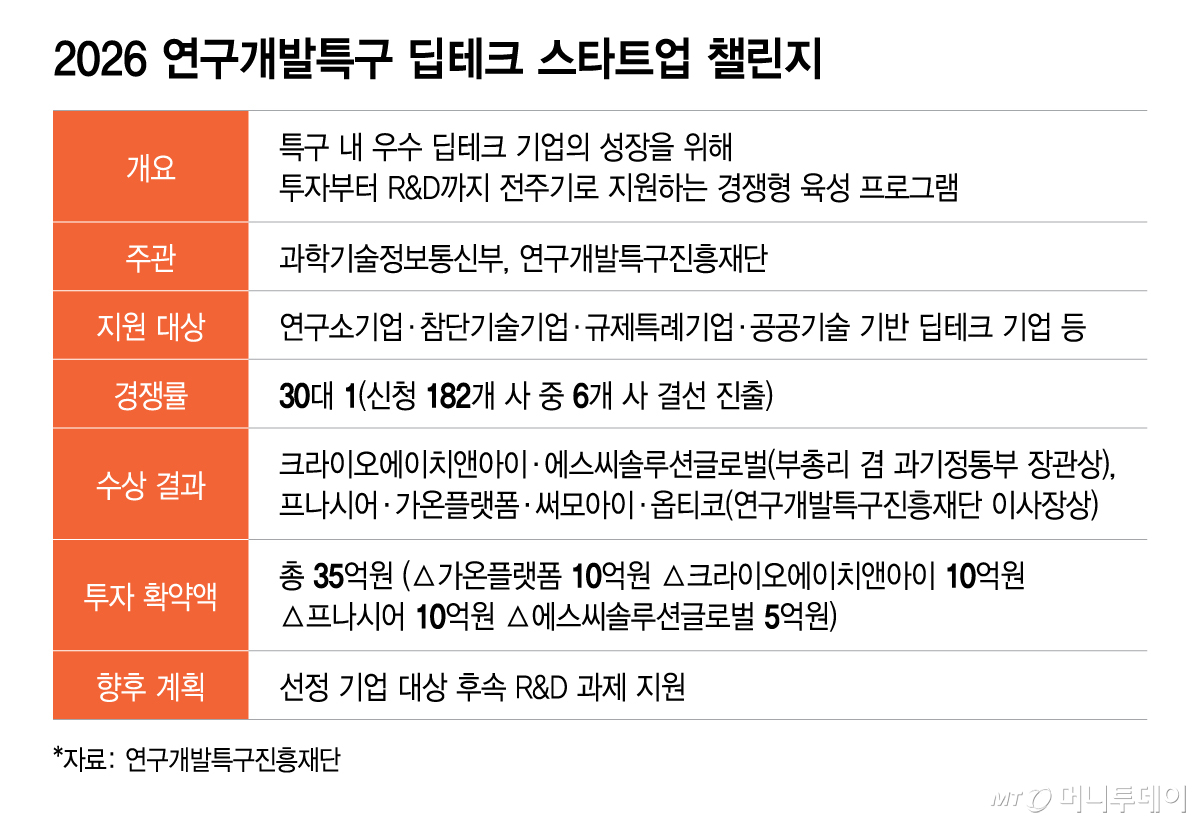
This year's Challenge received applications from 182 companies, and six advanced to the finals after overcoming a fierce competition ratio of approximately 30 to 1. Three private investors (△Inlight Ventures △Innopolis Partners △Sema Investment) began screening companies in June. After selecting 18 companies through written review, they conducted intensive coaching for two months to enhance commercialization strategies and IR capabilities. One-on-one consulting with investors was also carried out concurrently. Subsequently, finalists were selected through the main round (Pre-IR).
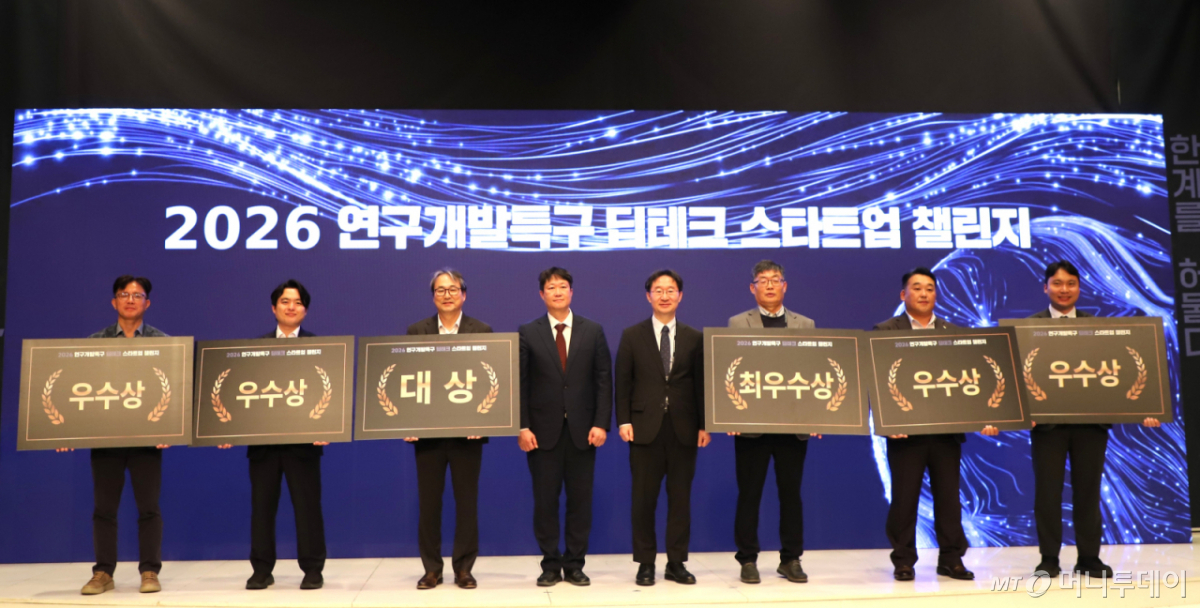
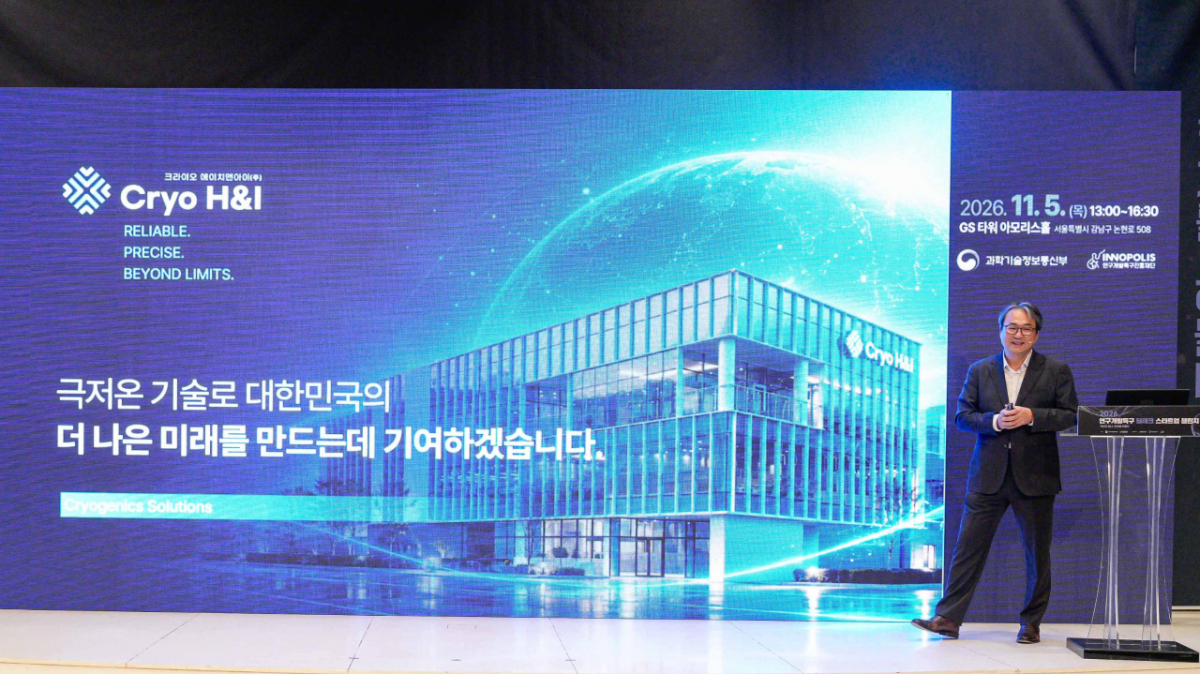
In the finals on the 5th, the grand prize (Vice Prime Minister and Ministry of Science and ICT Minister's Award) went to Cryo H&AI, a company manufacturing ultra-low temperature cooling equipment for semiconductors and quantum computers. The best award was selected for SC Solution Global, which holds an AIoT-based intelligent leak detection and network management solution. Four companies—△Gaon Platform △Thermo I △Optico and Pnacier—received the excellence awards (Special Zone Foundation Director's Award).
Investors who participated in judging and coaching also directly stepped up to make final investment commitments. The total investment commitment amount secured by four of the six finalists (△Gaon Platform △Cryo H&AI △SC Solution Global △Pnacier) reached 3.5 billion won.
Gaon Platform received its first investment commitment since founding through the Challenge. This company, which developed a solution called 'IPCM' that uses artificial intelligence (AI) to analyze nuclear power plant operation data and detect early signs of failure, secured an investment commitment of 1 billion won. Existing investors also secured additional investments. Cryo H&AI develops ultra-low temperature cooling equipment used in semiconductor processes and quantum computers. The additional investment amount committed at this Challenge was 1 billion won.
The Special Zone Foundation stated, "A company receiving its first investment commitment since founding and a company securing an additional investment commitment following existing investments were born side by side," adding, "It will serve as a representative case of connecting private capital to startups pursuing both initial and additional investments."
Taking responsibility for follow-up R&D as well
The next task for companies that have secured investment is technology advancement and demonstration. The Challenge links government R&D necessary for technology advancement and demonstration even after investment.
Three companies selected last year received a total of 3 billion won in investment through the Special Zone Fund. Currently, they are receiving support for follow-up R&D projects worth 500 million won per company to advance technology commercialization. The Ministry of Science and ICT and the Special Zone Foundation plan to provide linked support for 2027 follow-up R&D projects to the four companies that received investment commitments this year.
Director Jung stated, "For deep tech companies to grow in the market, private investment and follow-up R&D must be organically connected," adding, "We will not stop at discovering good technology, but will continue to provide growth opportunities until that technology gains competitiveness in the market."

 in TECH


