

New drug development biotechs (biotechnology companies) with valuations exceeding 500 billion won are set to make consecutive appearances in the initial public offering (IPO) market. As a series of major biotech IPOs approach their housing subscription periods, investor interest in the primary market is rising.
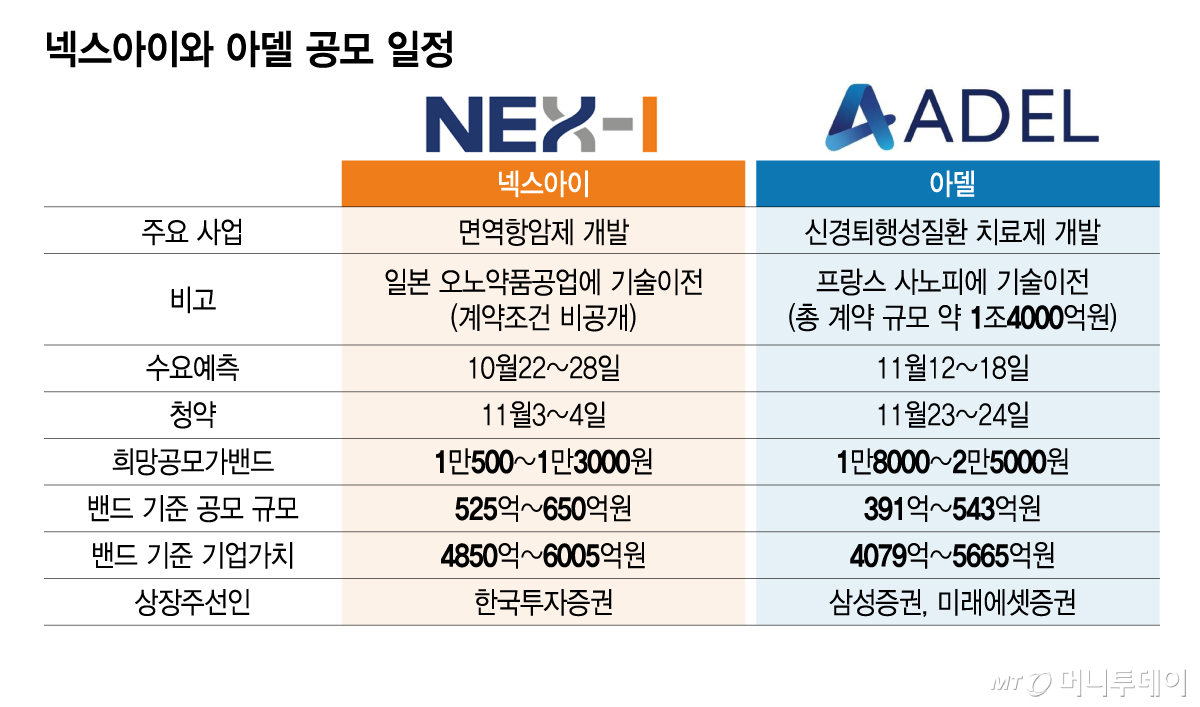
According to industry sources on the 18th, Nexia will conduct demand forecasting for institutional investors this month. Following this, Adel will begin its public offering procedures next month. The housing subscription dates for retail investors are scheduled for the 3rd and 4th of next month for Nexia, and the 23rd and 24th of the same month for Adel.
Nexia and Adel are biotechs with corporate valuations exceeding 500 billion won based on the upper end of their desired price bands. It is rare in the domestic IPO market for a new drug development biotech to have a corporate valuation surpassing 500 billion won. In particular, it is unusual for major biotechs to conduct housing subscriptions in the same month. The success of Nexia and Adel’s offerings is highly likely to influence investor sentiment toward biotech and healthcare companies in the primary market going forward.
A burden is that investment demand for biotech stocks has been relatively sluggish in the recent domestic stock market. This is because investment demand for biotech IPOs inevitably affects the valuation of listed biotech companies. It is known that Nexia and Adel have set their desired price bands somewhat conservatively, taking into account the recent stock market conditions.
Analysts suggest that the case of Ingenia Therapeutics (Reg.S), a major biotech IPO that went through public offering procedures in July last month, could serve as a reference for IPO investors. The representative new drug pipeline of Ingenia Therapeutics is undergoing large-scale Phase 3 trials by US-based Merck (MSD). However, the evaluation in the primary market was not favorable. It is interpreted that this was influenced by factors such as sluggish biotech investment demand in the stock market and its status as a biotech company, resulting in a relatively high valuation.
In fact, the demand forecasting competition ratio for Ingenia was only 50.4 to 1. As a result, the offering price was set at 12,000 won, the lower end of the desired price band (12,000–14,500 won). The corporate valuation based on the offering price is 645.2 billion won. The housing subscription competition ratio was 3.09 to 1, effectively failing to achieve a popular subscription rate.
However, IIngenia has delivered profits to IPO investors after its listing. As of the closing price on the 16th, the stock price of Ingenia is 24,000 won. Investors who have held the stock since the offering have effectively achieved a 100% return.
Nexia and Adel are both biotechs with global technology transfer experience and are companies that have gained relative recognition in the over-the-counter market. The success of their offerings is expected to hinge on evaluations of specific growth strategies, including business development plans such as future pipeline technology transfers, during the public offering process.
Nexia holds new drug platform technology (NEXORA) for identifying causal factors related to immune resistance in cancer immunotherapy. Based on this, it has discovered multiple immune checkpoint inhibitor pipelines. Its representative pipeline is the immune checkpoint inhibitor 'NXI-101'. In March 2024, it was transferred to Japan’s Ono Pharmaceutical, considered a powerhouse in immune checkpoint inhibitors, during the preclinical stage. The follow-up pipeline 'NXI-201' has already received approval for Phase 1/2 clinical trial plans (IND) from the Ministry of Food and Drug Safety and the US FDA. It is evaluated that the scalability of new drug pipelines based on its proprietary immune resistance-related new drug development platform technology is a strength.
Adel is a company primarily researching degenerative brain diseases, with its representative pipeline being the Alzheimer’s disease treatment 'ADEL-Y01'. After independently conducting Phase 1a trials, it transferred the technology to Sanofi in December 2025 ahead of Phase 1b. The total contract size for this deal is $1.04 billion (approximately 1.39 trillion won). The upfront payment was $80 million (approximately 110 billion won), which is at the highest level among technology transfer deals by domestic biotechs. It is analyzed that the company has excellent capabilities in discovering and designing new drug candidates preferred by global big pharma companies. The follow-up pipeline 'ADEL-Y04' is currently in negotiations for a technology transfer with a global big pharma company. A technology transfer contract is expected to be possible as early as next year.
An investment industry official said, "Considering the recent stock market conditions, it remains to be seen how much investment demand in the primary market will be drawn by consecutive offerings from major biotechs," adding, "Ultimately, market evaluations of individual companies' new drug pipelines, differentiated technological competitiveness, and follow-up business development strategies will determine the success or failure of the offerings."

 in THEBIO
