

The court effectively expanded the scope of the injunction against unfair labor practices to cover the entire production process, putting a brake on the strategy of the union at Samsung Biologics (hereinafter Samba) to pressure management with a "production halt" card during its second general strike. However, as the gap between the union and management over wages and performance bonuses remains unresolved, negotiations are still shrouded in uncertainty.
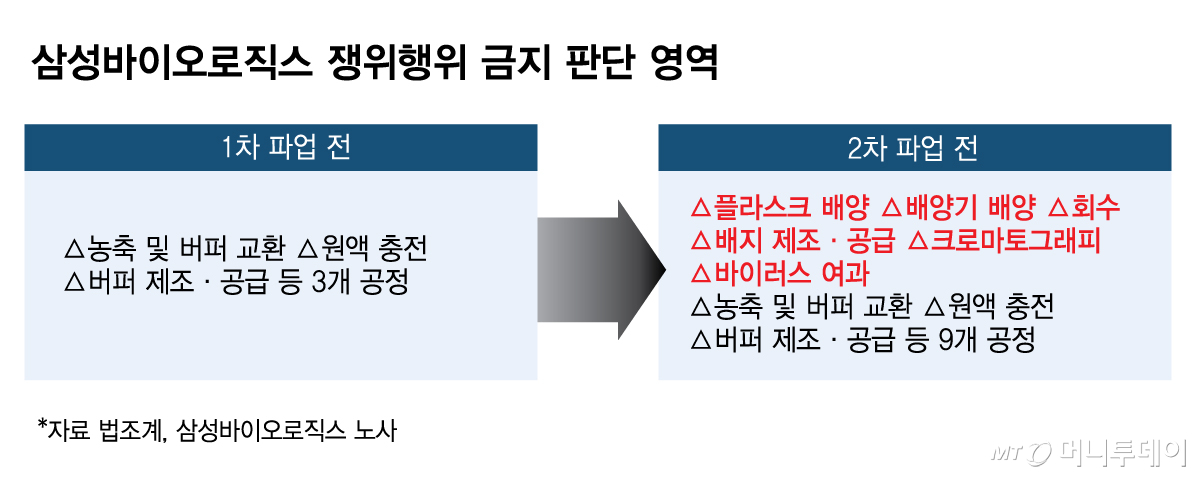
According to industry sources on the 18th, the First Civil Division of the Seoul High Court Incheon Branch ruled on the 16th to grant Samba's appeal for an injunction against unfair labor practices, approving the nine processes requested by management. The first-instance court had only prohibited unfair labor practices in three processes conducted in the latter half of production: concentration and buffer exchange, bulk filling, and buffer manufacturing and supply. In the appellate review, the scope was expanded to include six processes from the first half (flask culture, bioreactor culture, harvest, media manufacturing and supply, chromatography, and virus filtration), bringing the total to nine approved processes.
The court stated, "In the production process of biopharmaceuticals, the only way to prevent deterioration of raw materials and products is to complete (culture and purification) processes," adding, "This falls under 'work to prevent deterioration or spoilage of raw materials or products' as stipulated in the Trade Union Act, and must be carried out normally during a labor dispute period." The court further noted that "the need for preservation is recognized considering the social impact of supply disruptions for treatments such as biliary tract cancer and metastatic breast cancer, for which no alternative drugs exist."
In accordance with the court's ruling, the union must maintain the same level of personnel, operating hours, and scale of operations as usual across all processes even during a strike. The union's strategy to pressure management through "extensive losses via production halt" during a three-week second general strike starting on the 26th is expected to face significant obstacles. However, the union has stated it will not abandon the strike. Union representatives said, "From the point of initiating the strike, we can still halt the production of new batches (product units obtained in a single manufacturing run under identical conditions)," adding, "Our plan for collective action remains unchanged, but there is a high possibility that the start date of the strike will be changed."
Samba's union and management have failed to narrow their differences over wage increase rates and the payment of performance bonuses equivalent to 15% of operating profit. After failing to reach an agreement even in post-dispute mediation involving labor, management, and the government (labor-management-government), the Samba union has expanded the front of the conflict by demanding collective bargaining with its second-largest shareholder, Samsung Electronics, and sending letters to the Korea Exchange and the Financial Supervisory Service requesting a review of the rights offering (paid-in capital increase) currently in progress.
It is widely assessed that this court decision has dealt a serious blow to the momentum of the Samba union's struggle. Given that the union must accept the reduced effectiveness of its labor dispute actions while management also bears the burden of production and customer response, there are predictions that "last-minute negotiations" may take place. This year, Samsung Electronics' labor and management also reached an agreement through government-mediated negotiations after a court decision restricting unfair labor practices ahead of a general strike.
An industry official said, "As a CDMO (Contract Development and Manufacturing Organization) company where trust with global customers is crucial, prolonged labor-management conflict is a burden for both sides," predicting that "the court's decision could serve as an opportunity for further negotiations." The Samba side stated, "We will continue to make efforts toward a mutually beneficial labor-management relationship."

 in THEBIO
