

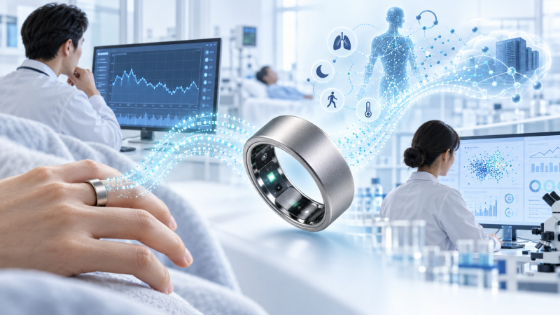
Wearable healthcare companies utilizing ring-shaped devices are accelerating their expansion into areas ranging from personal health management to blood pressure treatment and clinical trials for new drugs. As the scope of data utilization broadens into medical settings, companies are racing to prove measurement accuracy and clinical utility value, moving beyond simple device sales.
According to industry sources on the 15th, Finnish smart ring company Oura is pushing for a U.S. stock market listing with a corporate valuation in the trillions of won. Although it postponed its schedule last month citing market uncertainty, the push for an IPO is seen as an opportunity for wearable companies that analyze biometric data to be evaluated not just as device manufacturers, but as healthcare platforms.
Oura has combined smart ring sales with a paid subscription service. The ring measures sleep and body temperature changes, activity levels, and other metrics, providing analyzed health management information. This structure ensures recurring revenue through user service subscriptions even after the initial device sale.
Revenue remains hardware-centric. Sales from October last year to June this year reached $1.2145 billion (approximately 1.635 trillion won), surpassing total sales for the previous fiscal year ($978.5 million). However, approximately 80% of revenue in the most recent three months was generated from hardware, making it a challenge to connect users and biometric data into sustained service revenue going forward.
Companies like Fitbit, which grew as an activity tracker, and GoPro, which pioneered the action camera market, also faced intensified competition and slowed growth after their initial market expansion. The fact that device popularity does not guarantee long-term platform competitiveness is the backdrop for wearable companies seeking to expand data utilization beyond personal health management.
In fact, in medical settings, the need for daily biometric data is growing due to aging populations and an increase in chronic diseases. According to the World Health Organization (WHO), as of 2024, there are approximately 1.4 billion people aged 30 to 79 worldwide with high blood pressure. Only slightly more than one in five patients has their blood pressure under control.
In hypertension management, blood pressure changes during daily life and sleep are also important. It is difficult to fully grasp nocturnal hypertension or variations by time of day using only intermittent measurements taken in the clinic. This is why wearable devices that collect biometric signals over long periods of wear are gaining attention as diagnostic and research tools.
However, information for personal health management differs from data used by medical professionals for diagnosis and treatment. Utilization in clinical settings requires accuracy and clinical evidence appropriate for that purpose. Even for the same ring-shaped device, the market it can enter varies depending on approved usage purposes and verification scope.
SkyLabs, Data Business Based on Continuous Blood Pressure Measurement… Expanding into Treatment, Academic Research, and New Drug Clinical Trials
In Korea, SkyLabs is linking its ring-type blood pressure monitor with a medical data business. While Oura grew as a health management service analyzing sleep and activity status, SkyLabs has focused on continuous blood pressure measurement for clinical use.
SkyLabs' 'CART BP pro' is a ring-type blood pressure monitor utilizing photoplethysmography (PPG) sensors and artificial intelligence (AI) algorithms. It has received approval from the Ministry of Food and Drug Safety and is used in clinical settings where national health insurance applies. According to the company, cumulative prescription records in Korea exceed 300,000 cases.
Instead of wrapping a cuff around the arm, users wear a ring to measure blood pressure during daily life and sleep. Medical professionals can use the collected data to understand patients' nocturnal blood pressure and patterns of change by time of day.
Data accumulated in clinical settings is also leading to research. Last month, SkyLabs signed a memorandum of understanding (MOU) for joint research with the Korean Hypertension Society to utilize approximately 300,000 cases of real-world data (RWD) from cuffless blood pressure measurements. Cuffless refers to a method of measuring blood pressure without a pressurization cuff.
The two parties plan to establish standards for standardizing cuffless blood pressure and criteria for clinical application by utilizing data generated by patients during daily life and sleep, according to medical professionals' prescriptions. The company was also selected as a research device supplier for the Korean Genome and Epidemiology Study (KoGES) conducted by the Korea Disease Control and Prevention Agency's National Institute of Health Research.
The company is also pursuing business expansion through 'CART NET,' a data platform for new drug clinical trials. The goal is to secure data for clinical trials, such as measuring changes in patients' blood pressure and biometric signals before and after administering new drugs. It discussed cooperation plans with multinational pharmaceutical companies and contract research organizations (CROs) at global bio events held in Basel, Switzerland, and elsewhere.
Lee Byung-hwan, CEO of SkyLabs, stated, "We aim to be a platform company that generates medical data, not just a company that makes blood pressure monitors or medical devices." He added, "We are expanding from hospital-use blood pressure monitoring to the personal market and broadening our business into markets where diverse medical data can be collected."
He further noted, "We are collecting medical data based on cloud technology while complying with the Personal Information Protection Act," adding, "Ultimately, this data will be utilized for training AI models or providing personalized medical services."

 in THEBIO
