

[For more diverse corporate information on the startups featured in this article, please visit the Unicorn Factory big data platform 'Data Lab'.]
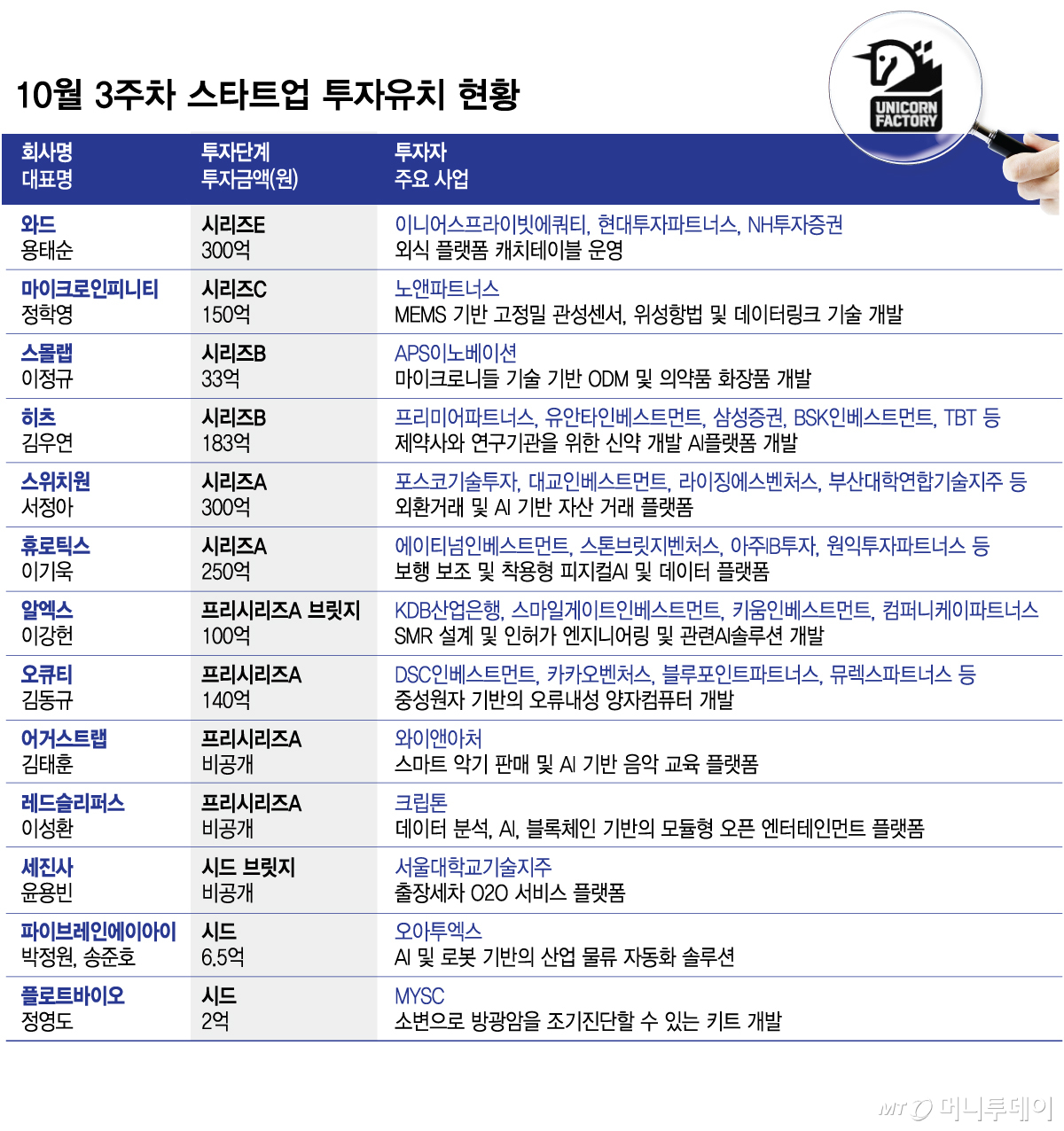
In the venture investment market during the third week of October (12–16), companies across various fields, including biotechnology, space, quantum computing, and small modular reactors (SMRs), secured funding. While investments in deep tech remained strong, news of fundraising for startups in lifestyle areas, such as O2O (online-offline linkage) services, also continued.
Companies that secured funding during this period (based on public disclosures) include Ward, Micro Infinity, Small Lab, HITS, Switch One, Hyrobotics, RX, Occu-T, August Lab, Red Sleepers, Sejin Sa, Five Brain AI, and Float Bio.
Investment rounds varied widely, ranging from seed to Series E. Most of the fundraising news was based on large-scale capital raises exceeding 10 billion won.
“Supplying AI platform for drug development”… HITS raises 18.3 billion won in Series B

HITS (HITS), an AI (artificial intelligence) biotech platform company, raised 18.3 billion won in a Series B investment round. With this investment, the company’s cumulative fundraising reached 28.6 billion won.
The round was led by Premier Partners, with six institutional investors joining as new investors: Yuanta Investment, Samsung Securities, BSK Investment, TBT Partners, and IBK Venture Investment. Existing investors Korea Investment Partners, Capsule Partners, and Laplace Partners also participated in the follow-on investment.
HITS is a company that provides AI platforms for drug development and biotech data analysis to pharmaceutical companies and research institutions. Unlike typical AI drug discovery companies that focus on developing their own drug candidates, HITS has built a business model of supplying AI research platforms to external research institutions. This structure reduces risks associated with clinical trial failures or regulatory delays and allows revenue to grow rapidly as the customer base expands.
Yoon Ha-young, executive at Premier Partners, stated, “HITS has demonstrated top-tier global model performance in key benchmarks through its AI-specialized foundation model project and implemented it into a platform that customers can easily utilize, securing performance, usability, and commercial viability.” He added, “In the long term, we expect HITS to expand its business beyond drug development into the ‘AI for Science’ field, applying AI across scientific research as a whole, thereby innovating the way scientific R&D is conducted.”
Switch One raises 30 billion won in Series A… Expands gold and digital asset business
Global foreign exchange tech company Switch One raised approximately 30 billion won in a Series A investment round. Existing shareholders, including Busan United Technology Holdings, POSCO Investment, Infobank, and Daekyo Investment, along with Switch One’s partner affiliates, participated as strategic investors (SI).
Switch One launched its business in July 2022 as an application for currency exchange and foreign currency storage that offers a 100% exchange rate discount. Since then, it has expanded its business areas to include digital assets based on physical assets such as gold, silver, and copper, offline gold sales, and trading agents based on AI algorithms. As of October this year, the company’s cumulative transaction volume reached 8 trillion won, with first-half revenue recorded at 96.6 billion won.
Switch One plans to invest the secured funds in building gold trading infrastructure, entering the Japanese digital asset market, and advancing AI (artificial intelligence) trading technology. Specifically, the company will build gold trading infrastructure, including a gold wholesale trading system and vault operations, and pursue businesses related to gold coins. It also plans to prepare for a yen stablecoin business through its Japanese subsidiary.
Seo Jung-a, CEO of Switch One, said, “Based on the trading technology validated through foreign exchange tech, we will expand our digital assets based on physical assets and entry into the Japanese market, aiming to grow into a digital asset platform connecting Korea and Japan.”
Recovery starting in hospitals, extending to daily life… 25 billion won lump sum for ‘wearable robot’ developer
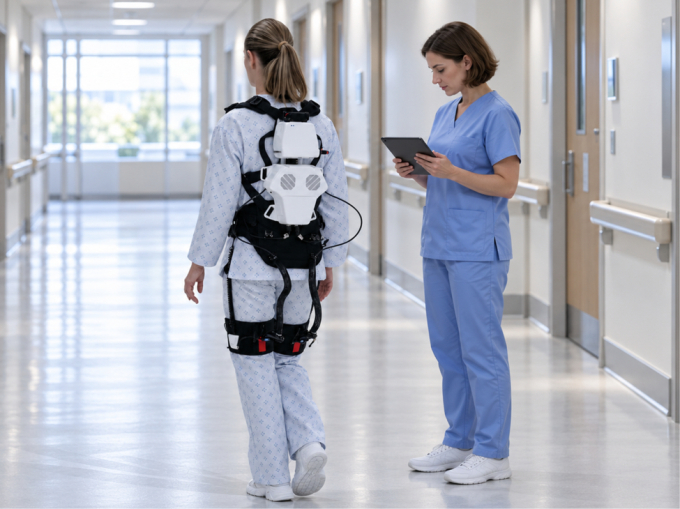
Wearable robotics company Hyrobotics raised 25 billion won in a Series A investment round. The cumulative fundraising amount has exceeded 33.5 billion won.
Founded in July 2022, Hyrobotics was established by Lee Ki-wook, a professor in the Department of Mechanical Engineering at Chung-Ang University. Lee (CEO) led research on clothing-type wearable robots through the U.S. Defense Advanced Research Projects Agency (DARPA) ‘Warrior Web’ project at Harvard University’s Wyss Institute. Based on this, Hyrobotics is developing a walking rehabilitation robot called ‘H-Medi.’
The round was led by Atinum Investment, with most existing investors participating, including Stonebridge Ventures, Ajou IB Investment, Wonik Investment Partners, Mirae Asset Venture Investment, and Doosan Investment. Strategic investors (SI) in the healthcare, distribution, and IT sectors, such as Daewoong, Naver, and Lotte, along with new investors including small and medium-sized Industrial Bank of Korea, also joined in large numbers.
A Hyrobotics official stated, “Strategic investors invested, noting the potential for business expansion from hospital rehabilitation to daily walking assistance and a wearable physical AI data platform.” He added, “We will pursue cooperation with them in expanding hospital supply and distribution networks, overseas expansion, and advancing data and software platforms.”
Lee Ki-wook, CEO of Hyrobotics, said, “Our goal is to ensure that the recovery of movement starting in hospitals leads to health in daily life.” He added, “With this investment, we will accelerate the global rollout of H-Medi and the commercialization of H-Care, and unveil a wearable robot that combines physical AI to help maintain health even in daily life.”
RX raises 10 billion won from Korea Development Bank and others… Cumulative funding reaches 23.9 billion won

RX (RX), a small modular reactor (SMR) engineering company, raised 10 billion won in a Pre-A bridge investment round.
New investors in this round included KDB Industrial Bank, Smilegate Investment, and Kiwoom Investment. Existing investor Company K Partners also executed a follow-on investment. Following its Pre-A fundraising last January, RX secured additional funds, bringing its cumulative fundraising to 23.9 billion won.
RX is a technology startup established primarily by researchers from the SMR design division of the Korea Atomic Energy Research Institute. Currently, it is developing ‘RX-50,’ a light-water thermal supply SMR, in a consortium with the Korea Atomic Energy Research Institute. RX-50 aims to replace fossil-fuel-based heat sources used in industrial sites, providing stable thermal energy without carbon emissions.
Lee Kang-hun, CEO of RX, stated, “We are grateful that national banks and major investment firms have recognized the potential of SMR as a new market.” He added, “We will enhance the technical completeness of RX-50 and grow into a company leading the transition to decarbonized thermal energy.”
“Catching quantum computer errors”… Occu-T raises 14 billion won in Pre-A
Occu-T, a neutral atom-based quantum computing company, raised 14 billion won in a Pre-Series A investment round.
The round was led by DSC Investment, with existing investors Kakao Ventures and Blue Point Partners participating in the follow-on investment. New investors included Murex Partners, Stonebridge Ventures, Schmidt, Jet Venture Capital (ZVC), and Global Innovation Labs (GIL).
Occu-T was founded by Kim Dong-gyu (CEO), a professor in the Department of Physics at Korea Advanced Institute of Science and Technology (KAIST). Kim (CEO) is also a founding member of QuEra, a U.S. quantum computing company that developed the world’s first 256-qubit neutral atom quantum computer.
Occu-T is developing ‘fault-tolerant quantum computers’ using neutral atoms cooled by lasers. Fault-tolerant quantum computers are systems designed to detect and correct errors occurring during computation, enabling stable performance of complex calculations. Occu-T’s differentiated technology is the ‘SDQ (Software-Defined Quantum Processor),’ which defines the functions and operations of a quantum processor via software. While previous approaches involved building hardware first and then applying software, SDQ is characterized by its ability to flexibly reconfigure the structure and operating methods of the quantum processor according to algorithmic requirements.
Kang Seong-min, executive at DSC Investment, said, “Occu-T possesses technical capabilities and a differentiated approach that can compete in the global market, giving it the potential to grow into a leading company in the quantum computing field.” Shin Jung-ho, senior reviewer at Kakao Ventures, stated, “Given that Occu-T has achieved meaningful R&D results in a short period, we expect it to successfully resolve the remaining challenges toward commercialization.”
[Money Today Startup Media Platform Unicorn Factory]

 in FUTURE


