

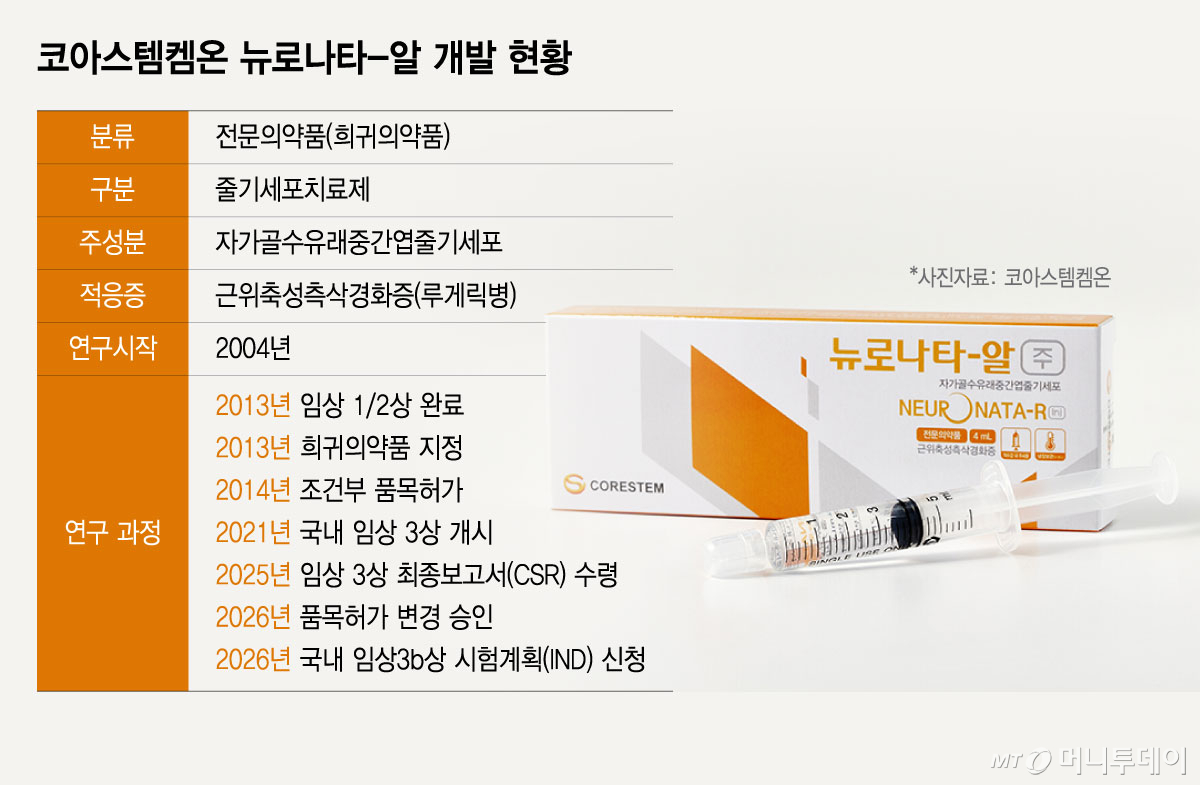
CorestemChemon has taken a step toward bringing Neuronata-R, its stem cell therapy for amyotrophic lateral sclerosis (ALS), also known as Lou Gehrig's disease, to the U.S. market.
The company aims to enter the market through the U.S. Food and Drug Administration's (FDA) accelerated approval pathway and generate more than 500 billion won in annual sales.
CorestemChemon said Thursday it had submitted an investigational new drug (IND) application to the Ministry of Food and Drug Safety (MFDS) for a Phase 3b clinical trial of Neuronata-R.
The Phase 3b trial will involve 146 adult ALS patients at three medical institutions in South Korea. Participants will be randomly assigned to receive either Neuronata-R or a placebo, with each group receiving two doses.
The primary objective is to determine whether two doses of Neuronata-R can slow the decline in patients' physical functions compared with a placebo.
The primary endpoint of the confirmatory trial is the change in the ALS Functional Rating Scale-Revised (ALSFRS-R), which measures physical function in ALS patients.
Neuronata-R, whose active ingredient is lenzumestrocel, is an autologous stem cell therapy manufactured using mesenchymal stem cells derived from patients' bone marrow.
The treatment completed Phase 2 trials and received conditional marketing approval from the MFDS in 2014. It was launched in 2015 as the first stem cell therapy for a neurological disease and has since been administered to numerous patients.
CorestemChemon began a Phase 3 trial of Neuronata-R in 2021 and received the final clinical study report (CSR) last year. The trial failed to demonstrate statistical significance across all patients for its primary endpoint, the Combined Assessment of Function and Survival (CAFS), and its secondary endpoint, the ALSFRS-R.
However, the company found evidence of efficacy in a subgroup of patients with relatively slow disease progression, defined as having neurofilament light chain (NfL) levels below 52 pg/mL.
In this subgroup, the treatment showed efficacy not only on the primary and secondary endpoints but also in slow vital capacity (SVC), a measure of lung function.
Based on these findings, the company obtained approval for a change to the product's marketing authorization in the first half of this year.
For the Phase 3b trial, the company plans to assess respiratory function, time to disease progression and changes in biomarkers associated with nerve cell damage and neuroinflammation, drawing on data from the Phase 3 trial.
CorestemChemon plans to use the Phase 3b trial as a stepping stone for entering the U.S. market. It is currently working with the FDA to develop a detailed regulatory strategy.
If the MFDS approves the domestic Phase 3b trial, CorestemChemon plans to submit the trial application to the FDA and subsequently seek accelerated approval.
The FDA's accelerated approval program allows drugs to receive early approval based on surrogate or intermediate clinical endpoints, with clinical benefit to be verified through confirmatory trials after approval.
Because the requirement is to initiate a confirmatory trial rather than wait for its results, the company believes it can apply for accelerated approval without waiting for the Phase 3b results.
The global ALS treatment market is projected to reach $1.097 billion in 2027, equivalent to about 1.47 trillion won. CorestemChemon estimates that Neuronata-R could generate more than 500 billion won in annual sales if it receives FDA approval, based on the commercial performance of competing drugs.
As ALS has no treatment that can fundamentally halt disease progression, the market could expand further if Neuronata-R becomes the first stem cell therapy to receive FDA approval for the disease.
"ALS is a rare disease with no fundamental cure, and the FDA tends to encourage and provide incentives for research into new treatments," a CorestemChemon official said. "Neuronata-R is competitive because we already have Phase 3 data, and the treatment is being marketed in South Korea, where its safety has also been confirmed."
The official added, "We have continued to meet with the FDA and provide information on the number of patients enrolled in clinical trials, clinical data and sales history, and the FDA is well aware of these details. The Phase 3b trial is the starting point for aligning our domestic clinical development with our U.S. regulatory strategy. We will work closely with the FDA to prepare for Phase 3b approval and the accelerated approval process without setbacks."

 in THEBIO
