

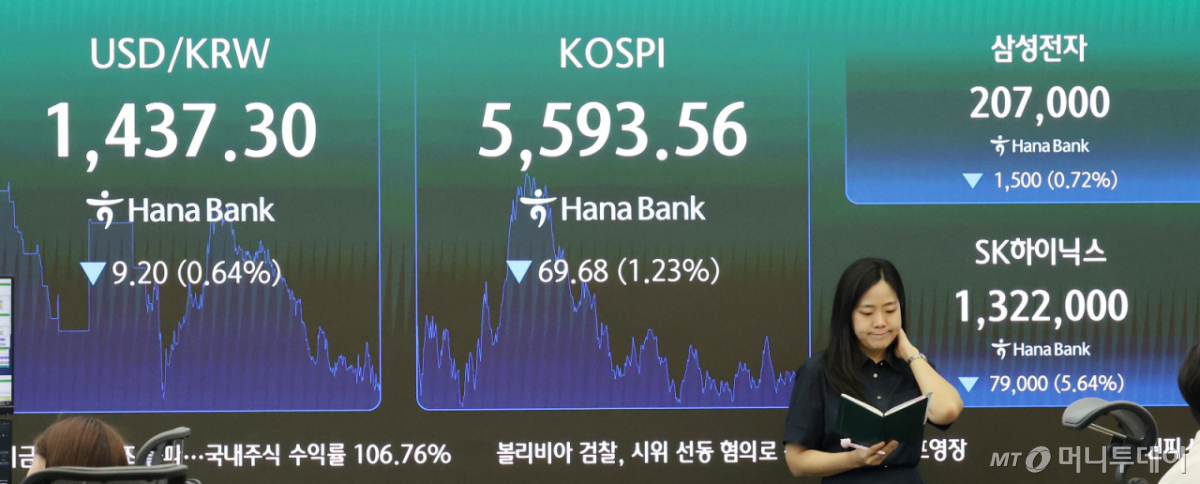
The won/dollar exchange rate fell to the 1,430 won range for the first time in five months. As markets interpreted the Federal Reserve System's (Federal Reserve) decision to hold interest rates as a signal that it would not rush into further tightening, combined with capital inflows related to SK Hynix American Depositary Receipts (ADRs), downward pressure on the exchange rate intensified.
On the 30th, in Seoul's foreign exchange market, the won/dollar exchange rate closed weekly trading at 1,437.4 won, down 9.3 won from the previous trading day. This marks the lowest level in approximately five months based on the weekly closing price since February 26 (1,425.8 won).
During the morning session, the exchange rate dropped as low as 1,435.9 won before rebounding to 1,447.7 won and then falling back below 1,440 won, showing significant volatility. On an intraday low basis, this was the lowest level since February 27 (1,430.5 won), just before the outbreak of the Middle East war.
Overnight, the Federal Reserve held a meeting of the Federal Open Market Committee (FOMC) and kept the base rate unchanged at 3.50% to 3.75% annually. This marks the fifth consecutive hold this year. Unlike the previous meeting where the decision to hold rates was unanimous, three out of twelve members today advocated for a 0.25 percentage point increase.
Despite the minority opinion calling for an increase, Federal Reserve Chair Kevin Warsh stated in a press conference that financial conditions had tightened due to rising U.S. Treasury yields since the June FOMC meeting. This led to a growing perception that the intensity of further tightening by the Federal Reserve may be more limited than initially expected.
Immediately following the press conference, the dollar showed weakness, and the cumulative interest rate hike expectations for the end of this year reflected in federal funds futures markets dropped from 1.7 times before the FOMC meeting to 1.3 times after the meeting.
Min Kyung-won, a researcher at Woori Bank, said, "The market's expectation for an increase in September has diminished, triggering dollar weakness. If the personal consumption expenditure (PCE) price data released tonight meets or comes in lower than expected, the trend of lowering the won/dollar exchange rate level is likely to continue."
In addition, dollar inflows related to SK Hynix ADRs and increased volumes of month-end export companies' negotiations (dollar sales) have also contributed to pulling down the exchange rate.
However, the future direction of the won/dollar exchange rate is expected to depend on foreign stock fund flows after short-term supply and demand factors are exhausted. Recent assessments indicate that a significant portion of capital inflows related to SK Hynix ADRs and month-end negotiation volumes has already been absorbed. On this day, foreigners made net purchases exceeding 1.3 trillion won in the stock market.

 in ECONOMY
