

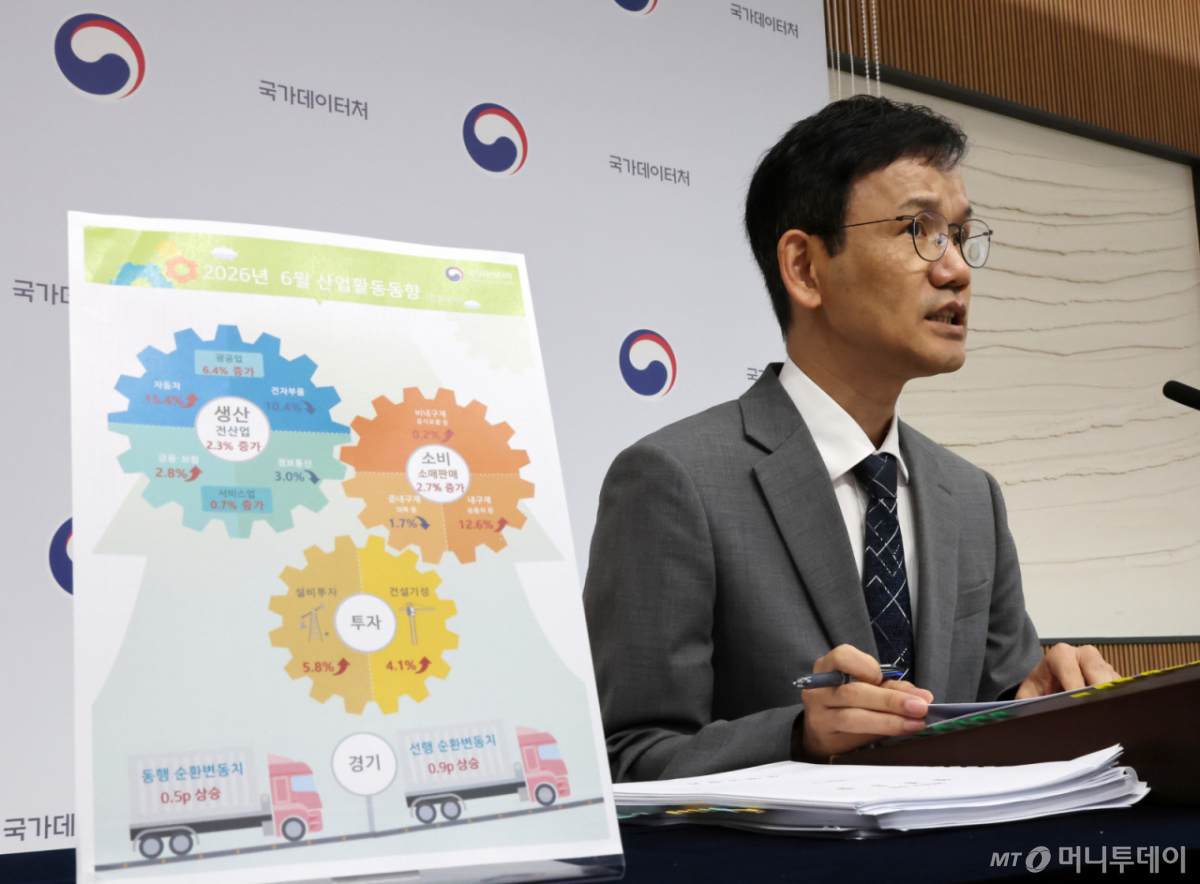
'Bubble theory of AI (artificial intelligence)' continues to be raised, yet major industrial activity indicators showed robust performance. Reflecting the second-quarter results of leading semiconductor companies, semiconductor production is soaring, and the automotive sector, which had been somewhat sluggish, led economic recovery.
In particular, the outlook for future economic conditions is 'rosy,' as the cyclically adjusted composite leading index rose to its largest increase in 17 years and two months. However, the government still cites uncertainties. This is because variables such as the situation in the Middle East and overreliance on semiconductors cannot be ignored.
The 'June 2026 Industrial Activity Trends' released by the National Data Office on the 31st can be understood as following a similar trend to second-quarter GDP (gross domestic product). According to an announcement by the Bank of Korea on the 23rd, the second-quarter growth rate (preliminary estimate) was 0.6%.
Given that first-quarter growth was 1.8%, the second-quarter growth rate can be evaluated as a 'surprise' when considering base effects. Even if third- and fourth-quarter growth rates record only -0.1% each, annual growth will exceed 3.0%. The government's growth target for this year is 3.0%. This indicates that the trends in the first and second quarters were favorable.
Reflecting this, industrial activity trends in June showed increases across production (2.3%), consumption (2.7%), and equipment investment (5.8%) compared to the previous month.
Excluding the semiconductor sector, which has consistently shown strong performance in June's industrial activity trends and is approaching a 'constant,' the most prominent area was automobiles.
Due to factors such as new car launches, automobile production increased by 15.4% in June. Automobiles also had a positive impact on consumption. Retail sales of automobiles rose by 21.8% compared to the previous month in June. This result reflects the combined effects of factors such as the individual consumption tax on automobiles that ended in June.
Industrial activity conditions after July are also positive based on indicators. In July, the consumer confidence index and business confidence index recorded 106.8 and 98.5, respectively, rising by 0.2 points and 0.8 points compared to the previous month. Exports in July increased by 52.3% year-on-year based on data from the 1st to 20.
In fact, the cyclically adjusted composite leading index, which forecasts future economic trends, stood at 105.7, a rise of 0.9 points from the previous month. This marks an eighth consecutive month of increases, with the magnitude of the rise being the largest in 17 years and two months since April 2009 (1.1 points).
However, there are no purely rosy forecasts. Signs indicate that the Middle East war may escalate again, heightening uncertainties, and it remains unclear how the stock market crash in July will affect industrial activity. The stock market is a component of the composite leading index and can also influence consumer sentiment.
The Ministry of Economy and Finance also stated in materials released on this day that while "the continued significant increase in July exports and improving trends in consumption and business confidence are expected to positively impact future economic conditions," it noted that "external uncertainties persist, such as renewed tensions in the Middle East due to a resumption of armed conflict between the United States and Iran."
Deputy Prime Minister and Minister of Economy and Finance Gu Yoon-cheol chaired an emergency economic meeting on this day and said, "The government will maintain heightened vigilance, closely monitor economic conditions centered on the emergency economic meeting, and respond promptly as needed."

 in ECONOMY
