

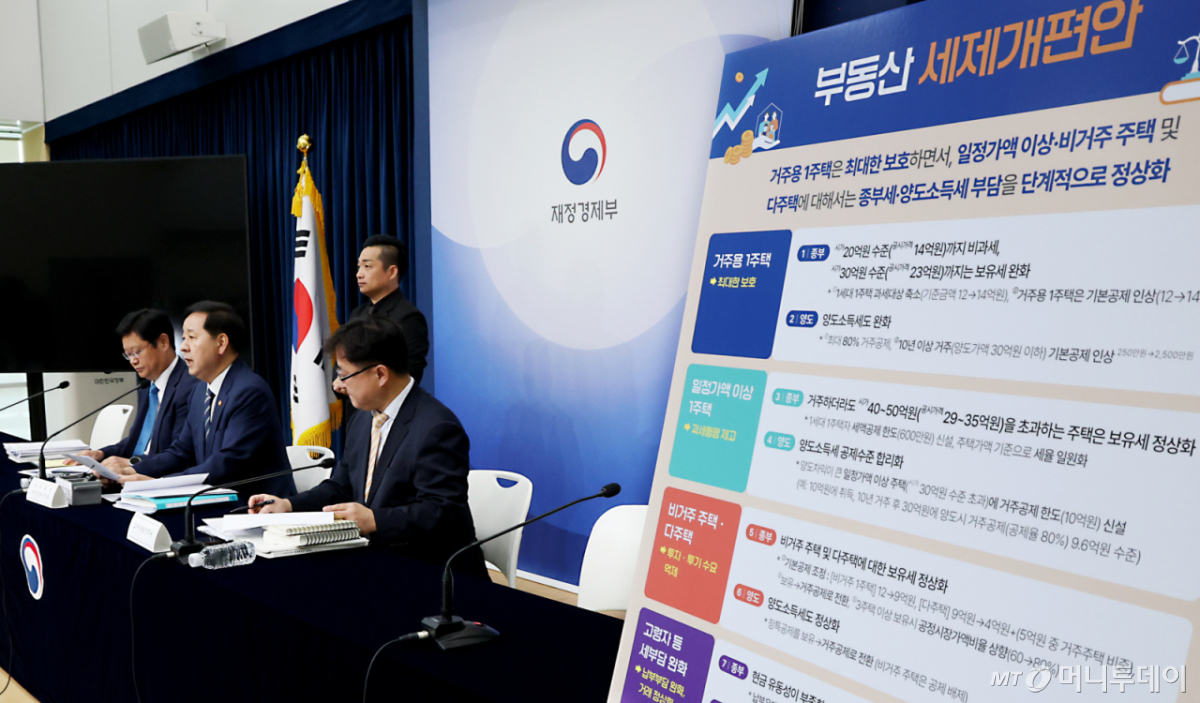
The real estate tax reform plan announced by the Ministry of Economy and Finance on the third has drawn mixed reactions. Forecasts range from the expectation that increased taxes will be passed on to rental prices to various concerns such as frozen housing inventory and bubble effects. While a minority view, it is also true that some argue the intensity of the tax reform is weak.
Beyond real estate taxes, there are numerous contentious issues, including differing stances on the taxation of virtual assets starting next year and the law to prevent stock price suppression. This explains why political circles, which must deliberate on tax laws during this year's regular National Assembly session in the second half based on the government's proposal, have put forward diverse opinions regarding the tax reform plan. Intense debates are expected during the National Assembly deliberation process.
According to relevant ministries on the fourth, this real estate tax reform plan was designed primarily around comprehensive real estate tax, targeting non-residents and multi-homeowners with increased burdens. Even single-homeowners who are non-residents will see a relatively significant increase in the comprehensive real estate tax. However, it did not lead to a comprehensive overhaul of the real estate tax system.
Last year, the Ministry of Economy and Finance commissioned a research study to explore rationalization measures for real estate taxes, reviewing the level of tax reform. This reflected recommendations from organizations such as the OECD (OECD) that holding taxes (comprehensive real estate tax, property tax) should be raised while transaction taxes (acquisition tax, capital gains tax) should be lowered. At a real estate symposium held before the announcement of the tax reform plan, there was no disagreement on the direction of raising holding taxes and lowering transaction taxes.
However, this time the focus was solely on strengthening holding taxes like the comprehensive real estate tax. While the capital gains tax included a temporary measure to ease progressive taxation for multi-homeowners, the core of transaction taxes—the acquisition tax—remained unchanged. The fact that the progressive taxation on capital gains for multi-homeowners, which ended its suspension in May, was temporarily eased is also a point of criticism from the perspective of policy consistency, even though the content of the policy itself differs.
A Ministry of Economy and Finance official explained, "To provide selling opportunities through the normalization of holding taxes, we have sought to balance holding taxes and capital gains taxes through gradual reform of capital gains taxes and temporary easing of progressive taxation for multi-homeowners." The official added, "(Regarding progressive taxation on capital gains) We considered that if the current level is maintained, multi-homeowners may face difficulties with both holding and selling after the tax reform."
Additional discussions on virtual asset taxation are also inevitable. The virtual asset taxation confirmed in 2022 was postponed three times—2023, 2025, and 2027—due to an underdeveloped tax system. Since this year's tax reform plan does not include a postponement measure, taxation will proceed as scheduled starting next year.
In the context where the decision was made not to introduce the financial investment income tax, which was planned for introduction in 2023, concerns have been consistently raised that taxing virtual assets could create equity issues. In particular, opposition from young people is expected to be relatively strong regarding virtual asset taxation. The Ministry of Economy and Finance plans to implement virtual asset taxation first and make improvements if problems arise.
A Ministry of Economy and Finance official stated, "Regarding stocks, major shareholders are already subject to capital gains taxes and transaction taxes on overseas unlisted stock transfers, so stocks are not completely tax-exempt." The official continued, "Since virtual assets are completely tax-exempt, it is reasonable to impose taxation on a certain portion of them."
Additionally, the law to prevent stock price suppression included in the tax reform plan drew critical remarks from Lee So-yeong (Rep.) of the ruling Democratic Party of Korea. The law to prevent stock price suppression involves re-evaluating the stock value of companies whose PBR (price-to-book ratio) falls within the bottom 25% by industry (KOSPI) or 10% (KOSDAQ). Lee (Rep.) announced opposition, citing reasons such as there being virtually no applicable targets.

 in ECONOMY
