


As commercialization of small modular reactors (SMRs) accelerates in the United States, participation by South Korean nuclear power companies with global competitiveness is gradually becoming visible. In particular, analyses suggest that through South Korea's U.S. investment projects, long-standing obstacles to SMR commercialization in the U.S.—namely EPC (engineering, procurement, and construction) capabilities and funding issues—could be resolved.
According to government and industry sources on the 14th, Bill Gates, CEO of TerraPower, visited South Korea that day to meet with key officials from the government, the National Assembly, and major corporations to discuss ways to strengthen cooperation between the two countries. Although TerraPower is currently regarded as the leading energy company closest to SMR commercialization in the United States, it lacks sufficient EPC capabilities and thus requires collaboration with South Korean companies that possess over 50 years of nuclear power plant construction and operation expertise.
TerraPower's fourth-generation nuclear technology, the sodium-cooled fast reactor (SFR), is evaluated as a significant advancement over currently operating third-generation reactors in terms of safety and economic efficiency. While SMRs are attracting attention as promising future technologies—with more than 100 technology development projects underway globally amid fierce competition—TerraPower is analyzed as being the most advanced in commercialization among them.
TerraPower was selected in 2020 as a participant in the U.S. Department of Energy's Advanced Reactor Demonstration Program (ARDP) and received development funding. In 2024, it began construction of a sodium (Natrium) SMR demonstration project using SFR technology in the Camarero area of Wyoming. In March this year, TerraPower became the first to receive commercial advanced reactor construction approval from the U.S. Nuclear Regulatory Commission (NRC), and construction work is currently underway with a target for commercial operation by 2031.
The reason the United States is accelerating SMR commercialization is to respond to the rapidly increasing electricity demand driven by massive investments in artificial intelligence (AI) data centers. AI data centers require large-scale power supply, and it has been pointed out that the U.S.'s aging power grid and insufficient generation capacity are inadequate for operating such facilities.
In response, major big-tech companies are focusing on "behind-the-meter" (BTM) power generation, which allows them to directly supply electricity to AI data centers they build. Since AI data centers require stable, large-scale power supply around the clock, BTM power sources such as gas-fired generation, fuel cells, and SMRs are gaining attention.
Gas-fired generation offers high stability but faces concerns over high fuel costs and carbon emissions, while fuel cells suffer from limited generation capacity. In contrast, SMRs are evaluated as suitable for powering AI data centers because they can provide stable baseload power by reducing risks compared to large-scale nuclear plants through miniaturization and modularization.
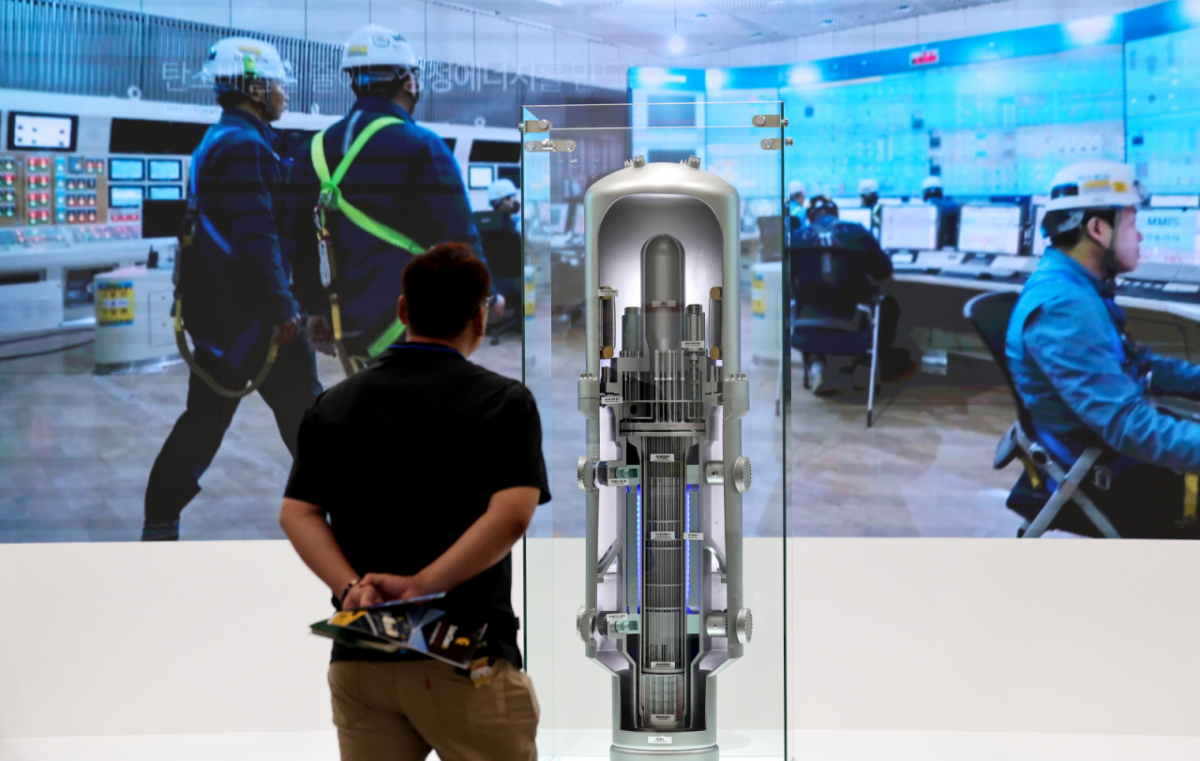
However, since SMRs still lack proven commercial operation records, it is crucial to address challenges such as the high costs of building demonstration plants and issues related to construction and operational capabilities. In particular, following the 1979 Three Mile Island nuclear accident in the United States, the domestic nuclear industry base weakened significantly, making it difficult to commercialize SMR technology even if available.
One proposed solution to mitigate U.S. EPC execution risks and funding uncertainties is South Korea's U.S. investment project. Through a tariff agreement with the United States last year, South Korea committed to promoting $200 billion in advanced industry investments and $150 billion in shipbuilding cooperation. Among the candidates for advanced industry investment, SMRs are reportedly being seriously considered.
If hundreds of billions of dollars are invested in SMRs through the U.S. investment project, the United States could significantly alleviate its initial project cost burden. Additionally, given that South Korea has accumulated over 50 years of nuclear power plant construction and operation experience both domestically and internationally, South Korean nuclear companies' participation in EPC activities through the U.S. investment project could enhance SMR execution capabilities.
Like South Korea, Japan must also conduct U.S. investments through a tariff agreement. In March, Japan decided to invest $40 billion in GE Vernova Hitachi's SMR projects in Tennessee and Alabama and is considering a $25 billion investment in NuScale Power. Combined, these two projects amount to approximately 90 trillion won.
Meritz Securities researcher Moon Kyung-won stated, "The U.S. SMR project follows a structure where the United States provides design and site, while allied nations contribute manufacturing and capital." He further analyzed, "From South Korea's perspective, since domestic companies can handle core equipment and construction for SMRs, this will be a major business with significant value creation potential."

 in ECONOMY

