

As the government continues to announce new real estate tax and financial policies, market attention is focused on 'non-resident single homeowners.' While single homeowners have been given more benefits in the past to regulate multi-homeowners, going forward, even if they are single homeowners, non-residents will effectively be treated as regulatory targets.
The government has presented the concept of a non-resident single homeowner through methods such as defining exceptions. However, the way non-resident single homeowners are defined differs between tax and financial sectors, causing confusion. Critics point out that dissatisfaction from the demand side is inevitable.
According to relevant ministries on the 17th, the Financial Services Commission announced real estate financial policies on the 13th, classifying non-resident single homeowners with speculative purposes as targets for restrictions on transfer loan guarantees.
The content stipulates that new loans and maturity extensions for transfer loans are generally prohibited for single homeowners who own apartments in the Seoul metropolitan area or regulated regions, whose homes are currently under lease agreements, and who have never actually resided in said home with their spouse.
The Financial Services Commission has ruled that if either the individual or their spouse has at least once actually resided there and transferred their resident registration, they are not subject to regulation.
Article 6 of the Resident Registration Act defines a person who establishes an address in a specific area for the purpose of residing there for 30 days or more as a target for resident registration. In other words, residing for at least 30 days allows one to be exempt from transfer loan restrictions. This is a looser form than the non-resident single homeowner regulations under real estate tax law.
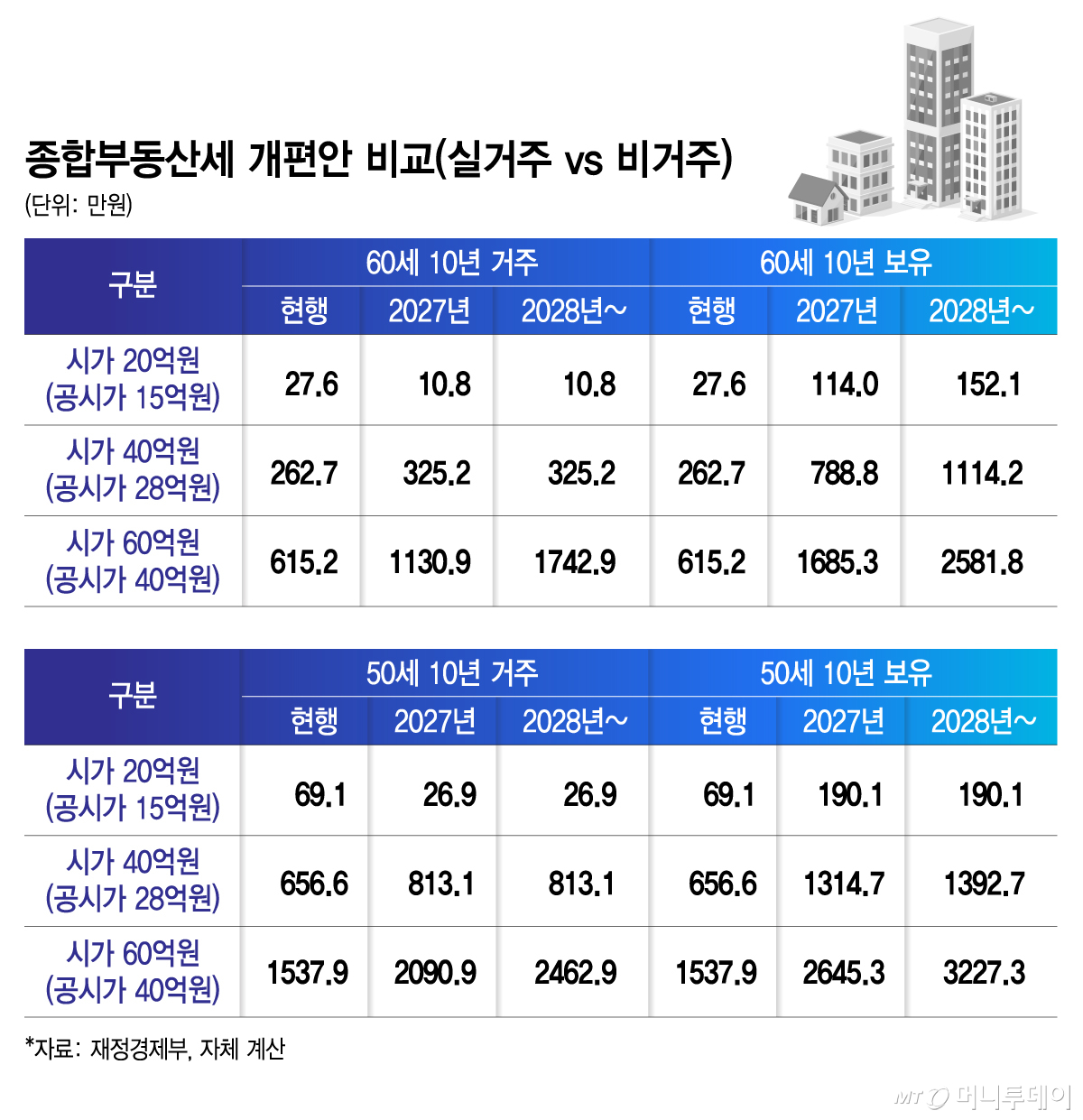
The Ministry of Economy and Finance announced a tax reform plan on the 3rd, deciding to reduce the basic deduction amount for comprehensive real estate tax for non-resident single homeowners. Reducing the basic deduction amount increases the land and house tax.
The special long-term holding deduction for capital gains tax, which previously recognized up to 80% (40% each for ownership and residence periods), will recognize a maximum of 80% based solely on residence after 2029. This means whether a single homeowner resides in the property becomes a key factor in determining capital gains tax or land and house tax.
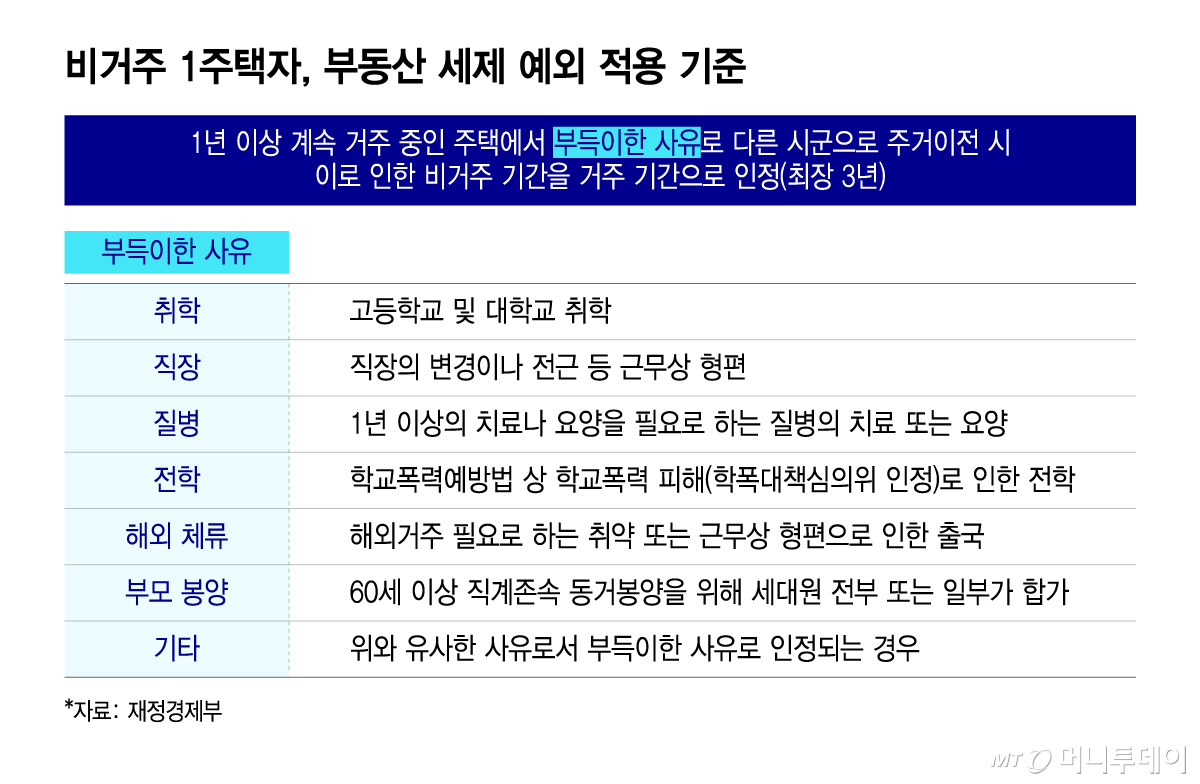
The Ministry of Economy and Finance states that non-residence periods due to 'unavoidable reasons' are recognized as residence periods. Typical cases include moving one's address to another city, county, or district from a home where they have continuously resided for over a year due to reasons such as school enrollment, illness, transferring schools, overseas stay, or caring for parents.
Given that it requires meeting both the period of over one year and specific reasons such as school enrollment or transferring schools, this can be considered stricter than the conditions for transfer loan restrictions. Additionally, newly constructed homes acquired through redevelopment or reconstruction projects also have half of the construction period recognized as a residence period.
A Ministry of Economy and Finance official explained, "Finance and taxation have different natures," adding, "Loans assess the situation at a specific point in time, whereas capital gains tax is designed by looking at the entire period."
In other words, capital gains tax is a proportional calculation based on 'how long one has resided,' while loans are binary regarding 'whether one has ever resided,' leading to different perspectives. However, since the basic deduction for land and house tax considers only residence status regardless of duration, this explanation is also insufficient.
Consequently, single homeowners subject to non-residence regulations under tax law may perceive financial non-residence regulations as relatively looser, inevitably leading to dissatisfaction. Conversely, in the financial sector, since reasons such as reconstruction are not defined as exceptions for non-residence, further dissatisfaction could arise.
Seeming to keep this situation in mind, the Financial Services Commission plans to flexibly recognize unavoidable reasons for non-residence through the credit review committees of financial institutions.
A Ministry of Economy and Finance official stated, "(Taxation and finance) have different natures, so there is no need to necessarily go together," adding, "We will not revisit this in alignment with finance."

 in ECONOMY

