

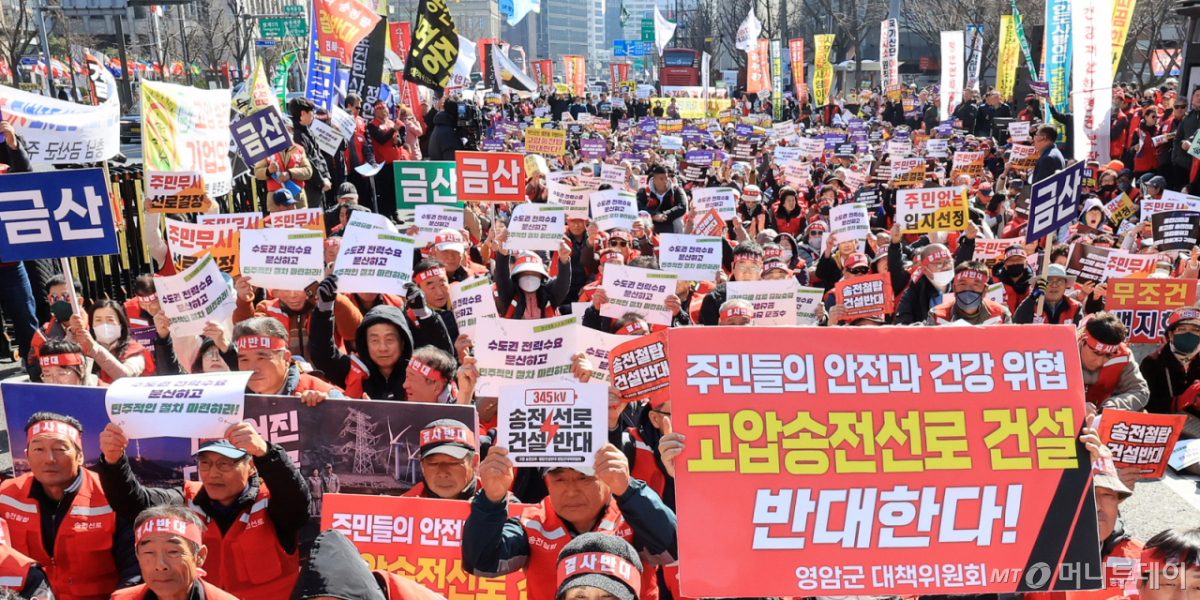
Although the government has decided to shorten administrative procedures for national key network projects through exemption from EIA, the issue of resident consultation remains in the actual process of building transmission grids. Even if EIA and permitting procedures are accelerated, it is pointed out that it will be difficult to fully achieve the expected effect of shortening the project period if construction is delayed due to resident opposition.
According to the power industry on the 24th, transmission grid projects often require consultation with residents and local governments in the process of route finalization and construction start even after EIA and permitting. Even if administrative procedures are expedited, if resident opposition surrounding the location of transmission lines and substations is prolonged, it will be difficult to expect the originally anticipated effect of shortening the project period.
In fact, the Donghae–Singapyeong 500kV transmission line, which is key to power supply in the capital area, saw construction delayed by about 66 months from the original plan due to ongoing resident opposition over concerns such as forest fires and land price declines during the site selection process.
The Bukdangjin–Sintangjeong 345kV transmission line experienced long-term delays in its project due to overlapping issues including resident opposition surrounding the construction of transmission towers and problems with local government approval for development activities. This means that even if administrative procedures such as EIA and permitting are carried out, significant time may be required before actual construction can begin if agreements with the local community are not reached.
Ultimately, how quickly conflicts between residents over routes and locations of transmission grids are resolved determines the speed of the project. In particular, since transmission lines often pass through multiple regions, conflict in one area can affect the overall schedule.
If construction of transmission grids is delayed, power generated in areas with high generation capacity may not be delivered to demand centers, leading to output control. This could also affect the timely operation of large-scale power demand centers such as semiconductor industrial complexes and AI data centers in the capital area.
The government and KEPCO are promoting undergrounding of transmission lines, expansion of resident-friendly substations, and resident explanation sessions and support measures to reduce resident opposition. Undergrounding is considered a measure that can reduce residents' negative feelings toward transmission towers. However, it requires higher project costs and longer construction periods than overhead lines, and there is also a possibility of new conflicts arising over underground routes and land compensation.
Even if transmission lines are moved underground, the issue of resident acceptance is not fully resolved. Accordingly, voices are being raised that in addition to shortening administrative procedures through EIA exemption, conflict adjustment at the government-wide level and resident compensation and support measures must be pursued in parallel.
A power industry official said, "The key to timely construction of the power grid is mutual cooperation with local residents and swift administrative support from local governments." He added, "To achieve the goal of stable national power supply while improving resident acceptance, active communication, understanding, and mutual cooperation are necessary."
As the government has launched efforts to expand transmission grids connecting large-scale power demand centers such as the Yongin semiconductor cluster and the Honam region with power generation bases, analysis suggests that how quickly resident acceptance can be secured is crucial to translating the project period shortening effect initiated by EIA exemption into actual construction start and completion.

 in ECONOMY
