

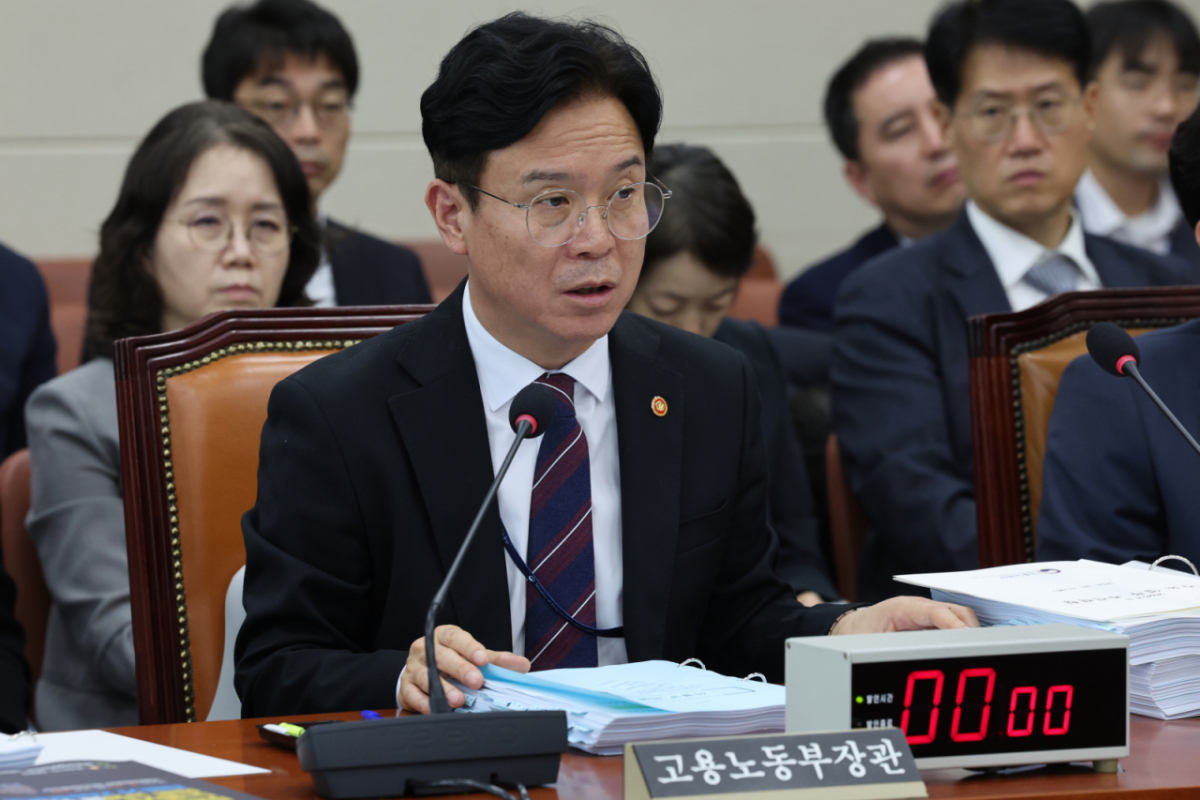
Employment and Labor Minister Kim Young-hoon said that there are "many aspects to be carefully reviewed" regarding the application of exceptions to the 52nd-hour weekly working hours limit.
He emphasized that legislative amendments banning the comprehensive wage system and extending the mandatory retirement age should be processed within the year. He also announced that the government will soon present a proposal for extending the mandatory retirement age.
Kim said that his position on major employment and labor issues in response to questions from lawmakers during the National Audit of the Ministry of Employment and Labor held at the Climate, Energy, Environment and Labor Committee of the National Assembly on Tuesday.
Lee Chul-gyu, a lawmaker from the People Power Party, emphasized the need to flexibilize working hours currently limited to 52 hours per week in order to strengthen industrial competitiveness, and asked for the minister's position on this matter.
When Rep. Lee said Minister Kim had opposed applying an exemption from the 52-hour workweek limit to research and development (R&D) workers during deliberations on the special act for the semiconductor industry, Kim replied, "At the time, I was working in the field, not serving as a minister." He added that he had held a negative view of the exemption.
When Minister Kim expressed a somewhat cautious stance on the issue, Rep. Lee questioned the shift, saying, "What prompted the minister, who had consistently opposed exceptions to the 52-hour workweek, to suddenly change his position?" Lee added, "This inevitably raises suspicions that his opposition to exceptions was not really about protecting workers' rights and interests, but was driven by something else."
Regarding the ongoing social dialogue among labor, management, and government on whether to apply exceptions to the 52nd-hour workweek within mega special zones, Lee criticized it as the government passing the buck.
In response, Kim stated, "For the success of mega special zones, corporate productivity and the protection of workers' right to health must be harmonized," adding, "The government will not cowardly pass the responsibility to the parties involved, but will responsibly coordinate alternatives well to derive good results."
In his opening remarks on this day as well, Kim emphasized, "(During the social dialogue process) we will not predetermine the outcome, but the government will serve as a facilitator of dialogue so that results can be created through conversation."
In response to questions from Kim Wi-sang, a lawmaker from the People Power Party, regarding the extension of the mandatory retirement age, he stated, "The bill must definitely be processed within the year."
When Kim pointed out, "By January next year, hundreds of thousands of retirees will be pushed into an income cliff, yet the government has not been able to present a single line of a specific bill so far," Kim responded, "The ruling party's TF (Task Force) has long discussed and matured the issue," adding, "If the government determines that discussions have matured to some extent and only a decision remains, it will promptly disclose its proposal without further delay."
Currently, in the National Assembly, centered on the Democratic Party of Korea as the ruling party, discussions are underway regarding extending the statutory mandatory retirement age from the current 60 years old to 65.
Options under discussion include extending the age to 65 all at once and extending it gradually in line with raising the initial receipt age for national pension benefits. On the other hand, there are also arguments that working periods should be extended through re-employment after retirement rather than extending the statutory mandatory retirement age.
Regarding the comprehensive wage system, which causes "free labor," he stated, "The bill to ban it must definitely pass in this second half of the year." Kim emphasized, "Long working hours are intertwined with a low-wage system, and one of the likely mechanisms connecting the low-wage system and long working hours is the comprehensive wage issue that causes free overtime work," adding, "It must be eradicated."
When Seo Wang-jin, a lawmaker from the Rebuilding Korea Party, pointed out that special extended labor allowing up to 64 hours per week (52 hours + 12 hours of excess) is being abused, leading to long working hours and resulting occupational disease accidents, Kim (Minister) responded, "We will review improvements."
Kim said, "Although our country's statutory working hours are 40 hours per week, the reason they fall below the OECD average is that there are too many exceptions for special extended labor," adding, "Even if special extended labor is unavoidable, we will thoroughly prepare post-hoc measures."

 in ECONOMY
