

Next year’s pilot program budget for rural basic income will increase to approximately 1.1658 trillion won, about four times this year’s amount. The number of eligible counties will expand to over 35, more than double the current coverage.
A new Agricultural Development Fund will be established by integrating three existing funds, and the public interest direct payment budget will exceed 3 trillion won for the first time. For the Rural-Urban Mutual Cooperation Fund, which had faced controversy over its effectiveness, a government contribution of 200 billion won will be included for the first time.
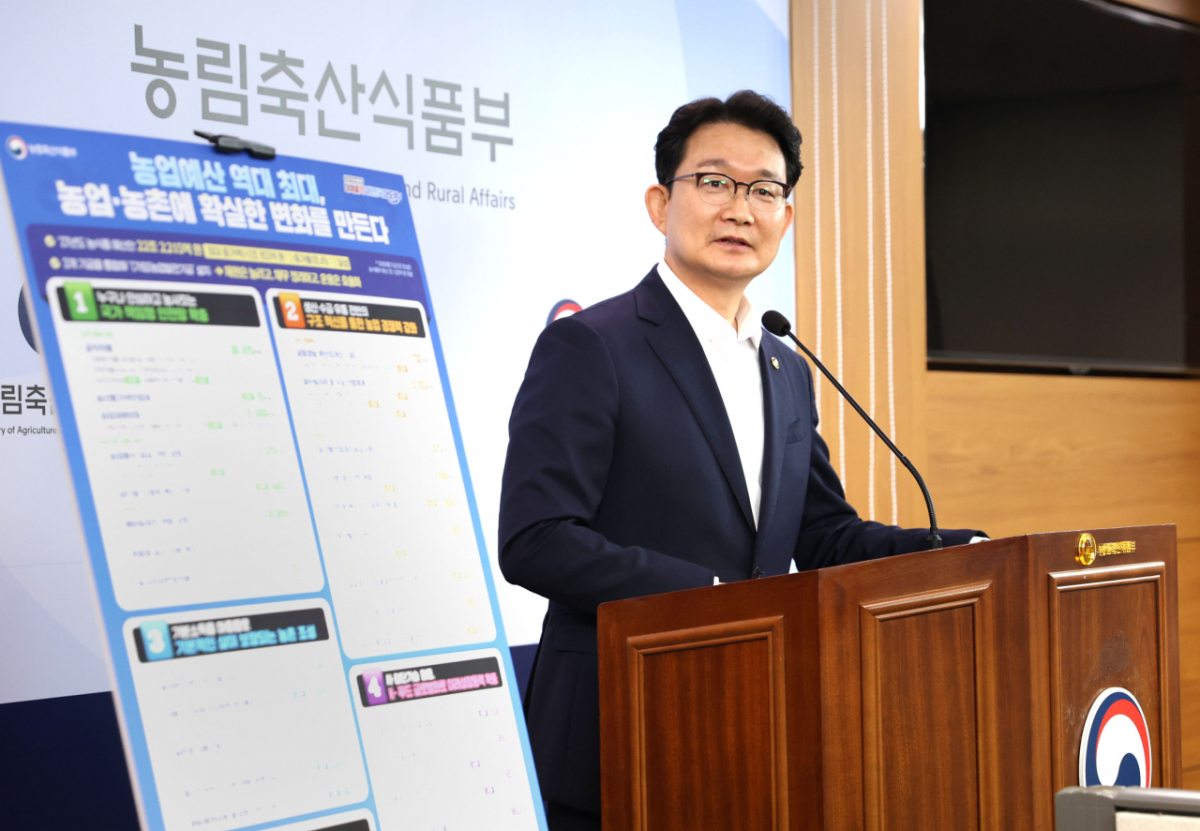
The Ministry of Agriculture, Food and Rural Affairs announced on the 1st that next year’s budget has been finalized at 22.2215 trillion won in the State Council meeting. This represents an increase of 2.853 trillion won (10.4%) compared to this year.
Following increases from 18.3392 trillion won two years ago, 18.7416 trillion won last year, and 20.1362 trillion won this year, the ministry’s budget will exceed 22.8 billion won for the first time next year.
Next year’s budget growth rate of 10.4% is the highest since 2000, surpassing the 9.4% recorded in 2002. The increase amount of 2.853 trillion won also exceeds this year’s increase of 1.3946 trillion won, marking the largest growth over the same period.
The significantly increased budget will be allocated to key agricultural policies. The rural basic income pilot program is a prime example. The budget will expand from 304.7 billion won (including this year’s supplementary budget) to 1.1658 trillion won next year, an increase of 3.8 times.
Eligible areas will be expanded from 17 counties this year to 35 counties next year, covering about half of the 69th counties designated as population-declining regions. To reduce the fiscal burden on local governments, the national subsidy ratio will also increase from 40% to 50%.
The public interest direct payment budget will rise from 2.9703 trillion won this year to 3.615 billion won next year, surpassing 3 trillion won for the first time. The strategic crop direct payment budget will also increase from 419.6 billion won to 456.8 billion won.
The agricultural product price stabilization system will be introduced for the first time. A new budget of 9.1 billion won has been allocated. If the average market price of major agricultural products falls below a reference price, the full or partial difference will be compensated. This measure aims to respond to sharp declines in agricultural product prices due to climate change.
The agricultural disaster insurance budget will expand from 776.9 billion won this year to 831.3 billion won next year. A new “quasi-insurance” program, which supports crops that are difficult to insure under existing systems through methods similar to insurance, will be introduced with a budget of 7.7 billion won. The agricultural safety disaster insurance coverage level will be raised to match the industrial accident insurance standard, and its budget will increase from 95.6 billion won to 122.8 billion won.
A government contribution of 200 billion won has been included in the Rural-Urban Mutual Cooperation Fund for the first time. This marks the first injection of public funds into a fund previously established primarily through voluntary contributions from the private sector.
Efforts to accelerate agricultural structural reform will also intensify. Support for facilities and equipment of joint farming corporations will expand from 6 cumulative cases this year to 36 next year, with the related budget increasing from 2.6 billion won to 22.8 billion won. A new low-interest loan program totaling 50.4 billion won will be introduced to provide operating capital for joint farming corporations.
A special purpose corporation (SPC) jointly funded by the public and private sectors will be established to build agricultural product smart fulfillment centers, with a new investment of 5.5 billion won. Expanding smart agricultural product distribution centers (APCs) equipped with robots and artificial intelligence (AI) to 155 locations will require an investment of 27.8 billion won.
An investment of 20.8 billion won will be allocated for the on-site demonstration and expansion of physical AI in the food and agriculture sector. Additionally, 44.1 billion won will be newly invested to develop three smart livestock complexes that consolidate and scale up aging livestock facilities.
The budget for K-food exports, which are currently performing well, will also increase. The export voucher budget will rise from 720 billion won this year to 880 billion won next year, and the number of “Next K-Food” growth targets will expand from 100 to 200. A new fund called “K-Ingredient Overseas Expansion Support Fund,” totaling 136 billion won, will be introduced to connect the use of domestic ingredients in Korean restaurants abroad to agricultural and food product exports.
Regarding food support, the number of recipients for the food voucher program will expand from 161,000 households to 180,000 households. The monthly support amount per household will increase from 40,000 won to 50,000 won based on single-person households. The national subsidy rate for college students’ “1,000 Won Breakfast” program will also rise from 2,000 won to 3,000 won per meal.
The fiscal structure of the agricultural sector will also be reorganized. The Ministry of Agriculture, Food and Rural Affairs plans to enact relevant legislation within the year to establish a provisional “Agricultural Development Fund” that integrates three existing funds: land management, agricultural product price stabilization, and FTA-related funds. By providing a legal basis to additionally utilize sources such as the rural special tax from existing fund resources, available funding will be expanded.
Separately, accumulated debts of 3.1 trillion won across four funds—land management, agricultural product price stabilization, FTA, and livestock development—will be repaid next year. Including debt repayment, next year’s Ministry of Agriculture, Food and Rural Affairs budget will reach 25.3081 trillion won, a 25.7% increase from this year.
Song Mi-ryeong, Minister of the Ministry of Agriculture, Food and Rural Affairs, stated, “With increased revenue from the rural special tax, we will faithfully invest fiscal resources to address challenges facing agriculture and rural areas and prepare for the future.” She added, “During the National Assembly deliberation process, we will secure and supplement as much budget as possible for agriculture and rural areas to ensure tangible changes felt on the ground.”

 in ECONOMY
