

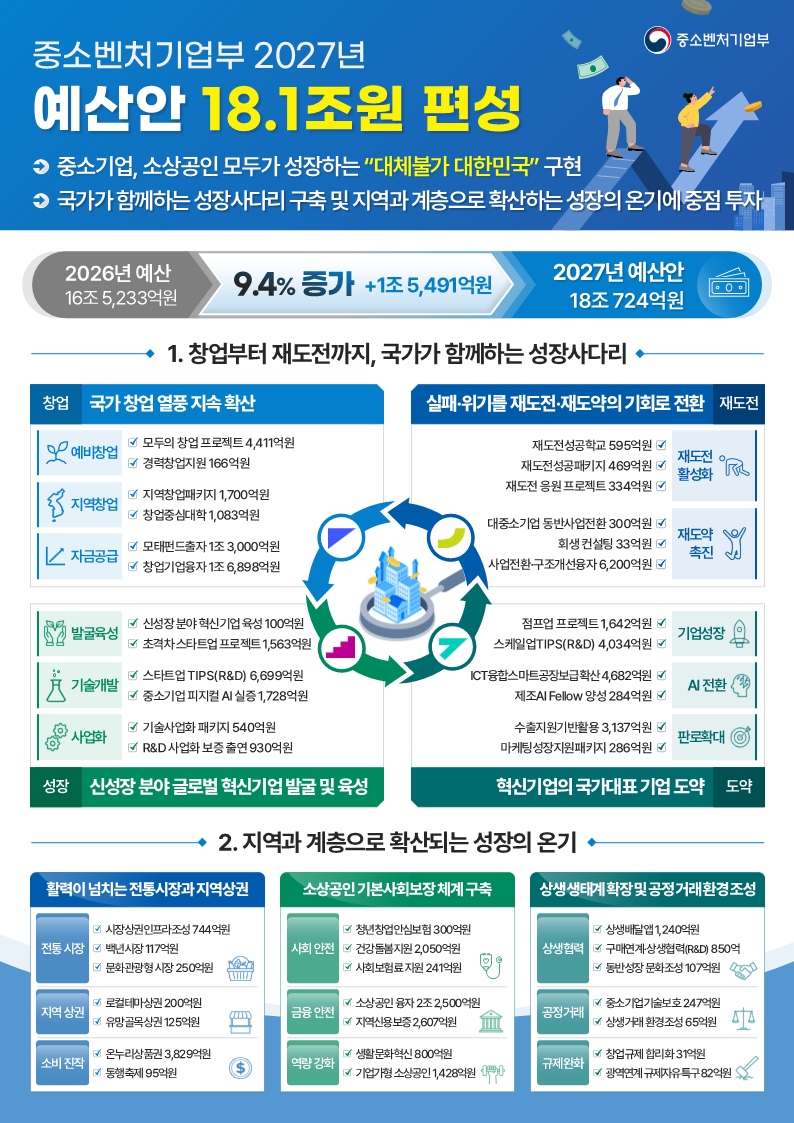
The Ministry of SMEs and Startups has allocated 18.724 trillion won in its budget proposal for next year, marking the largest amount ever. Through this, the ministry plans to launch focused investments aimed at fostering growth, including elevating small and medium-sized enterprises (SMEs) into mid-sized companies.
The Ministry of SMEs and Startups announced on the 1st that it has set the 2028 budget proposal at 18.724 trillion won, an increase of 1.5491 trillion won (a 9.4% rise) compared to the 2027 regular budget of 16.5233 trillion won, and plans to submit it to the National Assembly on the 3rd.
The Ministry of SMEs and Startups will pursue comprehensive reinvestment in key projects aimed at realizing a "Republic of Korea that cannot be replaced," where everyone grows, by eliminating conventional support programs that distribute small amounts indiscriminately and expanding the introduction of secondary guarantees for loan programs to secure funding sources.
First, the ministry plans to nurture innovative companies as national representative enterprises. To this end, it has allocated 164.2 billion won to the Jump-Up Program, which fosters promising companies with growth potential into mid-sized companies, aiming to enhance and expand support according to each stage of corporate growth. Additionally, a new project worth 54.3 billion won has been established to promote the growth of promising SMEs within the growth engine value chain, based on collaboration between regional core industries and across regions.
Furthermore, 468.2 billion won has been allocated to expand the dissemination of AI-centered smart factories, including the establishment of leading models for large-SME coexistence-type AX (artificial intelligence transformation) and manufacturing-AI-specialized smart factories. To strengthen support for SME manufacturing sites in terms of AX, a new project worth 28.4 billion won has been launched to train specialized personnel in manufacturing AI through collaboration with four major science institutes, including KAIST.
The existing uniform export voucher support system will be restructured into an Export Foundation Voucher to remove barriers to market entry and an Export Growth Package for customized support according to growth stages. The budget for this initiative has been expanded more than twofold to 313.7 billion won.
Budgets for overseas expansion have also been increased, including 23.8 billion won for large-SME joint advancement projects and 27.9 billion won for responding to overseas export regulations.
To expand domestic sales channels, a new Marketing Growth Support Package worth 28.6 billion won has been established, moving away from the previous practice of distributing small amounts indiscriminately and instead providing customized support through consulting services tailored to each company.
SME policy funds will be restructured around user needs, simplifying the previously complex program structure into four categories: startup enterprises, growth enterprises, re-challenge support, and business stability. A total of 4.4 trillion won in loans has been allocated: 1.6898 trillion won for startup enterprise support, 1.4898 trillion won for growth enterprise support, and 840 billion won for re-challenge and leapfrog support. Additionally, secondary guarantees will be provided for private loans totaling 1 trillion won, aiming to deliver a total financial support package of 5.4 trillion won.
In particular, the ministry will focus its investment on supporting the transformation of failure and crisis into opportunities for re-challenge and re-leapfrogging.
For entrepreneurs seeking to restart after failure, a Re-Challenge Success School worth 59.5 billion won has been newly established to provide concentrated support including analysis of failure causes, psychological counseling, and childcare services. A Re-Challenge Encouragement Project worth 33.4 billion won will also be launched to select and intensively support companies with successful re-challenge cases. Additionally, the Re-Challenge Success Package budget has been expanded to 46.9 billion won.
An AI-based crisis monitoring system will be built for 250,000 SMEs, and a new project worth 30 billion won has been allocated to support large-SME joint business transformation projects, enabling systematic structural improvements and business transitions for crisis-hit SMEs.
Furthermore, the plan is to revitalize local commercial districts through support for traditional markets and small business owners.
To proactively prepare for climate crises such as unprecedented heatwaves, 56.2 billion won has been allocated to the Traditional Market Safety Management Package project, which expands support for safety facilities within traditional markets. Additionally, 42.7 billion won has been set aside for a traditional market development project that supports Hallyu consumption in traditional markets by designating them as tourism hubs and linking them with cultural and tourism initiatives.
A budget of 20 billion won has been allocated to develop local theme commercial districts, fostering areas where consumers can enjoy local gastronomy, cultural heritage, and experiential activities through content development. Additionally, 7.2 billion won has been set aside to cultivate global commercial districts where domestic and international visitors can consume K-culture by integrating local tourism and cultural resources. This reflects a three-dimensional regional commercial district policy encompassing points (startups), lines (commercial districts), and areas (expansion).
In particular, a customized policy insurance has been newly established to ensure that young small business owners with startups less than five years old can recover even if they face management crises such as suspension or closure. A budget of 30 billion won has been allocated for this initiative. Additionally, the Hope Return Package, which supports stable closures and rapid recovery for small business owners, has received a new allocation of 315.3 billion won, strengthening the support system for recovery before and after closure.
To enable small business owners who struggled to care for their health due to livelihood burdens to undergo health checkups, a new project has been established to subsidize suspension costs and labor expenses for substitute personnel associated with participation in national health screenings. A budget of 20.5 billion won has been allocated for this purpose.
To promote the inclusion of small business owners in social security systems, a new allocation of 4.2 billion won has been made for the SME employer workers' compensation insurance premium support project, and 19.9 billion won has been allocated to support employment insurance premiums for self-employed individuals.
Furthermore, SME loan programs will be comprehensively restructured to focus on supporting small business owners who face difficulties in securing funding. The existing general business stability fund of 1.22 trillion won will be converted into a secondary guarantee support project for loans totaling 2 trillion won. This includes growth promotion funds of 700 billion won, business stability funds of 1.3 trillion won, and crisis response funds of 250 billion won, aiming to deliver a total financial support package of 4.25 trillion won.
To alleviate the financial burden on local small business owners with insufficient collateral, support for the financial safety net will be strengthened, including allocating 260.7 billion won for the regional credit guarantee foundation re-guarantee budget.
In addition, to mitigate monopolistic practices by private delivery platforms and reduce the burden on small business owners, 124 billion won has been allocated to support the development of a public delivery app that encourages consumers, participating businesses, and riders to use it as their preferred platform.
No-yong-seok, First Vice Minister of the Ministry of SMEs and Startups, stated, "The 2028 budget proposal was formulated by re-examining the Ministry's support programs from scratch, implementing bold expenditure restructuring, and focusing on directions that enable small and medium-sized venture companies and small business owners to achieve genuine growth." He added, "The Ministry of SMEs and Startups will dedicate all its capabilities to realizing a 'Republic of Korea that cannot be replaced,' where everyone grows, through the expansion of the SME-venture growth ladder and the spread of warmth in growth."

 in ECONOMY
