

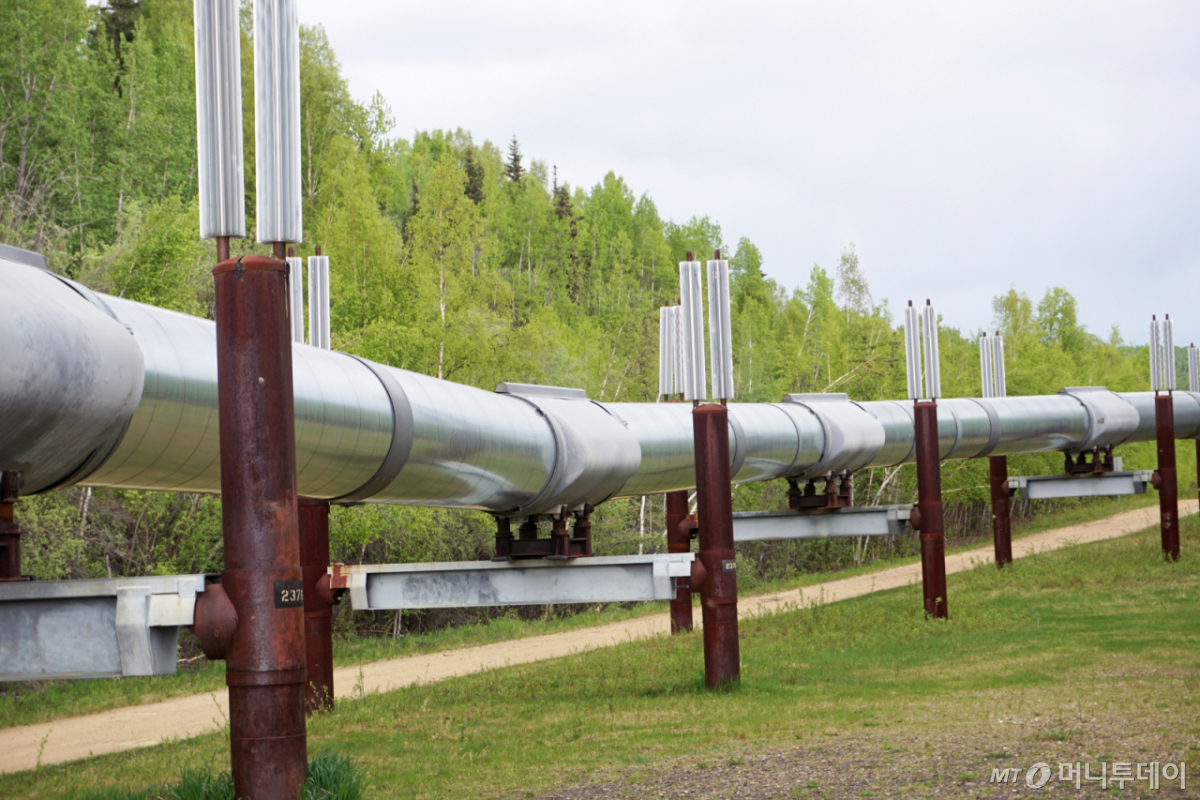
A $44 billion, 1,300-kilometer gas pipeline project that will transport natural gas from northern Alaska to the south for liquefaction and export to Asia has finally landed on the South Korea-U.S. investment negotiation table. President Trump has repeatedly called for South Korean participation since taking office, and with "Alaska LNG" now included as a U.S. investment agenda item by the government, formal investment discussions have begun in earnest.
According to political circles and the government on the 7th, the content of the U.S. investment negotiations was discussed during a closed-door meeting between the administration and the National Assembly today, ahead of a report to the National Assembly. It has been confirmed that the Alaska LNG project is also included in the scope of U.S. investment discussions. Under the Special Act on U.S. Investment Negotiations, the government must report negotiation results and key contents to the National Assembly before concluding any agreements.
The Alaska LNG project involves transporting natural gas from Alaska's North Slope region via a 1,300-kilometer pipeline to near Nikiski in southern Alaska, where it will be liquefied for export. The project is valued at approximately $44 billion and is led by GlenFarms, a U.S. energy infrastructure development company. It aims to produce and export up to 20 million tons of LNG annually.
The connection between Alaska LNG and South Korean investment in the United States began last year. In his March 2025 address to Congress, President Trump mentioned that countries including South Korea and Japan could make large-scale investments in the Alaska LNG project.
Project viability remains a concern. Minister of Trade, Industry and Energy Kim Jeong-kwan evaluated Alaska LNG as a "high-risk project" during a November session of the National Assembly last year, stating that it was difficult to include under current criteria for U.S. investment targets. However, he explained that domestic companies or the government could show interest in purchasing LNG once the project progresses.
Meanwhile, South Korean corporate activities have become more concrete. In September last year, POSCO International signed a preliminary agreement with GlenFarms to receive 1 million tons of LNG annually for 20 years and agreed to supply steel materials for the 1,300-kilometer pipeline. In December of the same year, it also signed a Strategic Partnership Basic Agreement (HOA) with the Alaska Gasline Development Corporation (AGDC), under the Alaska state government, and GlenFarms. The agreement covers cooperation on LNG procurement and supply of steel for gas pipeline construction.
The project timeline has also been outlined. GlenFarms plans to make a final investment decision (FID) for the pipeline section in 2026 and for the export terminal in early 2027, with LNG exports set to begin in 2031. However, since FIDs have not yet been finalized, the schedule may change.
President Trump's calls for South Korean participation continued. On the 2nd (local time), he mentioned at the White House that countries including South Korea and Japan would participate in projects involving fuel and oil supply from Alaska and construction of energy infrastructure such as gas pipelines.
Discussions on Alaska LNG, initially sparked by U.S. calls for participation, have moved through debates over project viability to cooperation with South Korean companies, and ultimately reached the government's U.S. investment negotiation table. A project that the government deemed difficult to include as a U.S. investment target in November last year has now become a subject of actual investment discussions within 10 months.
While questions remain regarding the viability of Alaska LNG investments from a business perspective, analysts suggest that the government may have made some concessions to achieve a broader agreement on U.S. investments including nuclear power plants.
South Korea has agreed to $350 billion in U.S. investments during trade negotiations with the United States. Following the confirmation of the Texas Ensynal gas combined-cycle power project as the first U.S. investment initiative by the government, and now with Alaska LNG included in the discussion scope, the range of U.S. investments has expanded to include energy and infrastructure sectors.
Future details on investment scale, methods, funding sources, and the roles of the South Korean government and companies are expected to be determined through additional negotiations.

 in ECONOMY
