

If the government's projections hold, this year and next will witness an unprecedented "bumper tax harvest."
In particular, the variance between this year's initial budget and the projected figures is expected to record the highest level since the Korean War. This means that significantly more taxes are anticipated to be collected than the government initially estimated. The phenomenon is driven by the super-boom in the semiconductor industry.
Forecasts indicating higher tax collection this year emerged early on, as operating profits for Samsung Electronics and SK Hynix surged in line with the semiconductor "super-cycle." When corporate operating profits increase, corporate income tax revenue also rises.
However, in the past, corporate performance was not immediately reflected in that year's corporate income tax. This is because corporate income tax is typically paid based on the previous year's results.
The system changed starting last year. The government mandated interim prepayment settlements for corporate income tax for business groups with assets of 5 trillion won or more, subject to public disclosure, beginning last year. Under this system, companies prepay corporate income tax in the current year based on their first-half performance. Major semiconductor companies fell under this category.
Samsung Electronics and SK Hynix recorded operating profits of 146.7 trillion won and 98.1 trillion won, respectively, in the first half of this year. The combined operating profit for both companies last year was 91 trillion won. In just the first half of this year, they earned 2.7 times their total operating profit from all of last year.
The corporate income tax paid by these two companies increased substantially. As interim prepayments were made, the government revised its tax revenue outlook, resulting in a variance in tax collection.
To understand the tax revenue variance, one must examine the budget formulation process. The government submits next year's budget proposal to the National Assembly in early September each year. Budgets are divided into revenue and expenditure; revenue budgets must be formulated based on forecasts.
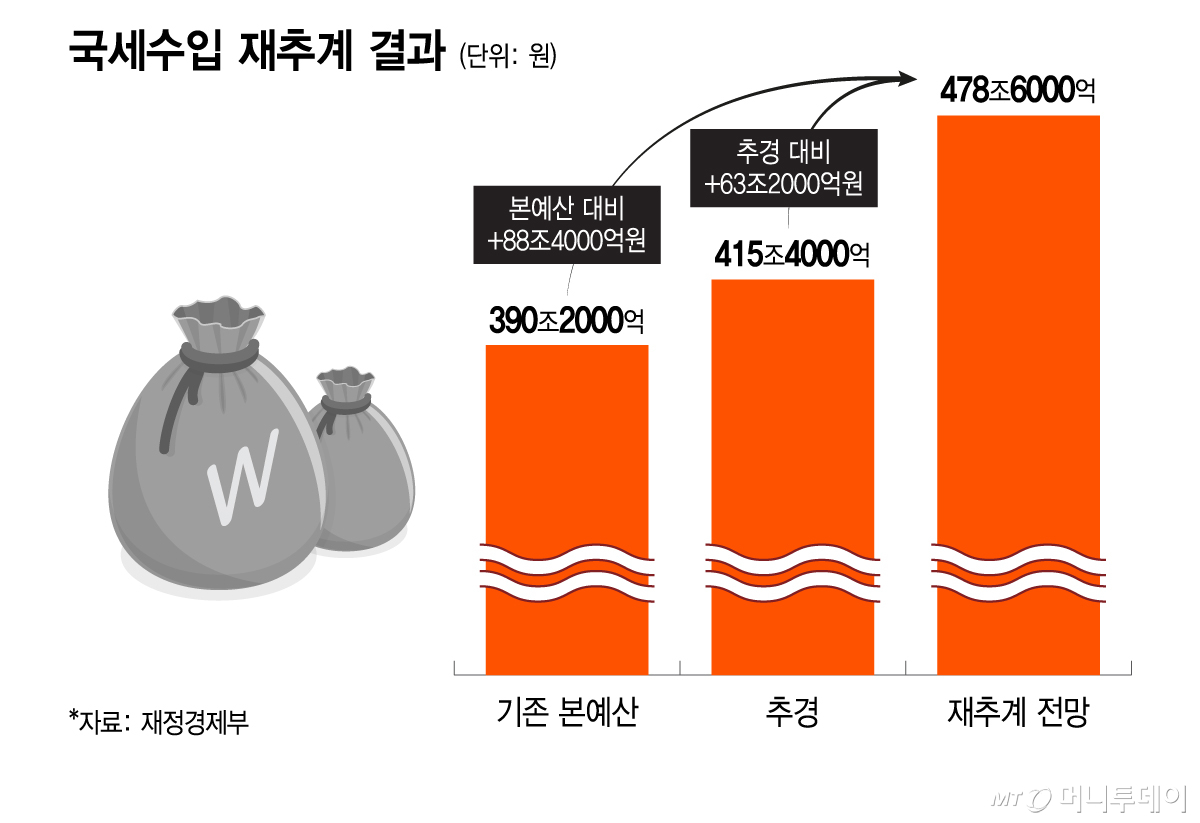
The government set this year's initial budget revenue at 390.2 trillion won, a level slightly exceeding last year's actual figure (373.9 trillion won). However, as the semiconductor boom became apparent, it was projected that more taxes would be collected.
Accordingly, when formulating the supplementary budget proposal at the end of March, the government raised this year's national tax revenue forecast to 415.4 trillion won. The excess tax revenue identified at that time was 25.2 trillion won. Excess tax revenue refers to the amount expected to exceed the budgeted figures.
As the first half of this year passed, revenue conditions improved further. With the start of corporate income tax interim prepayments in August, projections became reality. Consequently, the government has now raised this year's national tax revenue forecast to 478.6 trillion won, an increase of 63.2 trillion won (excess tax revenue) compared to the supplementary budget.
By tax category, corporate income tax is projected to increase by 35 trillion won and income tax by 15.6 trillion won compared to the supplementary budget revenue. Income tax collection is expected to rise due to increased performance bonuses at major companies and expanded housing transactions. Corporate income tax and income tax are driving the excess tax revenue.
The variance in national tax revenue compared to the supplementary budget is 15.2%. This is the fifth-highest level since 1950 (21.5%), 1988 (17.6%), 2000 (16.6%), and 1989 (15.3%). The variance compared to the initial budget reaches 22.7%, a level higher than that of 1950, when the Korean War took place.
If government projections are accurate, this year's national tax revenue will increase by 104.7 trillion won compared to last year's actual figure (373.9 trillion won). Next year's revenue budget is set at 584.4 trillion won, an increase of 105.8 trillion won from this year. This creates a structure where national tax revenue increases by over 100 trillion won each in this year and next year.
Kim Byung-cheol, Director-General for Tax Policy at the Ministry of Economy and Finance, stated, "This is the result of making every effort using all available information," adding, "This year, we plan to re-estimate national tax revenue in accordance with the National Fiscal Act and submit it to the National Assembly."

 in ECONOMY
