

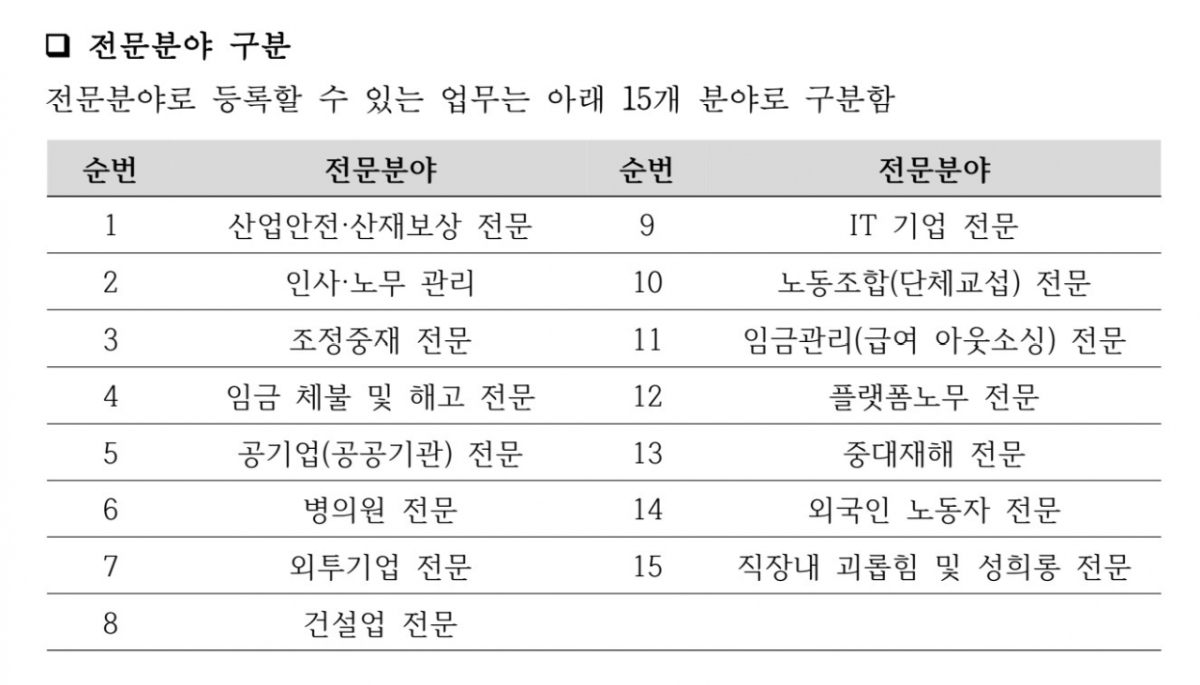
As the Labor Consultants Association moves to introduce a certification system for certified labor consultants, a key challenge has emerged: how to align the difficulty of certification requirements and the characteristics of work across different fields. Critics point out that since the complexity and time investment vary by specialized field, setting criteria based solely on the number of cases handled may fail to adequately reflect actual differences in expertise.
The current draft proposal presents distinct performance standards for 15 fields, including industrial safety and workers' compensation, human resources and labor management, labor unions and collective bargaining, and wage management and payroll outsourcing. Representative examples include 50 cases for workers' compensation, 10 for collective bargaining, and 30 for wage management and four major insurance outsourcing.
Practicing labor consultants point out that even a single case can vary significantly in terms of complexity, time investment, and fee. They argue that counting both multi-month consulting projects for large corporations and relatively short-term small-scale consulting as one case each makes it difficult to reflect actual differences in work experience.
One labor consultant stated, "Cases differ greatly in fees per case and time invested; judging expertise based solely on the number of cases handled has limitations." They added, "We need to re-evaluate what level of experience is required for each field."
There are also calls to further specify the standard for what constitutes 'one case.' Depending on whether one-time advisory opinions are treated the same as multi-year regular corporate consultations, and how differences in company size, contract duration, and fees are reflected, certification outcomes could vary.
The appropriateness of tasks included in specialized fields is also under review. Critics note that since activities like lectures are included in the human resources and labor management field, mixing tasks that actually assess expertise with generally performed duties requires more precise standards to determine how much professional recognition should be granted per field.
Another labor consultant remarked, "To certify a specialized field, it is crucial to examine how deeply one has worked in that area; relying solely on the number of cases handled may result in merely meeting formal requirements." They emphasized, "Standards reflecting the characteristics of work in each specialized field are necessary."
Ensuring the objectivity of performance verification is also a challenge. While lawyers' specialized certifications can be verified through public records such as court rulings, labor consultants' advisory and consulting services often rely on private contracts, making it highly likely that they will depend on contracts or work completion certificates.
The Labor Consultants Association requires applicants for specialized field registration to submit lists of handled cases and supporting documents, with provisions to cancel registration if false documentation is discovered. However, opinions suggest that penalizing falsification after the fact is a separate issue from objectively verifying the content, duration, and scale of submitted performance records.
One labor consultant stated, "As this is an official certification system for 'Certified Labor Consultants,' it must be possible to verify not just how many cases were handled, but also the level at which specific tasks were performed." They added, "For the system to truly demonstrate expertise, standards and review methods for each field need thorough refinement."


 in ECONOMY

