

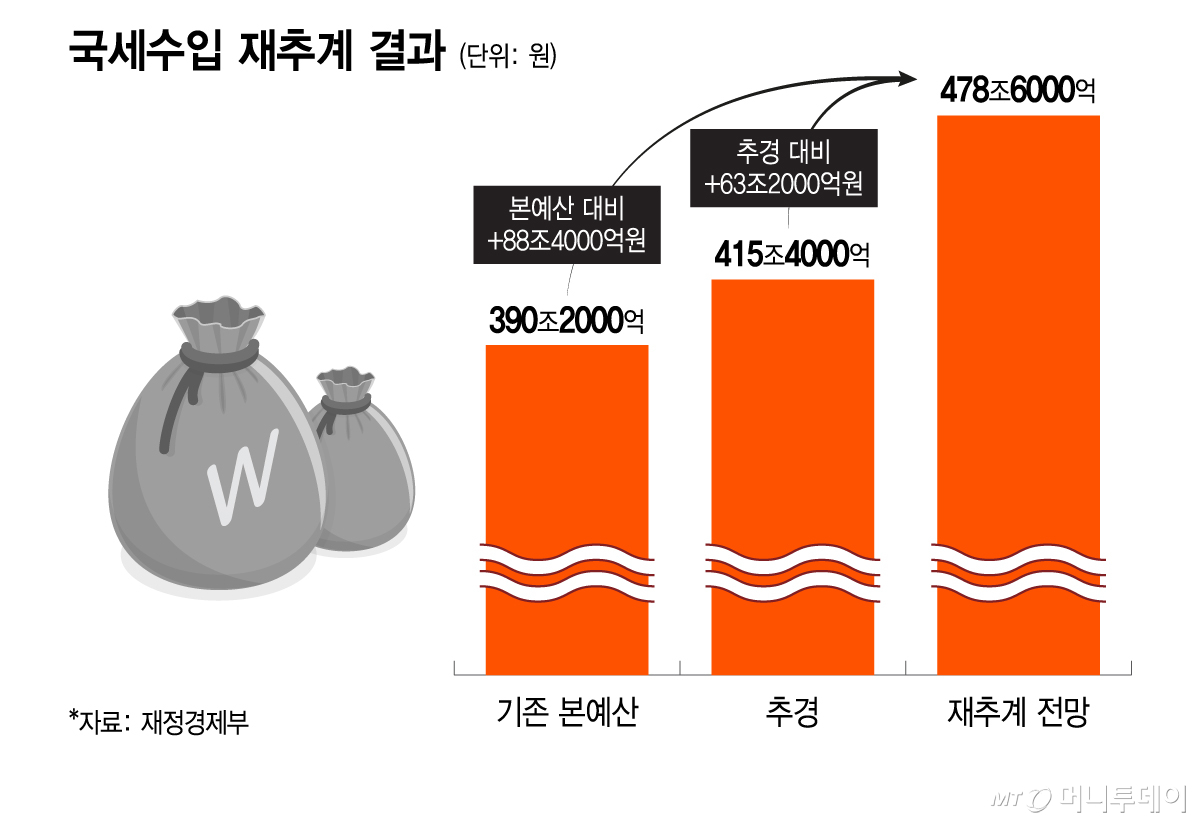
The government announced that the scale of this year’s surplus tax revenue, recalculated to reflect factors such as the semiconductor super cycle (super boom), has reached 63.2 trillion won. Considering the already expanded revenue budget (+25.2 trillion won) when the supplementary budget was formulated, it appears that 88.4 trillion won more in taxes will be collected than initially expected.
The government plans to allocate a portion of the surplus tax revenue to the Future Response Fund, with the exact allocation amount to be finalized after consultation with relevant ministries. Some forecasts suggest that if the surplus tax revenue is reflected in the 162.3 trillion won already included in next year’s budget, the size of the Future Response Fund could reach around 200 trillion won.
The government stated at the Tax Revenue Estimation Committee held on the 30th that, as a result of re-estimating tax revenue, this year’s national taxes are expected to amount to 478.6 trillion won, which is 63.2 trillion won more than the supplementary budget (415.4 trillion won) passed by the National Assembly in April last month.
Compared to the initial budget (390.2 trillion won), this represents an increase of 104.7 trillion won.
The tax revenue error rate is 15.2% based on the supplementary budget, making it the fifth largest error rate in history based on final budgets. The record for the highest historical tax revenue error rate was 21.5% in 1950 during the Korean War. However, the error rate based on this year’s initial budget is 22.7%.
Initially, the Ministry of Economy and Finance projected that 390.2 trillion won in national taxes would be collected this year. This was the forecast made when formulating this year’s budget last August.
However, the situation changed dramatically since the beginning of this year due to an unexpected semiconductor super boom. Accordingly, when formulating the supplementary budget in March last month, the government predicted that an additional 25.2 trillion won in taxes would be collected. The subsequent more dramatic boom in the semiconductor market was additionally reflected in this re-estimation.
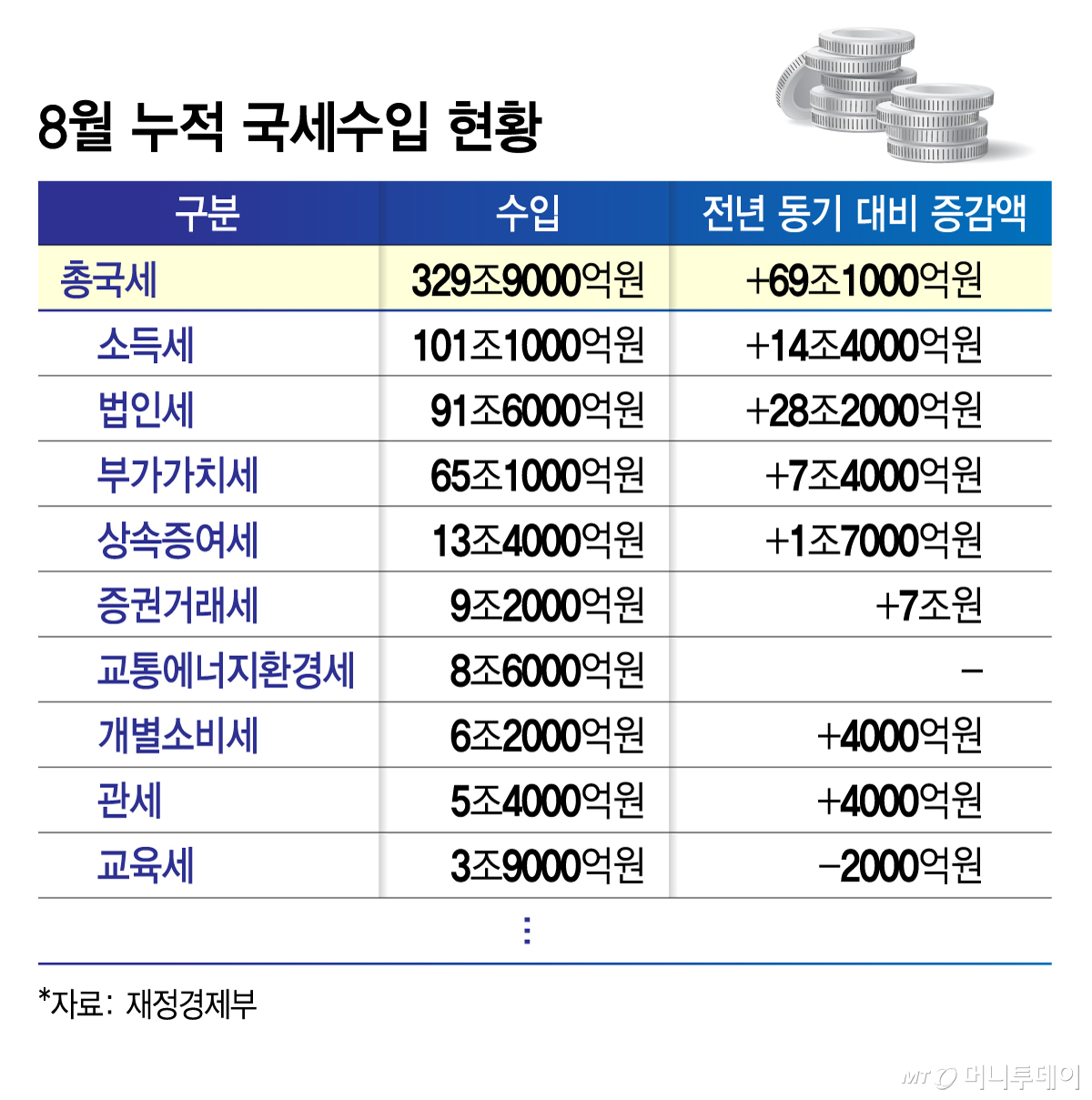
Specifically, the government estimated that corporate tax revenue would increase by 35 trillion won compared to the supplementary budget. Income tax revenue is also predicted to rise by 15.6 trillion won. This is interpreted as being due to the impact of the semiconductor boom.
In fact, the combined operating profit of Samsung Electronics and SK Hynix in the first half reached 244.9 trillion won. Actual performance increased by nearly 100 trillion won compared to the market forecast of 146.6 trillion won at the time of the supplementary budget formulation. Consequently, the interim corporate tax prepayment for the first-half performance increased significantly. Additionally, the strong performance of the two companies led to an increase in income tax due to rising wage growth rates, such as increased performance bonuses.
The stock market boom, centered on semiconductor stocks, also boosted tax revenue. The surplus tax revenue compared to the supplementary budget for securities transaction tax and agricultural special tax is 1.9 trillion won and 6.7 trillion won, respectively. Agricultural special tax is levied in conjunction with various taxes, including the KOSPI securities transaction tax.
The utilization plan for the surplus tax revenue remains undetermined. Fundamentally, the use of surplus tax revenue is stipulated in the National Fiscal Act. First, it must be used to repay national bonds, and the remaining national surplus funds must be transferred to local allocation taxes and local education finance allocations. Subsequently, at least 30% of the remaining resources must be contributed to the Public Fund Repayment Fund, and at least 30% of the money left after that must be used for repaying principal and interest on national bonds, government borrowings, and state compensation payments. Any funds remaining after completing all these procedures can be utilized as a source for the supplementary budget or deferred to next year’s revenue.
However, this year has introduced a new variable: the Future Response Fund. The government has proposed surplus tax revenue as one of the funding sources for the Future Response Fund. If the entire surplus tax revenue is added to the 162.3 trillion won included in next year’s budget by the government, the size of the Future Response Fund will arithmetically exceed 200 trillion won.
Kim Byung-cheol, Director-General for Tax Policy at the Ministry of Economy and Finance, stated, "The law submitted to the National Assembly (Act on the Establishment and Operation of the Future Response Fund) includes a provision allowing surplus tax revenue to be transferred to the Future Response Fund," adding, "Consultations are ongoing among relevant ministries regarding how to utilize the surplus tax revenue."

 in ECONOMY

