

Production, consumption and investment all declined month-on-month last month, marking a "triple decline" for the first time in three months. This was due to the impact of reduced operating days as summer vacations were concentrated in August, leading to decreases in automobile production and sales, among other factors.
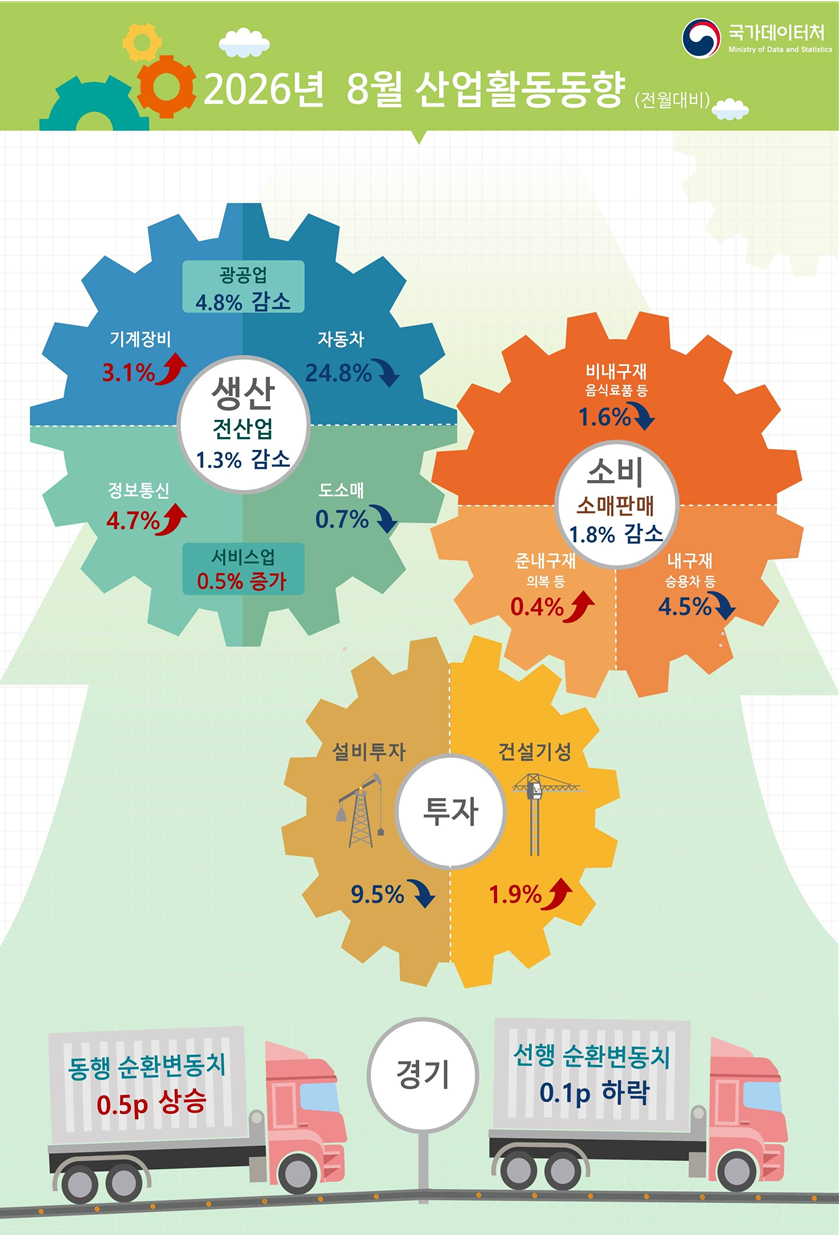
According to the "Industrial Activity Trends for August 2026" (preliminary) released by the National Data Agency on the 30th, total industrial production decreased by 1.3% month-on-month last August (the same standard applies hereinafter). It increased by 1.9% year-on-year. Retail sales and equipment investment decreased by 1.8% and 9.5%, respectively.
This marked a triple decline for the second time in three months, following May. The Data Agency analyzed that this is a temporary trend caused by reduced operating days, and that future trends should be monitored.
Manufacturing production decreased by 4.8%. While production increased in machinery and equipment (3.1%), it declined in automobiles (-24.8%) and rubber and plastic products (-11.0%). Specifically, the concentration of summer vacations in August reduced operating days, leading to a decrease in finished vehicle production. Due to the decline in finished vehicle production, transportation-related plastic products, tires and tubes, among others, also decreased.
Service industry production increased by 0.5%. While production declined in wholesale and retail (-0.7%), it increased in information and communications (4.7%) and professional, scientific and technical services (2.3%).
Retail sales, which represent goods consumption, decreased by 1.8%. While sales of quasi-durable goods such as clothing (0.4%) increased, sales of durable goods such as passenger cars (-4.5%) and non-durable goods such as food and beverages (-1.6%) declined. Passenger car sales also decreased as finished vehicle production fell. Consumption is divided into goods consumption and service consumption, but the Industrial Activity Trends report only covers goods consumption.
Equipment investment decreased by 9.5%. While investment increased in machinery such as semiconductor manufacturing equipment (1.6%), it declined in transportation equipment such as other transport equipment (-32.8%) due to reduced investment in ships and aircraft.
Construction output increased by 1.9%. While construction performance decreased in civil engineering (-3.9%), it increased in building construction (4.5%). This marked a return to growth one month after turning negative in July (-1.0%), as both non-residential and residential building construction increased.
The cyclical variation of the Coincident Composite Index, which indicates current economic conditions, rose by 0.5 points to 101.7. The cyclical variation of the Leading Composite Index, which predicts future economic trends, fell by 0.1 point to 104.2.

 in ECONOMY

