

The Korea Fair Trade Commission explains that, regarding recent record-breaking surcharge dispositions, the amounts were calculated based on clear legal grounds and consistent principles. In the case of the delivery app incident, the commission states that it exercised extreme caution by even holding an additional separate meeting during the process of calculating relevant revenue.
In fact, the "Monopoly Regulation and Fair Trade Act" clearly stipulates criteria for calculating surcharges related to △abuse of dominant market position, △cartels, △restrictions on cross-shareholdings, and △prohibited acts by business associations. It explicitly states that surcharges may be imposed considering factors such as the nature and degree of the violation, its duration and frequency, and the scale of unjust gains.
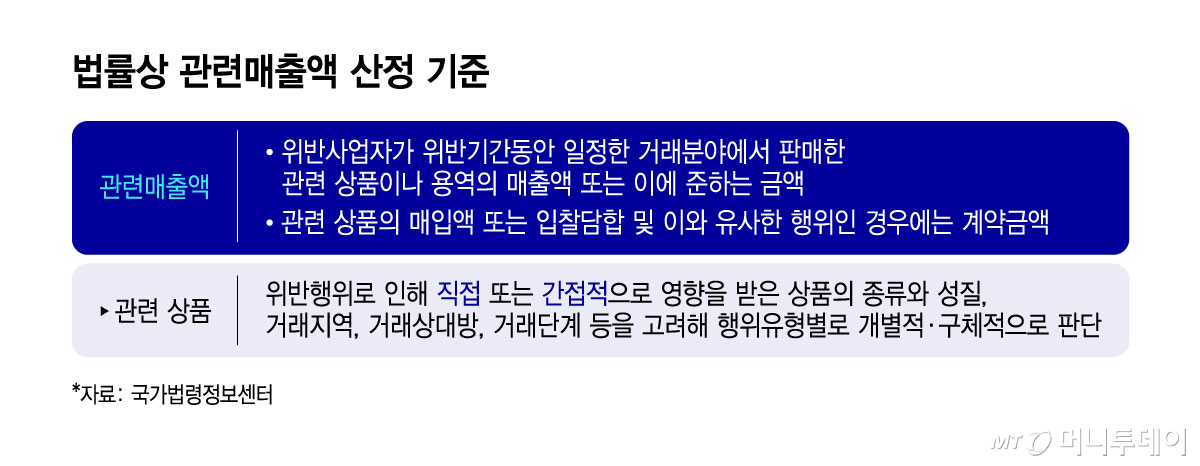
The core issue is the relevant revenue, which serves as the basis for imposing surcharges. According to the "Notice on Detailed Criteria for Imposing Surcharges, etc.," relevant revenue refers to the sales of related goods or services sold by a violating business in a specific transaction field during the period of violation. Here, "related goods" means goods directly or indirectly affected by the illegal act.
The commission explains that the significant increase in relevant revenue regarding the demand for most-favored-nation treatment from delivery apps is also in accordance with this legal provision.
Initially, the review team calculated relevant revenue focusing on companies that received direct contact from delivery platforms or had their transaction terms modified. However, during the deliberation process, it was determined that all stores within the implementation areas of "Wow Stores" (Coupang Eats) and "Baemin Club" were affected by the demand for most-favored-nation treatment. While the review team viewed the scope of related goods as those directly affected, the plenary session expanded this to include goods indirectly affected.
This judgment was based on the assessment that demands for most-favored-nation treatment were consistently made not only through phone calls and visits but also via POS systems and KakaoTalk notification messages. Additionally, providing temporary "Wow Store" or "Baemin Club" benefits to newly registered stores and then revoking them if the most-favored-nation conditions were not met was cited as a basis for calculating relevant revenue across all stores in the entire implementation areas of Wow Stores and Baemin Club.
In the government bond case, the Korea Fair Trade Commission did not accept the industry's request to calculate relevant revenue based on operating profits derived from the cartel. This is because current laws define the contract amount (winning bid amount) as the relevant revenue for bidding cartels. Instead, the commission partially accepted the respondent's argument that the entire relevant revenue calculated based on the winning bid amount does not constitute unjust gains from the cartel, and uniformly reduced the surcharge by 30%.
Professor Lee Hwang of Korea University Law School stated, "It is true that discretion in calculating relevant revenue has been granted to competition authorities by using abstract concepts like 'direct' and 'indirect.' However, since the content differs for each case, it is practically unavoidable that the Supreme Court's precedents acknowledge the Korea Fair Trade Commission's discretion."
However, concerns are being raised about the relevant revenue expanding and contracting like a rubber band during the plenary session process. This is because surcharges exceeding predictable ranges can lower companies' willingness to accept them.
In fact, in the plenary session for the delivery app case, the relevant revenue regarding the demand for most-favored-nation treatment was expanded to 5.0149 trillion won for Coupang Eats and 4.065 trillion won for Baemin, significantly exceeding market expectations. Initially, the relevant revenue presented by the Korea Fair Trade Commission through its review report (equivalent to an indictment) was 710 billion won and 730 billion won, respectively. In the case of Coupang Eats, the relevant revenue jumped by approximately seven times.
Consequently, arguments are emerging that controls over the Korea Fair Trade Commission's broad discretion should be strengthened to increase companies' acceptance of surcharges, and that transparency in the surcharge calculation process must be improved.
The EU (European Union) also uses a similar criterion to South Korea, basing relevant revenue on the sales of goods and services by companies directly or indirectly related to the illegal act. However, for competition law violations such as cartels or abuse of market dominance, surcharges can only be imposed up to a maximum of 10% of the total global revenue of the previous business year, including affiliates.
A former official from the Korea Fair Trade Commission explained, "The EU calculates surcharges based on the revenue earned by the company globally over one year, so the scale of the surcharge itself can be large. However, in South Korea, factors such as the duration of the violation are considered, creating a structure where the longer the violation period, the more indefinitely the relevant revenue increases."

 in ECONOMY
