

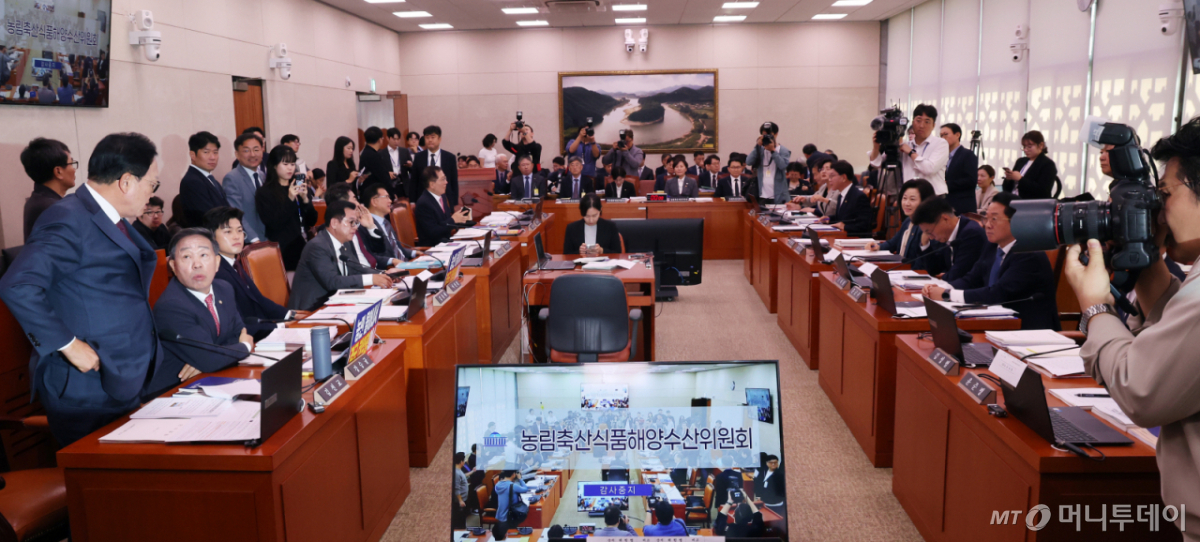
Issues regarding Nonghyup reform and the relocation of the Gwacheon Racecourse are expected to be major points of contention at the national audit of the Committee for Agriculture, Food and Rural Affairs of the National Assembly on the 16th.
For Nonghyup, inquiries are anticipated regarding its stance and response direction on matters such as the introduction of a direct election system for the central chairman and the establishment of an independent audit body. For the Korea Racing Authority, questions are expected to continue regarding the background behind the delay in the public solicitation for candidate sites for the racecourse relocation.
According to the National Assembly and other sources on the 15th, the Committee for Agriculture, Food and Rural Affairs will conduct a national audit of Nonghyup Central Association, Nonghyup Economic Holdings, Nonghyup Financial Holdings and their affiliates, and the Korea Racing Authority the following day.
At the Nonghyup national audit, governance reform issues such as the method of electing the central chairman and the independence of the audit body are cited as core points of contention. In particular, inquiries are expected regarding the scope of reform that Nonghyup Central Association can accept, remaining disagreements, and preparations for implementing the system after legislative amendments.
President Lee Jae-myung asked Song Mi-ryeong, Minister of Agriculture, Food and Rural Affairs, about the progress of Nonghyup reform at a cabinet meeting on the 29th of last month, but related legislation has yet to clear the hurdle in the National Assembly.
The amendment to the Nonghyup Act was also not processed at the subcommittee for bill review of the Committee for Agriculture, Food and Rural Affairs held on the same day. The amendment is scheduled to be discussed again at the bill subcommittee meeting to be held on the 27th of this month.
The government and ruling party are pushing for a direct election system for members and the establishment of an independent audit body. On the other hand, the opposition party has proposed options such as reflecting votes from both the chairman and members, or strengthening the personnel and budgetary authority of existing audit bodies.
Explanations also differ on whether consensus on the direction of reform has led to a concrete agreement. Yoon Jun-byung, a Democratic Party of Korea lawmaker, held a press conference on the 22nd of last month and announced that the Ministry of Agriculture, Food and Rural Affairs and Nonghyup had agreed on the introduction of a direct election system and the restructuring of the audit body. However, Nonghyup Central Association maintains that it only shared the basic direction and has not finalized detailed implementation plans.
The central association's stance on the second phase of Nonghyup reform being prepared by the government is also a point of interest. It was originally planned to be announced in July or August, but the announcement of the follow-up plan has been delayed as discussions on amending the Nonghyup Act, which includes first-phase reform tasks, have dragged on.
Internal control issues surrounding Central Chairman Kang Ho-dong, such as investigations and financial incidents, are also expected to be raised. As investigations continue following a government joint special audit, whether the reform tasks presented by Nonghyup have actually led to improvements in the personnel and audit systems is a major point of inquiry.
At the Korea Racing Authority national audit, the feasibility of executing the relocation plan for the Gwacheon Racecourse is cited as a major current issue. As the public solicitation for candidate sites, originally scheduled for last month, has been delayed, explanations are expected to be requested regarding the start time of the solicitation, the site selection process, and the overall relocation schedule.
How to narrow the gap between the government and the Korea Racing Authority over securing funds for the relocation is also a point of contention. The government maintains that specific costs can only be calculated once candidate sites are determined, while the Korea Racing Authority argues that financial support plans must be prepared first. Inquiries are also expected regarding measures to protect workers in the horse industry from potential management gaps and revenue declines during the relocation process.
Following the Nonghyup and Korea Racing Authority national audits on the 16th, the Committee for Agriculture, Food and Rural Affairs will audit the Korea Forest Service and the Central Association of Forestry Cooperatives on the 20th. It will conduct a comprehensive audit of the Ministry of Agriculture, Food and Rural Affairs and its subordinate institutional investors on the 22nd.

 in ECONOMY
