

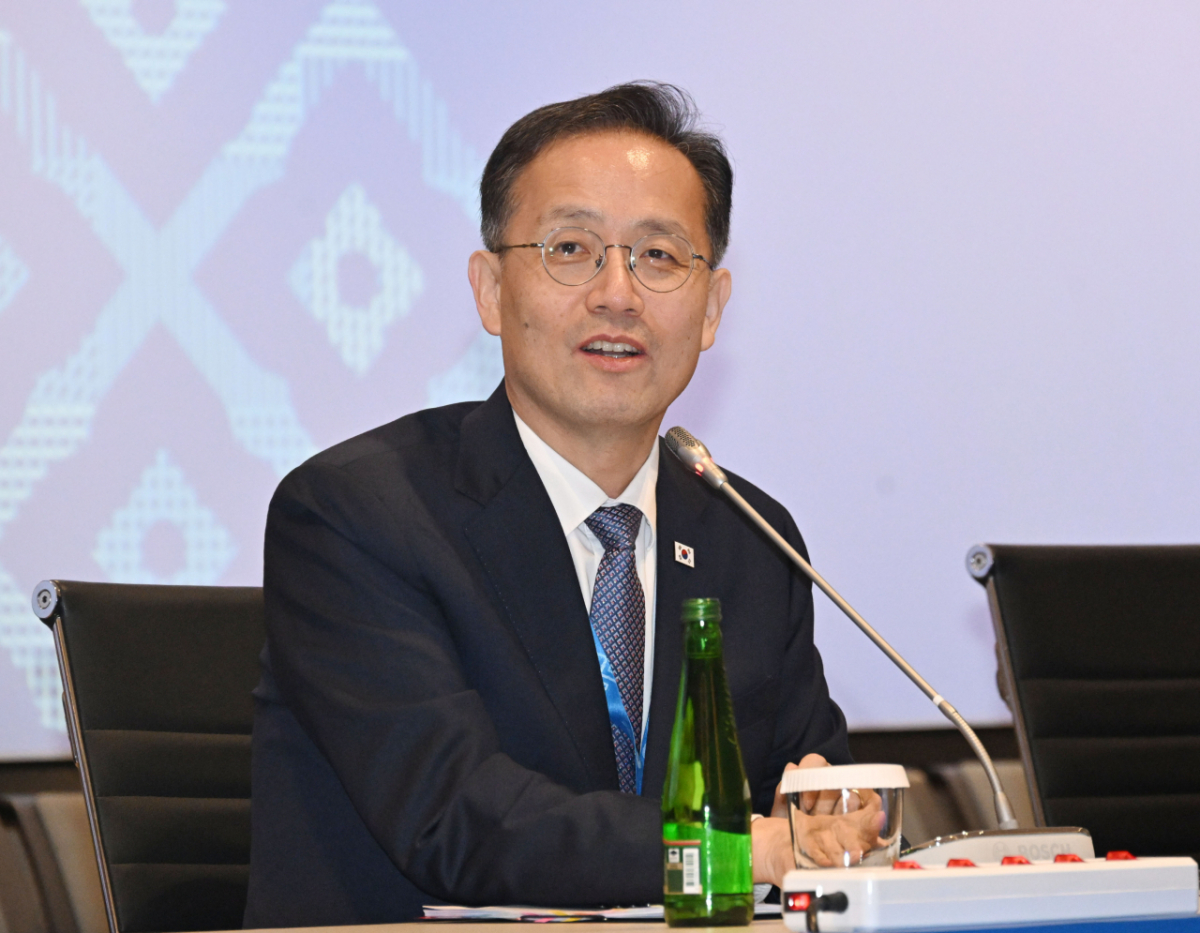
Deputy Prime Minister and Economy and Finance Minister Lee Hyeong-il projected this year's economic growth rate at 3.4% to 3.6%, higher than the government's previous forecast of 3%. The government will increase the frequency of its economic outlooks from twice a year to three times. It has also decided to consider additional capital gains tax relief for the sale of purchase-to-rent apartments in designated adjustment areas to public entities.
Lee, who visited Bangkok, Thailand, to attend events such as the International Monetary Fund (IMF) and World Bank Annual Meetings, met with the accompanying press corps locally on the 16th and stated, "A growth rate in the mid-3% range is possible," assuming no external variables.
The government's previous forecast was 3%, while the IMF's projection was 3.3%. Deputy Prime Minister Lee presented a more optimistic outlook than these figures. Regarding potential growth, he said it "can break away from its downward trend and rebound," adding that "the time for this is approaching."
The Ministry will expand the number of economic outlooks to three starting next year, aiming to respond swiftly to rapidly changing economic conditions. Currently, economic forecasts are released alongside the year-end economic growth strategy and the second-half economic growth strategy in June or July. The ministry is considering adding one more economic forecast while discontinuing the separate release of the second-half economic growth strategy.
In terms of expanding real estate supply, incentives will be provided when purchase-to-rent apartments in designated adjustment areas are sold to public sectors such as the Korea Land and Housing Corporation. Deputy Prime Minister Lee stated, "We are considering additional capital gains tax relief."
Recent stock market volatility was attributed to concerns over rising global interest rates, doubts about the profitability of investments in AI (artificial intelligence) and semiconductors, and geopolitical risks. While stating that "fundamentals remain solid," Lee conveyed that preparations are underway for market stabilization measures.
Regarding taxation on virtual assets, he said, "We will listen to opinions first before making a judgment." He noted that the timing of ending the maximum price system for oil depends on the progression of the Middle East war, including navigation through the Strait of Hormuz. The recent strengthening of the won against the dollar was assessed as "a process of returning to fundamentals."
The agenda of the US-Korea finance and monetary authorities' "four-party meeting" held on the 16th was not disclosed. Regarding whether the four-party meeting will be institutionalized, Deputy Prime Minister Lee said, "It is not yet at a stage where we can speak definitively."
The meeting was attended by Lee, Bank of Korea Governor Shin Hyun-song, Federal Reserve System Board (FRB) Chair Kevin Warsh, and US Treasury Under Secretary Francis Brooke. This marked the first time that representatives from both countries' finance authorities and central banks gathered for a meeting.
Lee emphasized the US-Korea currency swap as "a meaningful and necessary component in terms of serving as a robust safety net for the foreign exchange market."

 in ECONOMY
