

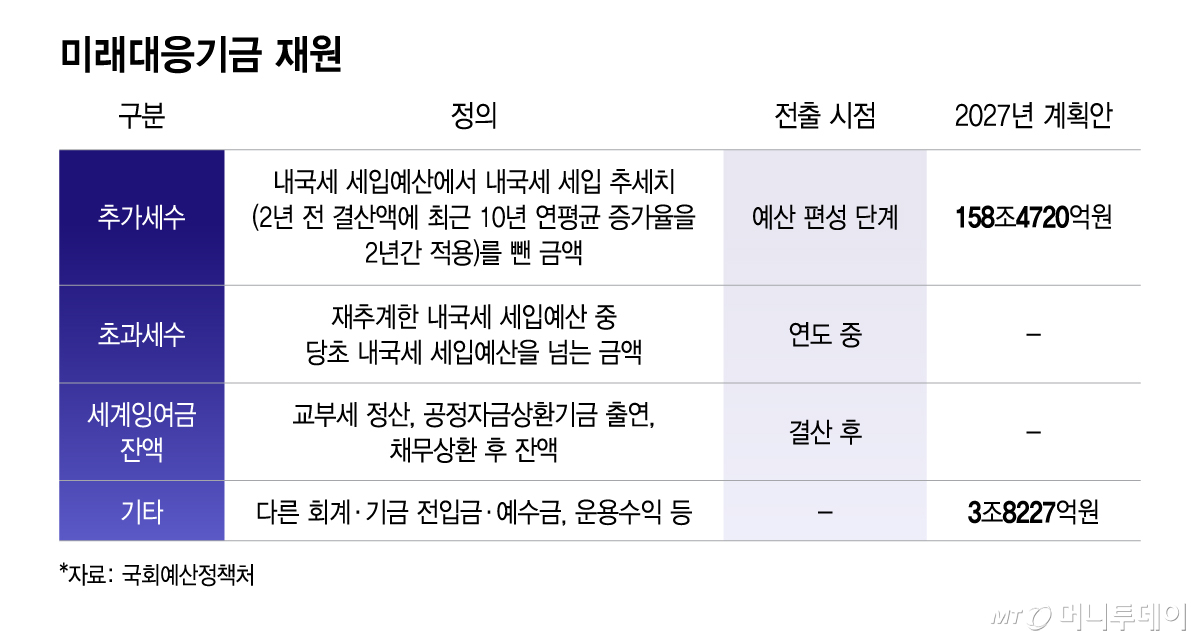
As the review of next year's 821 trillion won budget proposal has begun, the Future Response Fund (hereinafter "the Fund") has emerged as the biggest point of contention.
While the ruling and opposition parties face off, calling the Fund a "fiscal dam" and a "piggy bank," respectively, arguments are also being made that a significant portion of excess tax revenue should be simultaneously invested in both the Fund and a Korean-style strategic sovereign wealth fund. The intent is to maintain the fiscal stabilization function while strengthening strategic investment by adding 30 trillion to 50 trillion won from the resources allocated to the Fund into the sovereign wealth fund, thereby also securing the sustainability of the Fund.
The National Assembly's Committee on Economy and Finance held a public hearing on the bill to enact the Future Response Fund Act on the 3rd. Following the public hearing, the decision on whether to introduce the Fund will be made after legal review by the Committee on Economy and Finance and budget proposal review by the Special Committee on Budget and Accounts. The statutory deadline for processing next year's budget proposal is the 2nd of next month.
The size of the Fund included in the government's proposal is 162.3 trillion won. A portion of the 63.2 trillion won in excess tax revenue will also be allocated to the Fund. The initial size of the Fund is estimated at approximately 200 trillion won.
The government plans to spend 45.4 trillion won from the Fund next year alone. To this end, four accounts have been established: youth, growth drivers, local regions, and education/talent. The reduction in new government bond issuance is 12.5 trillion won. The remaining 104.4 trillion won constitutes surplus funds.
The issue is sustainability. The National Assembly Budget Office predicted that no additional tax revenue will be generated from 2029 onward. This means the Fund's largest source of resources will disappear. From a sustainability perspective, the Budget Office recommended that some projects allocated to the growth drivers account be restructured into strategic sovereign wealth funds and other vehicles.
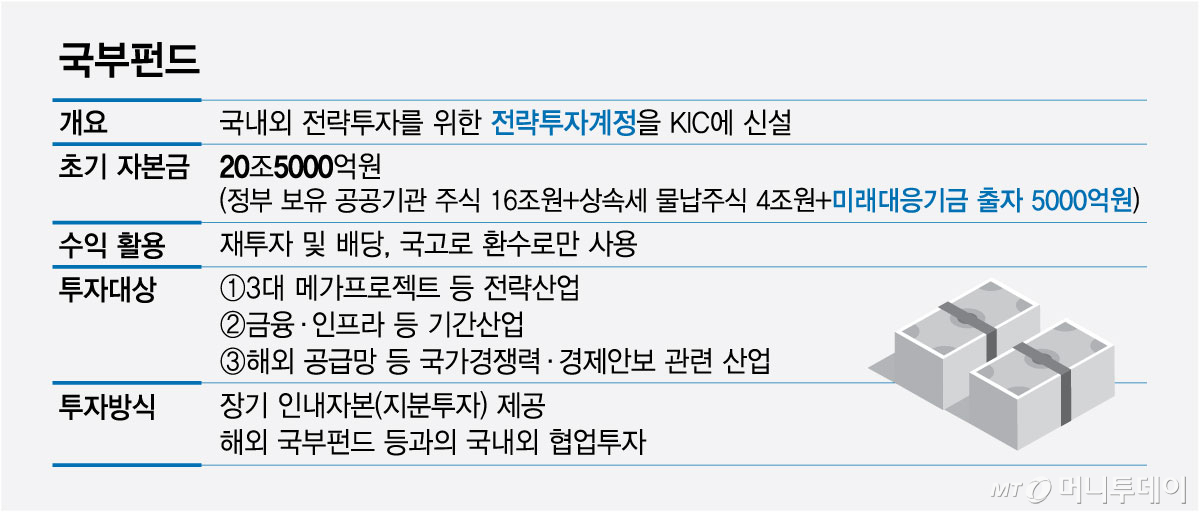
A strategic sovereign wealth fund is a fund that directly invests in companies in strategic sectors, operated by establishing a strategic investment account within the Korea Investment Corporation (KIC). The initial capital is at least 20.5 trillion won. The amount received as an equity contribution from the Fund is 50 trillion won.
In this regard, there are indications that the Fund's equity contribution should be increased because the strategic sovereign wealth fund's initial capital does not meet "economies of scale." If a substantial portion of the Fund's resources, amounting to tens of trillions of won, is contributed to the sovereign wealth fund, it can create a virtuous cycle where returns are recovered and reinvested into the Fund.
Kim Jung-sik, a professor in the Department of Economics at Yonsei University, said, "It is appropriate to increase investment in the sovereign wealth fund through the Fund to activate investment," adding, "The sovereign wealth fund can serve as national property, playing a supplementary role to fiscal policy, and can also be used as a second foreign exchange reserve."
Similar arguments were raised during the National Assembly's audit process. Kim Tae-nyeon, a Democratic Party of Korea lawmaker on the Committee on Economy and Finance responsible for the Fund, argued for expanding the sovereign wealth fund, stating, "Major countries are utilizing sovereign wealth funds as core means of national growth strategy and industrial policy."
Lawmaker Kim said, "In the initial stage, the state creates sufficient scale, and subsequently, investment returns are reinvested to grow national wealth through compound interest," explaining that this is why he argues the size of the Fund's equity contribution should be reconsidered to secure ammunition in the early stages of launch.

 in ECONOMY

