


Actress Hwang Shin-hye has decided not to receive meaningless life-sustaining medical care in the moments leading up to her death. She said she had wanted to express this intention in advance for a long time. This refers to the "Advance Directive on Life-Sustaining Treatment."
Hwang Shin-hye shares this story on the KBS1TV program "Hwang Shin-hye's Let's Live Together" airing at 7:40 p.m. on the 7th. She discusses health and death with Yang Jung-a and Shin Gye-sook.
Her decision to refuse life-sustaining treatment in advance while she is still alive stems from concern for her daughter. She decided to register an Advance Directive on Life-Sustaining Treatment to alleviate the burden on her daughter, Lee Jin-ah.
Hwang Shin-hye's mother, who underwent stomach cancer surgery seven years ago, also expressed her intention early on not to receive life-sustaining treatment. At the time, she reportedly handed over 10 million won she had saved, saying she did not want to be a burden to her family and that it should be used for surgery and nursing care costs.
"I hate meaningless life-sustaining treatment"… 3 million people pledge… Over 50,000 cases of life-sustaining treatment discontinuation
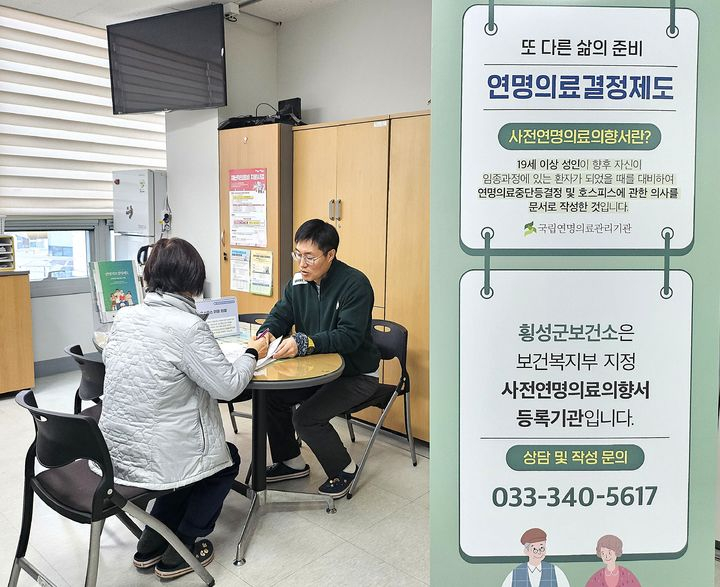
The Life-Sustaining Treatment Decision system was first implemented in 2018. Since then, the number of cases where life-sustaining treatment has been discontinued or deferred according to patient wishes has increased.
Registrations for Advance Directives on Life-Sustaining Treatment, which are used to make such decisions, also rose to over 3,069,000 by the end of last month. The rate of treatment discontinuation based on these directives was only 0.8% in 2018 but has rapidly increased to 18.5% last year.
In particular, the proportion of cases where life-sustaining treatment is stopped according to the patient's own will is increasing. It surged from 32.5% in 2018 to 50.8% last year and 52.4% through September this year.
Conditions are required for deferring or discontinuing life-sustaining treatment. First, there must be a medical judgment that there is no possibility of recovery.
Subsequently, the patient must express their will through an Advance Directive on Life-Sustaining Treatment or a Life-Sustaining Treatment Plan. Discontinuation of life-sustaining treatment is possible if two or more family members testify regarding the patient's usual intentions, or if all of the patient's family members reach a consensus.

 in ENTERTAINMENT

