

The mutual financial sector is showing optimism following the government's relaxation of regulations on group loans. With household loan handling restricted this year, group loans offer a potential lifeline. It is expected that demand for group loans will be particularly high among local savings banks and cooperatives where managing delinquency rates is urgent. However, some forecasts suggest that the effectiveness may be limited due to competition with commercial banks.
The mutual financial sector, including Nonghyup (NH), Shinhyup, and Saemaeul Savings Banks, is also paying close attention to this move to relax loan regulations. This could open up new avenues for stalled household loan sales. Due to total volume management, Saemaeul Savings Banks and Shinhyup cannot increase their household loan balances at all this year. Nonghyup is allowed to increase its balance by only 1.0% compared to the previous year's level.
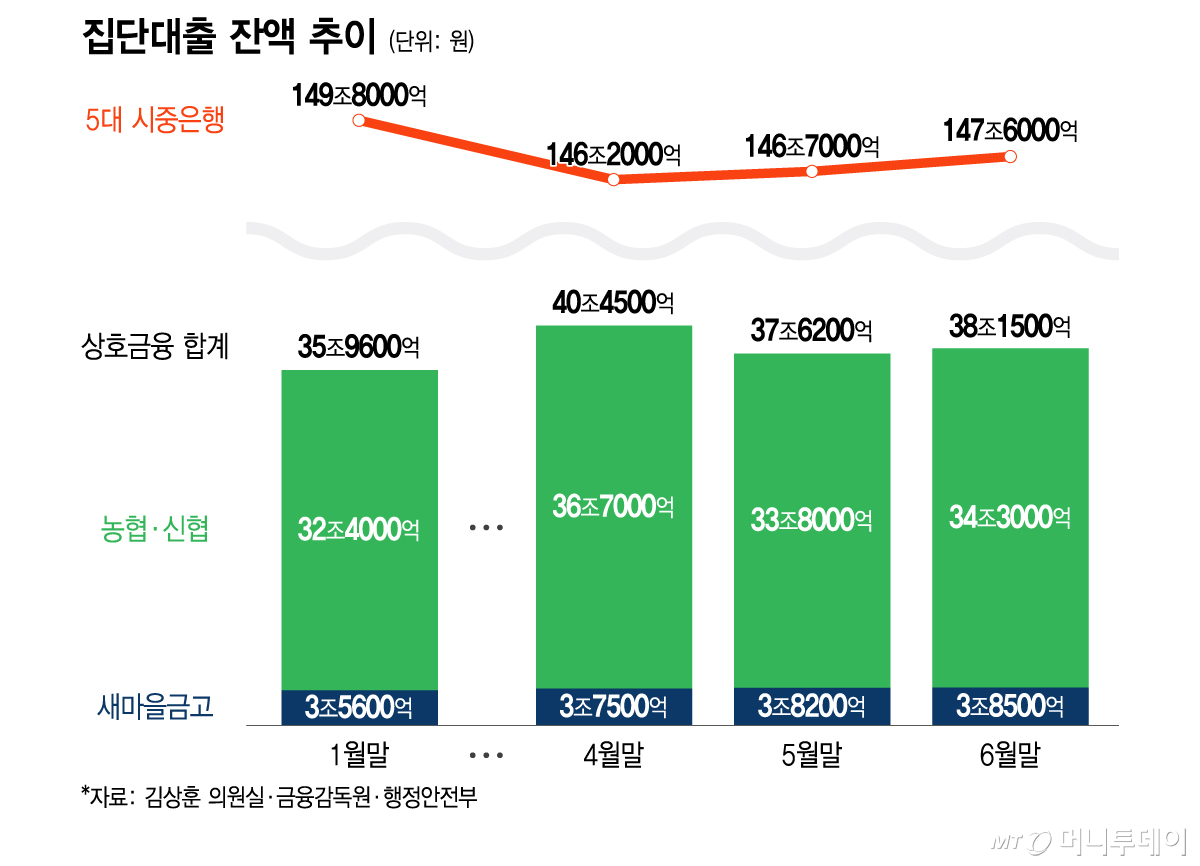
Nevertheless, household loans in the mutual financial sector increased this year. Most of these increases came from group loans. According to data submitted by People Power Party lawmaker Kim Sang-hoon to the Financial Supervisory Service and the Ministry of the Interior and Safety, as of the end of last month, the total balance of group loans for Nonghyup, Shinhyup, and Saemaeul Savings Banks stood at 38.15 trillion won. This represents an increase of approximately 3 trillion won compared to the end of last year (35.14 trillion won).
The surge in household loans was driven by construction progress payments, relocation costs, and new pre-sale housing balance loans contracted between late last year and early this year. Following this, strict management policies by financial authorities led mutual financial institutions to halt group loan handling, resulting in a slower pace of household loan growth.
If group loans are recognized as an exception to total volume management, it would free up additional lending capacity. In particular, if mutual financial institutions handle more group loans, they could receive assistance in managing delinquency rates. It is reported that financial authorities are currently demanding strict delinquency rate management for individual cooperatives and savings banks in local areas. To lower delinquency rates, the denominator in the calculation formula—the total loan volume—must be increased; however, this has been difficult because they cannot handle new household loans.
A mutual financial sector official stated, "Even if balance loans are excluded from total volume management, it would provide some relief for individual savings banks or cooperatives." The official further explained, "Balance loans are particularly favored by struggling cooperatives and savings banks because they can be processed in large batches for a significant number of housing units at once."
However, if competition with commercial banks arises over group loans, the positive effects may be limited. In group loans, developers or cooperatives select financial institutions on a project basis, making it inevitable that banks offering lower interest rates have an advantage. The expansion of group loans by mutual financial institutions was largely driven by the 'balloon effect' resulting from commercial banks exhausting their total loan volumes. In fact, as of the end of last month, the group loan balance for the five major commercial banks (KB Kookmin, Shinhan, Woori, Hana, and NH Nonghyup) stood at approximately 147.6 trillion won—about four times higher than that of mutual financial institutions.
Another official stated, "It is difficult to predict the extent of relaxation by financial authorities, so we must carefully assess the impact on the industry."

 in FINANCE
