

SK Hynix is expanding long-term supply agreements (LTAs) with global big tech companies to secure long-term demand in the AI memory semiconductor (hereinafter "memory") market. The strategy aims to enhance predictability in production and profitability by securing stable demand visibility beyond short-term performance. With full-scale shipments of HBM4 (6th-generation high-bandwidth memory) and next-generation DRAM expected in the second half, record-breaking performance is anticipated to continue.
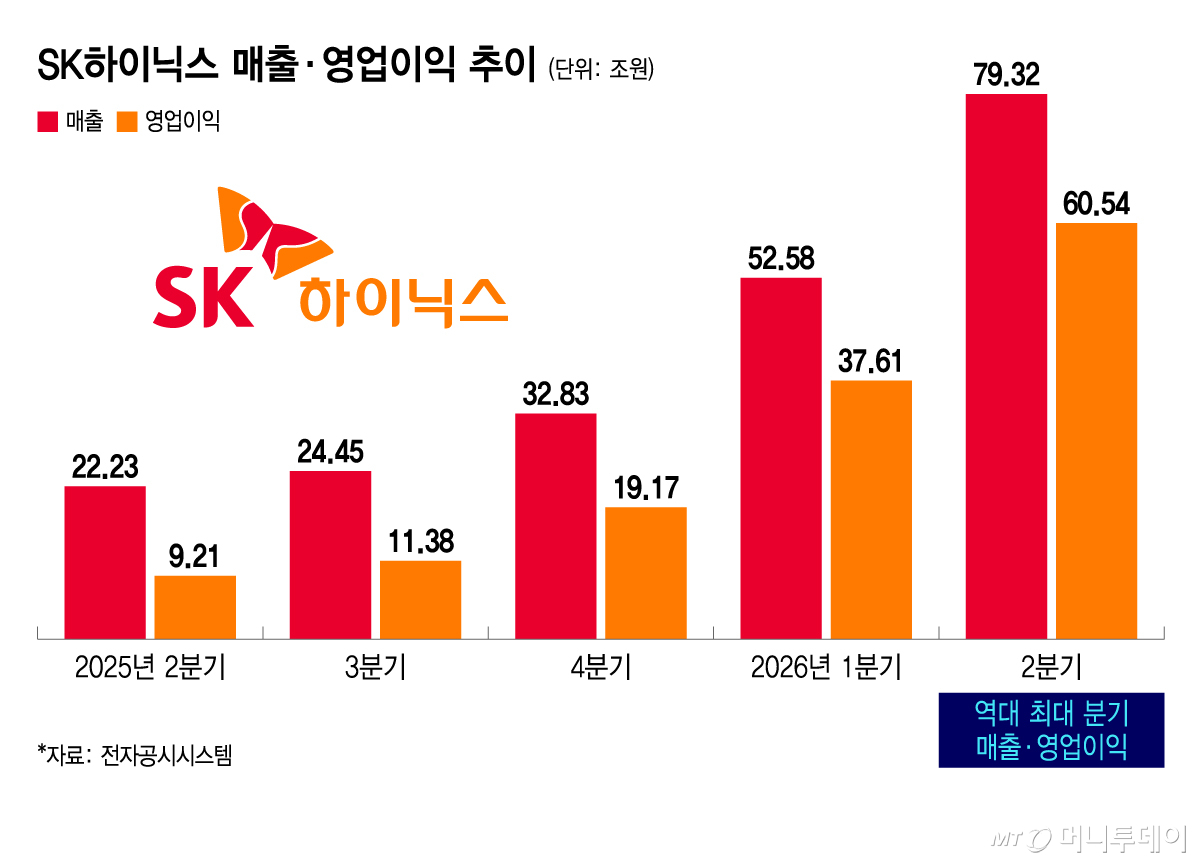
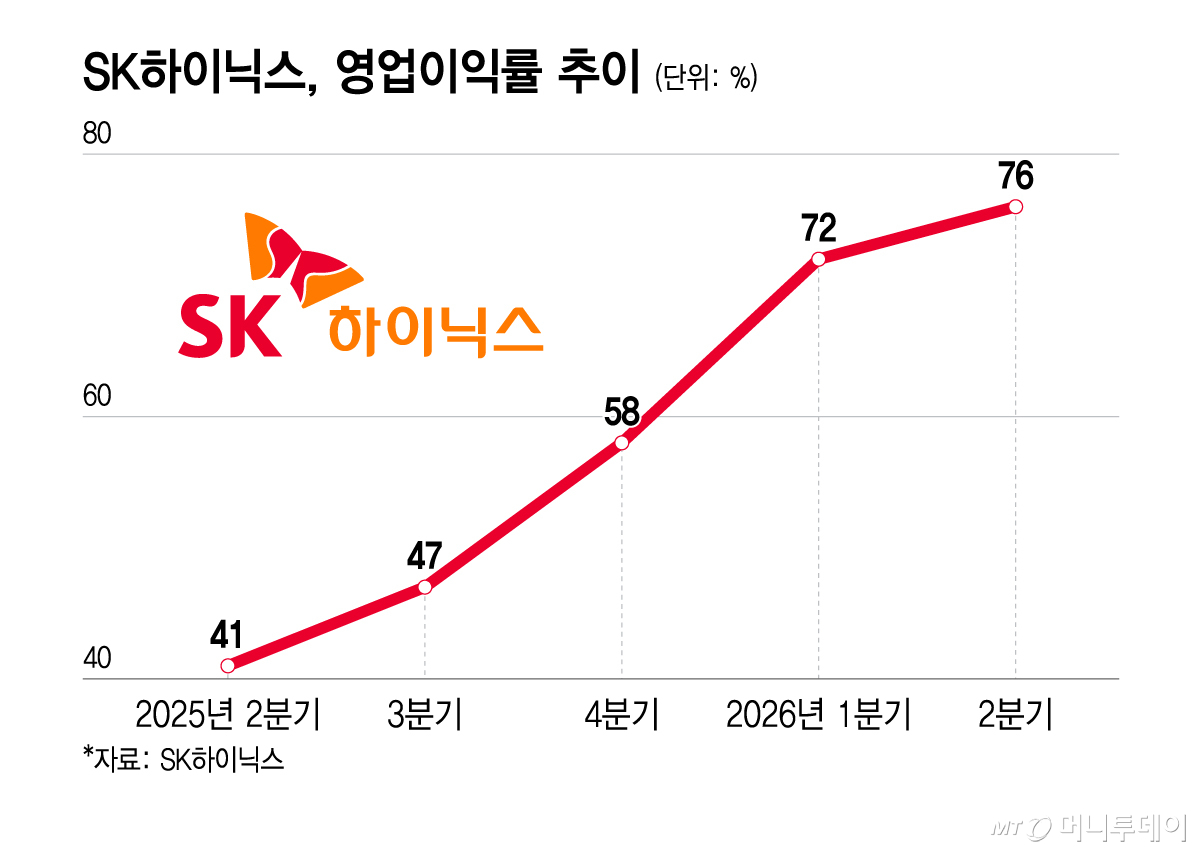
SK Hynix announced on the 29th that its revenue and operating profit for the second quarter totaled 79.3187 trillion won and 60.5426 trillion won, respectively. Quarterly operating profit reached a record high for five consecutive quarters. Factors such as the sale of investment assets from Kioxia (formerly Toshiba Memory), valuation gains, and favorable exchange rate effects contributed to net profit reaching 93.9226 trillion won.
Although revenue and operating profit did not meet the market's elevated expectations (consensus estimate), they remained within a reasonable range of recent industry forecasts. Park Jun-deok, in charge of DRAM marketing, stated, "The timing for expanding shipments of certain high-value-added DRAM products has been pushed to the second half, and portfolio composition affected overall ASP (average selling price). However, we are confident that performance improvement will strengthen further in the second half."
SK Hynix expects full-scale shipments of HBM4 sales, 10-nanometer 6th-generation (1c) DRAM, and SOCAMM2 in the second half. It is anticipated that the high-value-added 321-layer NAND flash (hereinafter "NAND") will account for half of domestic production capacity by year-end. The company also indicated that negotiations for HBM supply next year are progressing smoothly.
Signed LTAs with over 10 customers... Strengthening actual purchase obligations
Expanding LTAs is a core strategy to prepare for long-term growth in the AI memory market. Song Hyun-jong, president of SK Hynix, stated during today's earnings announcement, "We have concluded LTA (long-term supply agreement) negotiations with over 10 customers, including key clients so far, and are continuing discussions with major industry customers."
The contracting parties reportedly include major global big tech companies such as NVIDIA and Microsoft. Recently, SK Group signed a letter of intent (LOI) with NVIDIA to build AI infrastructure worth more than $500 billion. The executive in charge explained, "We are securing a stable profitability foundation centered on HBM, and long-term cooperation with key AI customers including NVIDIA supports this."
SK Hynix's LTAs typically have a base term of five years and go beyond simply extending contract durations. While contract terms vary by customer and product, prices are not fixed but designed to reflect market fluctuations. This means if memory prices rise in the future, such increases can be incorporated into the contracted price.
Along with long-term purchase commitments, conditions supporting contract fulfillment, such as deposits, have been included. This strengthens customers' actual purchase obligations and enhances visibility of medium-to-long-term demand. The executive noted, "This simultaneously improves downside stability for performance while allowing us to leverage additional demand and growth opportunities when market conditions are favorable."
The market views LTA expansion as one factor limiting the extent of ASP increases. Since long-term contract volumes do not immediately reflect recent sharp DRAM price hikes, some short-term price gains may be sacrificed. However, the positive effect of securing long-term demand and profitability is considered greater than this trade-off.
SK Hynix plans to expand production capacity based on the demand visibility secured through LTAs. It aims to develop Icheon in Gyeonggi Province and Yongin as key production hubs for next-generation DRAM and AI memory, while focusing on strengthening NAND and advanced packaging capabilities at its Cheongju facility in North Chungcheong Province. Equipment investment this year is expected to reach the high 40 trillion won range.
AI expansion drives increased memory demand... Shareholder returns also under review
SK Hynix forecasts continued growth in memory demand across the entire AI ecosystem. As AI services evolve into agent forms that perform complex tasks on behalf of users, demand is expanding not only for HBM but also for server DRAM and enterprise SSDs.
Song (President) stated, "DRAM and NAND demand this year will increase by mid-20% and late 10%, respectively, under constrained supply conditions. If supply constraints ease and latent demand is met, the market's growth potential could expand further."
SK Hynix also anticipates that major cloud service providers' (CSPs) AI infrastructure investments will remain robust in the medium to long term. This is because AI service competitiveness directly ties to big tech companies' core businesses such as search, advertising, cloud computing, and software. The emergence of high-efficiency AI models is also expected to reduce usage costs and entry barriers for AI services, thereby increasing overall usage volume and memory demand.
Additionally, the direction of shareholder returns is being reviewed from multiple angles. SK Hynix stated that due to regulatory and procedural constraints related to ADR (American Depositary Receipt) offerings, it is difficult to disclose new important information such as specific shareholder return plans at this time.
Song (President) added, "Given the significantly strengthened cash generation capability, we will be able to meaningfully expand shareholder returns while investing for future growth and achieving financial soundness goals. We will communicate with the market once specific plans are finalized."

 in INDUSTRY


