

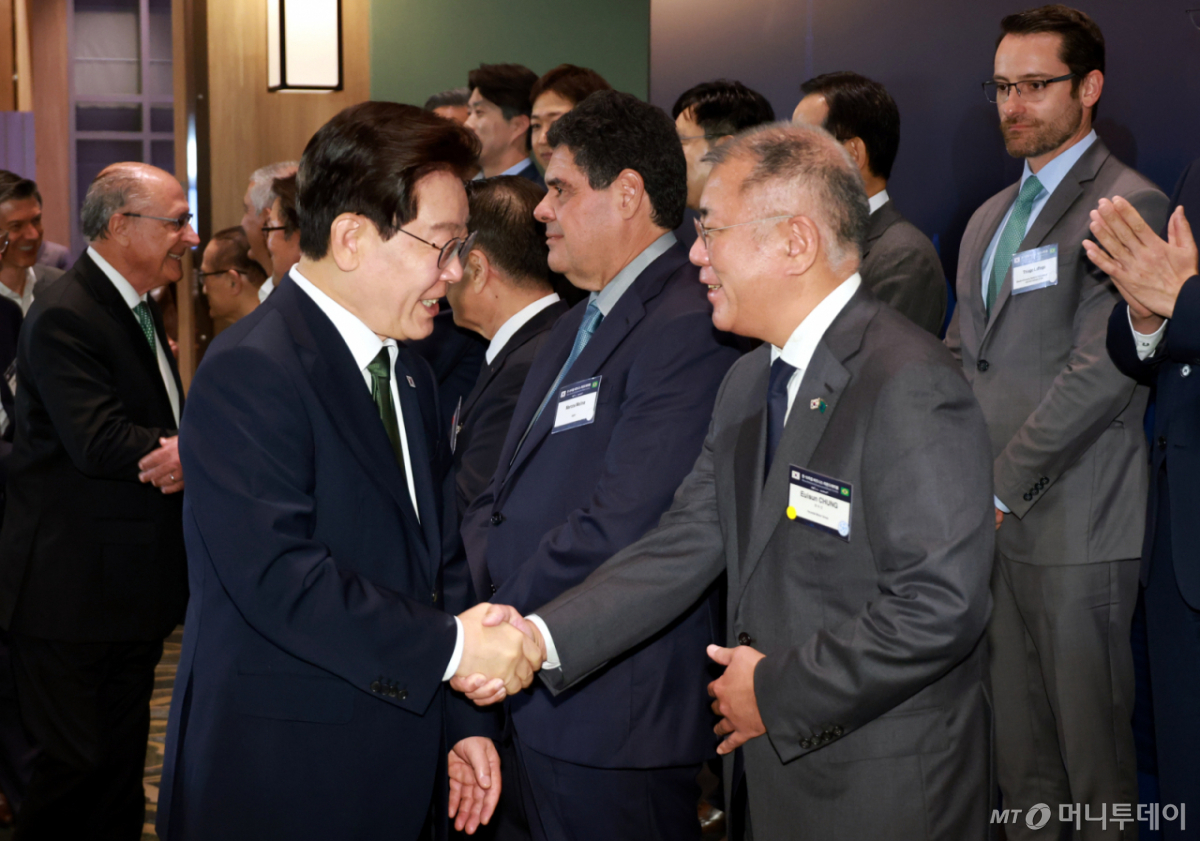
"We plan to advance technical cooperation with Brazil on green hydrogen production, hydrogen truck introduction, and SMR (small modular reactors)."
Hyundai Motor Group Chairman Chung Eui-sun made these remarks while attending the 'Korea-Brazil Business Round Table' in Sao Paulo, Brazil, on the 28th (local time). Earlier, in 2024, he met with Brazilian President Luiz Inácio Lula da Silva and announced an investment of $1.1 billion (approximately 1.6 trillion won) in Brazil by 2032. This statement appears to be a move toward fully launching related projects. At that time, Jeong (Chairman) cited hydrogen and other eco-friendly businesses as well as future technologies as the investment areas.
Brazil, home to the Amazon rainforest known as the "lungs of the Earth," is actively pursuing carbon reduction policies. Hyundai Motor Group has determined that there will be significant business opportunities in the clean energy sector during this process. This is also why Jeong (Chairman) stated at this Business Round Table that it would advance local projects in line with Brazil's decarbonization policy 'MOVER,' the national hydrogen program, and the national energy plan.
Hyundai Motor Group is expected to first build an electrolysis plant in Brazil and produce green hydrogen using local renewable energy facilities. Green hydrogen is hydrogen produced by splitting water using electricity generated from renewable energy. According to a report published last year by the Korea Institute for International Economic Policy, producing green hydrogen requires low renewable energy generation costs, and Brazil's northeastern region, which has abundant sunlight and strong winds, possesses "optimal conditions." The report indicates that the production cost per kilogram of green hydrogen is second only to the Middle East (2.7 dollars in the United Arab Emirates and 2.9 dollars in Saudi Arabia), with Brazil at 3.2 dollars being the lowest globally. Additionally, the EU (European Union) plans to import 10 million tons of green hydrogen by 2030, and Brazil's northeastern region holds ports close to Europe, making it advantageous for exports as well.
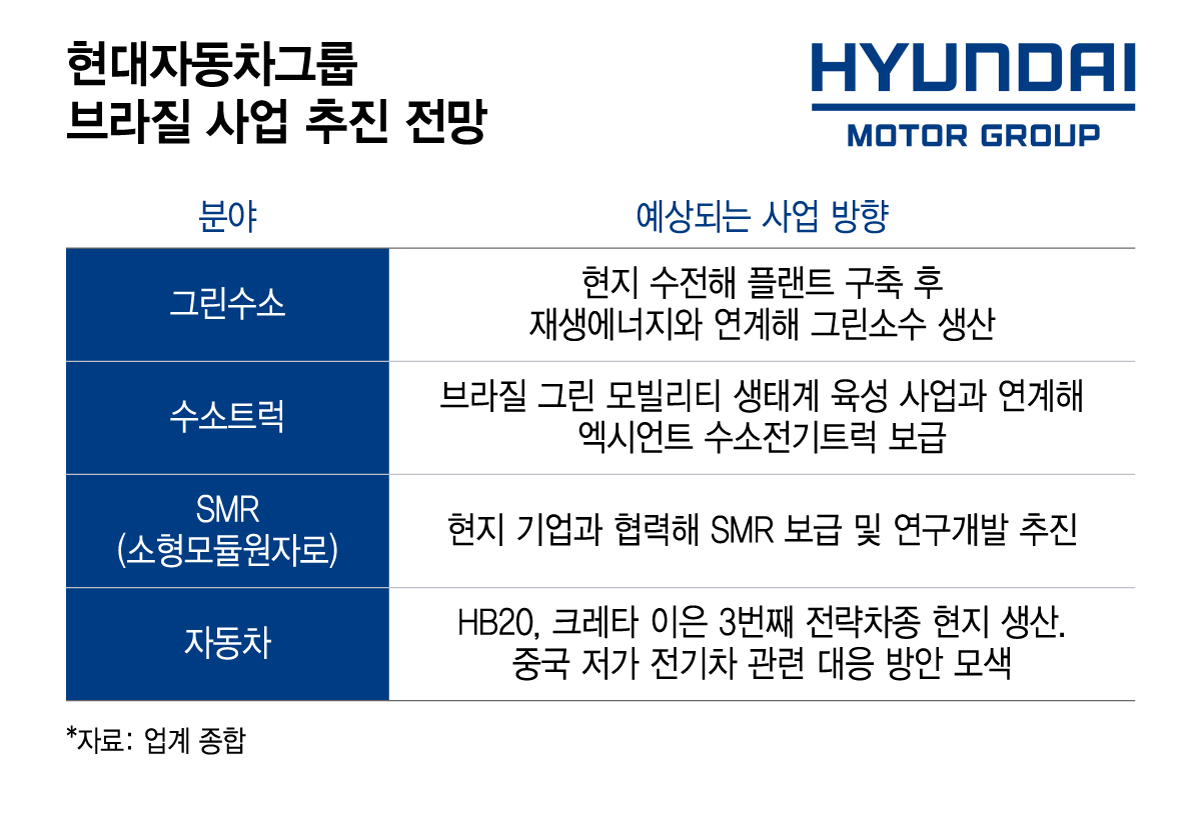
It is also expected that Hyundai Motor Group will push forward the local supply of its 'XCIENT Hydrogen Electric Truck.' The Brazilian government is working hard to foster a green mobility ecosystem by introducing programs like 'MOVER,' which applies environmental regulations to both domestic and imported vehicles. In March, Hyundai supplied eight XCIENT hydrogen electric trucks for Uruguay's wood logistics decarbonization project, taking its first step into the Latin American market with plans to gradually expand the scope of countries where these trucks will be deployed.
The group is also accelerating the introduction of SMRs in Brazil. Hyundai Motor Group is working on securing technology and commercializing SMRs by participating in the design of commercially available SMRs in the U.S. alongside Holtec International, a leading American nuclear power plant specialist company. Two years ago, during a meeting with President Lula, Jeong (Chairman) expressed strong determination to pursue projects in Brazil, stating, "We hope to explore cooperation opportunities in the SMR field as well."
Meanwhile, Hyundai Motor Group is also carefully considering strategies to expand car sales in Latin American markets such as Brazil and to counter aggressive low-priced Chinese electric vehicle attacks. HMG Management Research Institute, the group's think tank, recently shared an internal report analyzing why China's BYD 'Dolphin Mini' model has gained popularity in Brazil. When asked by reporters about the outlook for the Brazilian market at the Business Round Table, Jeong (Chairman) said, "There is still a long way to go," adding, "China is also aggressively targeting (the local market) these days."

 in INDUSTRY

