

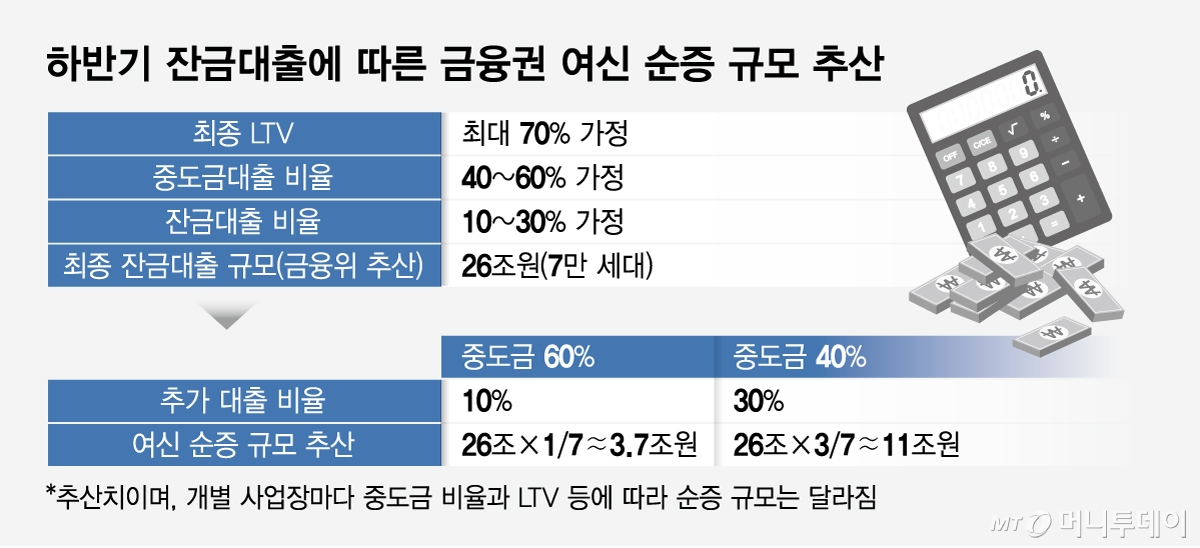
Financial authorities have fallen into a “total volume regulation dilemma.” While maintaining a strict total volume management stance to curb household debt, they have effectively neutralized the regulation by allowing exceptions for balance payment loans totaling 26 trillion won for 70,000 households in the second half alone. Critics point out that policy goals of expanding housing supply and managing household loans are clashing.
According to financial sector sources on the 29th, the Financial Services Commission held a meeting with five major banks (KB Kookmin, Shinhan, Hana, Woori, and NH NongHyup Bank) the previous day, requesting that scheduled balance payment loans in the second half be executed without disruption. The Financial Services Commission expects balance payment loan demand of about 26 trillion won for approximately 70,000 households in the second half.
The 26 trillion won estimated by financial authorities does not all constitute new household loans. A significant portion consists of amounts where interim construction loans already disbursed are converted into balance payment loans. Within the banking sector, considering the typical structure of interim and balance payment loans, actual new lending is estimated to range from 3.7 trillion won to 11 trillion won (about 15% to 40%) out of the 26th trillion won. While differences exist depending on individual projects’ interim loan ratios and final Loan-to-Value (LTV) ratios, officials explain that once interim loans already disbursed are excluded, the net increase in final balance payment loans would be around this level.
Even with this estimate, new lending could match or exceed the approximately 430 billion won target for household loan growth set by the five major banks this year. Financial authorities are also considering allowing exceptions not only for balance payment loans but also for relocation costs and interim construction loans related to expanding housing supply. If so-called group loans—including relocation costs, interim loans, and balance payments—are all granted exceptions, even if the total household loan volume management target is met for the year, the “exceptions” will inevitably far exceed the “target.”
Financial Commission Chairman Lee Eoung-won explained at the National Assembly’s Political Affairs Committee session today that “(allowing an exception for balance payment loans) does not mean a policy shift.” He added, “Balance payment loans can still be obtained within regulations now, but strict total volume management caused banks to tighten lending.” He clarified that allowing balance payment loans was merely about coordinating with banks to ensure proper execution, not changing policy.
However, the financial sector evaluates that financial authorities are effectively trapped in a dilemma as the policy purpose of total volume regulation clashes with protecting genuine demanders. Maintaining total volume regulation to manage household debt makes it difficult for move-in-bound households to secure balance payments, while conversely, granting exceptions for balance payment loans inevitably undermines the effectiveness of total volume management.
Controversy over fairness is also raised. Pre-sale housing complexes where thousands of households move in simultaneously receive exception treatment because they were planned as loans at the time of pre-sale, whereas individual genuine demanders purchasing existing homes separately remain subject to total volume regulation. The difference between the two cases lies in whether the home purchase was planned one or two years ago or contracted this year.
A financial sector official pointed out, “Total volume regulation existed one or two years ago as well; what changed is simply whether loud voices were raised at a seminar attended by President Lee Jae-myung.” The official noted that even among genuine demanders, eligibility for loans now depends on whether they are individuals or groups.

 in FINANCE
