

As the Financial Services Commission and the Financial Supervisory Service are being mentioned as targets for a second round of public institutional investor relocation, concerns are rising within the financial sector that a forced, rushed relocation could cause significant disruption to financial companies and the financial market. The core duties of the financial authorities involve inspecting and licensing financial firms, yet over 90% of these companies are concentrated in Seoul and the metropolitan area. Critics argue that forcing such a move would lead only to inefficiency and unnecessary costs being incurred in Yangsan.
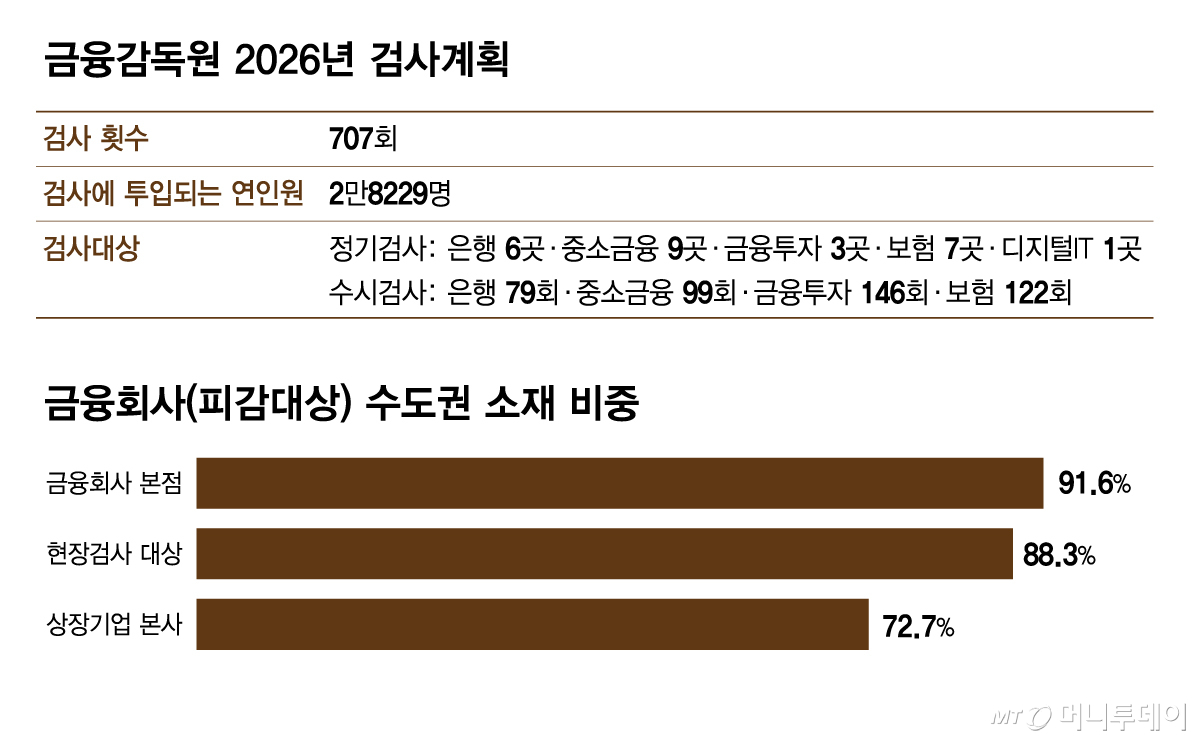
According to financial sector reports on the 18th, if the Financial Supervisory Service, headquartered on Yeouido in Seoul, relocates to local areas such as Sejong City, practical concerns are being raised about its ability to properly carry out its core functions of inspecting and supervising financial companies. The Financial Supervisory Service plans to conduct a total of 707 inspections this year. These include regular and unscheduled inspections targeting banks, securities firms, insurance companies, credit card issuers, mutual financial institutions, and savings banks, requiring the deployment of up to 28,229 person-years of Financial Supervisory Service staff alone.
If the Financial Supervisory Service relocates to Sejong, nearly 30,000 inspection personnel would need to travel back to Seoul or the metropolitan area for 'reverse business trips.' This is because 91.6% of financial company headquarters are located in the metropolitan region, and 88.3% of the financial firms subject to on-site inspections by the Financial Supervisory Service are also based there. Narrowing the scope to the capital market, 72.7% of listed companies' headquarters are distributed in the metropolitan area.
Financial Supervisory Service staff must often travel to the relevant financial company for extended periods—sometimes over a month—when conducting regular inspections. In some cases involving banks, more than 20 personnel are deployed at once. If the Financial Supervisory Service moves to Sejong, dozens of staff would need to undertake long-term business trips to Seoul lasting over a month for each regular inspection.
Travel expenses could also become 'unrealistically' inflated. According to internal regulations of the Financial Supervisory Service, daily allowances for inspection-related travel (excluding transportation costs) are around 150,000 won. Of this, accommodation costs range from 80,000 to 100,000 won depending on the region. These figures assume local-area business trips. For trips to Seoul, however, accommodation and living expenses would need to be significantly higher. Assuming 30,000 personnel travel to Seoul annually, an additional cost of 30 thousand won to 4 billion won would be incurred. Over a 10-year period, this could amount to hundreds of billions of won.
Relocation costs could also exceed those for general institutional investors due to the sensitive and complex nature of the financial sector as their primary business area. For example, when the Ministry of Oceans and Fisheries completed its headquarters relocation from Sejong City to Busan last year, direct moving costs were reported to be approximately 118.9 billion won. The ministry's headquarters staff numbered around 600 to 700 people. In contrast, the Financial Supervisory Service has about 2,200 employees—roughly three times that number. While direct comparison is difficult, the financial sector estimates that relocation costs could reach 300 billion won, with additional expenses of hundreds of billions of won required for IT infrastructure relocation.
The local relocation of financial authorities places a heavy burden primarily on financial companies. The Financial Services Commission and the Financial Supervisory Service are responsible for licensing and permitting financial firms. As a result, these companies would frequently need to travel to local areas to obtain necessary approvals, severely compromising operational efficiency. Moreover, the costs amounting to hundreds of billions of won resulting from the relocation would ultimately be borne by financial companies. The Financial Supervisory Service operates as a non-capital special public institution (other public institutional investor), and supervisory fees paid annually by financial companies—totaling approximately 350 billion won—account for 70% of its budget.
Such a move would also run counter to financial consumer protection efforts. Currently, 81.4% of financial complaints are concentrated in the metropolitan area. Vulnerable groups, including the elderly, have traditionally filed complaints at the Yeouido Financial Supervisory Service complaint center. Relocating this facility could create a 'blind spot' from the perspective of consumer protection.
The government plans to finalize and announce its plan for relocating public institutional investors as early as this month, or at the latest by the end of the year. However, it is reported that when selecting targets for relocation, the functional efficiency of each institutional investor post-relocation will be an important consideration. Financial Supervisory Service Chairman Lee Chan-jin stated during a press conference in March: "It is simply the reality of finance that everything is concentrated in Seoul and the metropolitan area," adding, "It is difficult to imagine leaving the field and going anywhere else."

 in FINANCE
