

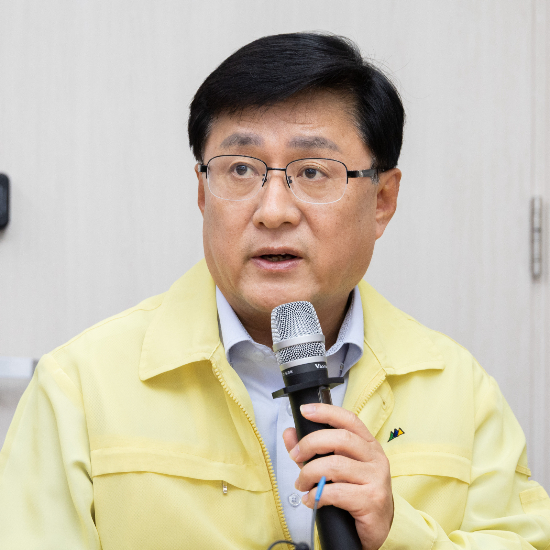
Minister Kim Sung-hwan stated regarding the upcoming regional differential electricity rate system that "it has been decided to name it the 'Industrial Regional Electricity Rate System'" to prevent misunderstanding that the system, which applies only to industrial users, would also cover residential users.
Kim said on the 18th during a roundtable meeting at the Sejong Government Complex, "There is a risk that people may mistakenly believe the regional electricity rate system implies differential pricing for residential rates as well."
The Industrial Regional Electricity Rate System is a new pricing structure that reflects transmission costs and other factors in electricity rates, applying lower rates to local areas closer to electricity production sites. It will apply only to industrial electricity rates; residential rates will continue to follow the progressive tiered system based on usage volume regardless of region.
Regarding the timing for announcing the Industrial Regional Electricity Rate System, Kim explained, "We originally planned to release the basic proposal through a public hearing this week, but it was postponed due to the Ulchi training period. We will hold a public hearing next week to present the plan and gather public opinion." The Ministry of Climate, Energy and Environment is designing a four-tier regional rate system that accounts for local characteristics such as urban areas, rural areas, and regions facing population decline.
Plans to finalize the schedule and format for a symposium discussing whether to pursue new nuclear power plants are expected to be confirmed as early as this week. Kim stated, "Whether to include nuclear power in the 12th Basic Electricity Supply and Demand Plan (Electricity Plan), and what process will be followed until a decision is made, must be determined by next week at the latest."
He added, "The biggest concern regarding the 12th Electricity Plan is nuclear power. We have not yet decided how many additional reactors to build or the exact process for making that decision; we will gather opinions through symposiums while working toward a conclusion."
On the continued operation of nuclear plants reaching their design lifespan, Kim said, "The duration of continued operation varies by country—some extend it by 10 years, others by 20. While there were points of agreement with the Ministry's inquiry about extending operations to 20 years, no commitment was made." He further noted, "This matter may fall outside the Ministry's jurisdiction, making it difficult for me to provide a responsible answer."
Addressing recent record-breaking heavy rainfall in the Gyeongnam region, Kim stated, "In the past, such events occurred with 30- or 50-year frequency, but now we are experiencing extreme heavy rains and droughts with 200-year frequencies repeatedly. It will not be easy to control these at the national level; it may require efforts spanning 50 years in the short term and up to 100 years in the long term."
He continued, "One key task is to refine the Korea Meteorological Administration's radar system by dividing it into smaller pixels to precisely measure rainfall frequency and provide early warnings. Another critical task is to proactively allocate budgets to reinforce urban sewer systems currently designed for 30- or 50-year frequencies, starting with areas most vulnerable to damage, so that natural drainage can occur quickly even during extreme heavy rains."
As such extreme weather events repeat, concerns are rising about whether industrial water supply to semiconductor industrial complexes in the Honam region will remain stable. In response, Kim said, "Considering international cases, ultrapure water used in semiconductor processes must inevitably be supplied from dams. For other water needed for cooling, we should increase the frequency of reuse."
He added, "In the Jeollanam-do region, some water that previously flowed into rivers and then to the sea will now be redirected, and Najuho and Jangseongho reservoirs, formerly used for agriculture, will be supplied as water sources for semiconductor facilities. Currently, we do not anticipate a shortage of water for semiconductor factories."
Regarding criticisms that the Ministry of Climate, Energy and Environment is overly focused on energy issues at the expense of environmental responsibilities, Kim acknowledged, "This is a point we must deeply reflect upon. Indeed, there are concerns that the emphasis on energy has led to the Ministry's original role in environmental protection not being fulfilled properly."
He stated, "It is our fundamental duty to ensure that the environment is not damaged during the supply of electricity and water for semiconductor operations. Regarding power supply for Honam semiconductors, undergrounding the section below National Route 49 and along the Hwangryong River embankment will have almost no environmental impact."
He further emphasized, "Regarding water supply, we considered constructing new Dongbok Dam and Dongbokcheon Dam, but doing so would cause environmental issues. Fortunately, since the existing Dongbok Dam is expected to cause relatively less ecological damage, we decided not to build a new one but instead expand the current facility. We will ensure minimal harm throughout this process."

 in ECONOMY
