

The Korea Deposit Insurance Corporation has reduced the net debt of the special account established to resolve non-performing assets in savings banks by approximately 1 trillion won this year. Considering the pace of debt reduction, extending the account's operational period by one year as planned could allow for full debt resolution by the end of next year.
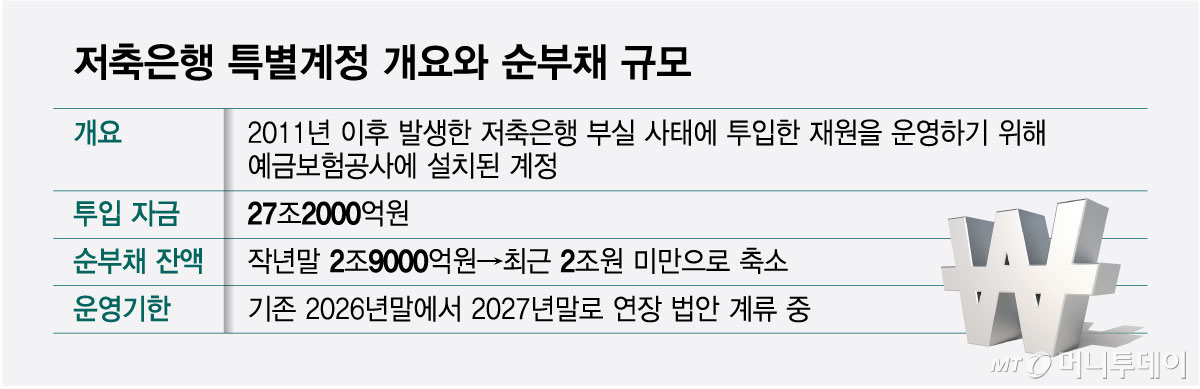
According to financial sector sources on the 18th, the net debt of the special account for savings banks has fallen from 2.9 trillion won at the end of 2025 to below 2 trillion won recently. This represents a reduction of about 1 trillion won just this year.
The special account was established as a temporary measure within the Deposit Insurance Corporation in 2011 to secure funding needed for restructuring during the savings bank crisis at that time. It was created to prevent the spread of savings bank insolvencies across the broader financial market by separating the costs of resolving bad assets from the savings banks' own accounts and having the entire financial industry share the burden.
Initially, funds expected to be injected through the special account were projected at 15 trillion won. However, as additional savings bank insolvencies occurred between 2011 and 2015, a total of 27.2 trillion won was spent on restructuring 31 savings banks—an increase of 12.2 trillion won over the original estimate.
The Korea Deposit Insurance Corporation has been recovering funds by selling off receivables and real estate held by bankruptcy estates of insolvent savings banks, while also injecting deposit insurance premiums paid by financial institutions into the special account to repay debt. As of the end of 2025, out of a cumulative support amount of 27.2 trillion won, 22.9 trillion won has been repaid, reducing the special account's debt to 4.3 trillion won. Taking into account held assets such as cash and subrogation claims totaling 1.3 trillion won, the net debt stood at approximately 2.9 trillion won.
This year, the Korea Deposit Insurance Corporation has accelerated recovery efforts, bringing the net debt below 2 trillion won. Recently, the corporation has focused on recovering remaining assets from bankrupt savings banks by selling off long-term non-performing project financing (PF) assets and artworks. To combat asset concealment by insolvent-related parties through virtual currencies, it also conducted property investigations targeting all virtual asset service providers.
Although the special account's operation period is set to end on December 31 this year, considering the pace of debt reduction, extending it by one year appears sufficient for normal liquidation by the end of next year. Previously, the Financial Services Commission estimated that terminating the special account at the end of this year would result in a deficit of approximately 1.2 trillion to 1.6 trillion won.
In response, the government is pushing forward with plans to extend the special account's operational period by one year until the end of 2027. Yoo Dong-soo, chairman of the National Assembly's Political Affairs Committee and a member of the Democratic Party of Korea, has already introduced a bill to amend the Deposit Insurance Act to extend the deadline by one year.
However, some dissatisfaction has emerged within other financial sectors regarding the prolonged burden associated with extending the special account. Although the special account was established to resolve savings bank insolvencies, it has received 45% of deposit insurance premiums paid by other industries such as commercial banks, life insurance, property-casualty insurance, and securities firms. In contrast, savings banks bear 100% of their own deposit insurance premiums.
A Korea Deposit Insurance Corporation official stated, "We expect that extending the period by one year will allow for the normal liquidation of the remaining debt in the special account." The official added, "While some voices may arise from other industries, there is no disagreement on the broader principle that we must prevent this situation from escalating into a systemic financial crisis."

 in FINANCE
