

Following a Supreme Court ruling that insurance companies must pay general cancer insurance benefits when small-scale cancers such as thyroid cancer spread to other parts of the body, insurers have begun disbursing additional insurance benefits totaling hundreds of billions of won.
According to the insurance industry on the 19th, Meritz Fire & Marine changed the criteria for paying benefits for thyroid lymph node metastatic cancer to that of general cancer in line with the Supreme Court precedent and financial authorities' guidance, resulting in the payment of 29.2 billion won in insurance benefits. As a result, the loss ratio rose by 1.1 percentage points (P).
Major property and casualty insurers including Samsung Fire & Marine, Hyundai Marine & Fire Insurance, DB Insurance, and KB Insurance are also reported to have paid additional insurance benefits ranging from 10 billion to 30 billion won in connection with this matter. While the disbursement of additional insurance benefits for past contracts has officially begun since the first half of this year, the scale of burden varies by insurer, and some insurers have yet to reflect these costs in their accounting.
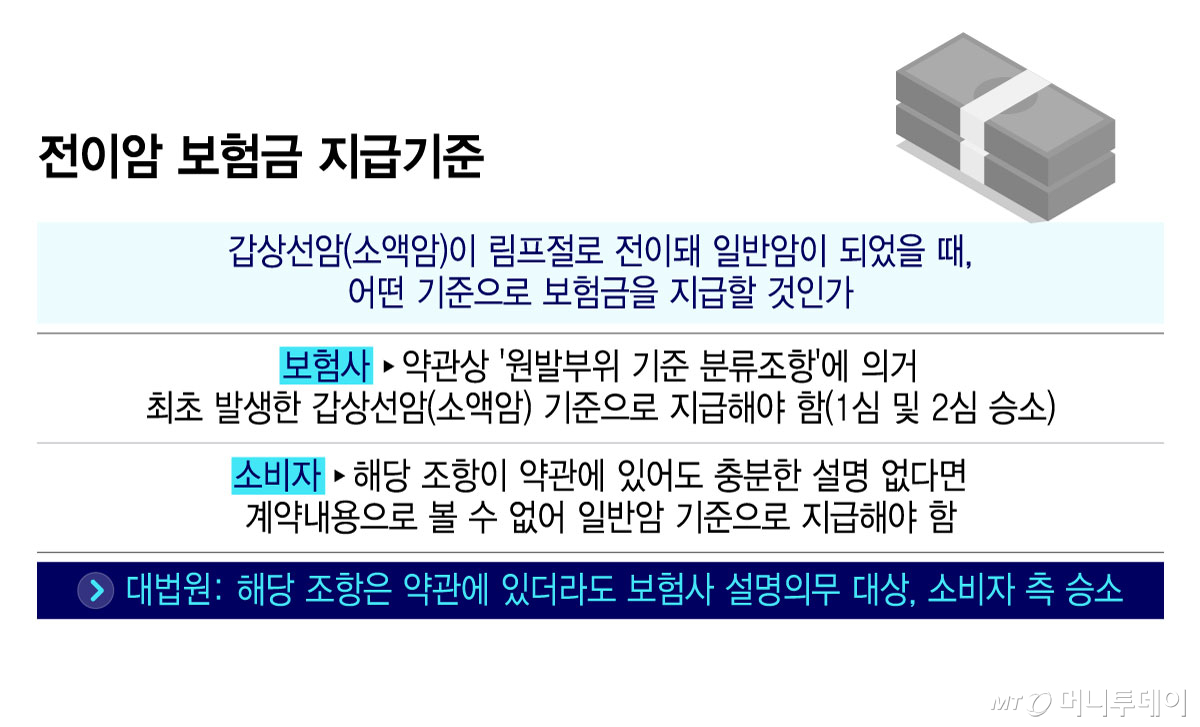
Insurance companies have previously paid only small-scale cancer insurance benefits corresponding to thyroid cancer even when cancer originating in the thyroid spread to other parts of the body, based on policy provisions stating that "the diagnosis of cancer and payment of insurance benefits are determined by the primary site." However, if this content was not sufficiently explained during the product explanation process, insurers were required to pay general cancer insurance benefits.
The insurer's burden varies significantly depending on whether it is classified as a small-scale cancer or a general cancer. Thyroid cancer insurance benefits typically range from 5 million to 10 million won, while general cancer diagnosis insurance benefits are around 50 million won. If a product offers 10 million won for thyroid cancer, previously only 10 million won would be paid even in cases of metastasis; however, if the duty of explanation was not fulfilled, insurers must pay the general cancer benefit of 50 million won. If 10 million won has already been paid, the insurer must provide an additional payment of 40 million won.
In March last year, the Supreme Court recognized the insurance company's duty of explanation in a case where a policyholder with thyroid cancer that had metastasized to lymph nodes claimed general cancer insurance benefits. This overturned the lower court's ruling, which had held that insurance benefits should be paid based on the primary cancer site. The court ruled that even if relevant criteria are explicitly stated in the policy terms, it is difficult for insurers to claim such provisions as part of the contract if they did not sufficiently explain them to consumers during the product explanation process. Since the "primary site classification clause" determines the amount of insurance benefits and the scope of coverage, it constitutes an important element of the insurance contract, meaning insurers were required to provide specific and detailed explanations.
Some insurers began revising their product explanation documents even before the Supreme Court's ruling was issued. Rather than merely including relevant content in the policy terms, they adopted a method of more clearly explaining how insurance benefits would change if small-scale cancers such as thyroid cancer metastasized to other parts of the body in the product explanation documents. Property and casualty insurers, having incurred costs for paying hundreds of billions of won in additional insurance benefits, are now changing their sales procedures to provide clearer guidance on core coverage contents and limitations during the product explanation and solicitation processes.
An industry official stated, "In the past, it was common practice to pay insurance benefits based solely on relevant provisions explicitly stated in the policy terms," adding, "Since the Supreme Court ruling, it has become important not only whether such content is written in the policy terms but also whether consumers actually received explanations of key contents during the enrollment process. Insurers are now paying close attention to product explanations."

 in FINANCE
