

To prevent long-term rule by financial holding company chairmen, a proposal is gaining traction to require unanimous "consent" from the Chairman Candidate Recommendation Committee (Chairman Recommendation Committee) within the board of directors before the shareholders' meeting when a chairman seeks a third consecutive term. Financial authorities initially pursued amending the Financial Company Governance Act to prohibit three consecutive terms outright, but as constitutional concerns emerged even within the ruling party, the unanimous consent alternative has recently become a leading option under review.
According to political sources on the 26th, the Democratic Party of Korea and the Financial Services Commission are discussing a measure requiring unanimous (100%) consent from all members of the Chairman Recommendation Committee within the board when a financial company CEO seeks a third consecutive term, as one way to prevent unreasonable long-term consolidation of power. The government and ruling party are expected to finalize and announce concrete measures as early as early next month.
Currently, for a financial holding company chairman to be re-elected or seek a third consecutive term, they must obtain consent from more than two-thirds of the board after passing through the Chairman Recommendation Committee (or Executive Candidate Recommendation Committee), followed by approval from over half (50%) of the shares represented at the shareholders' meeting.
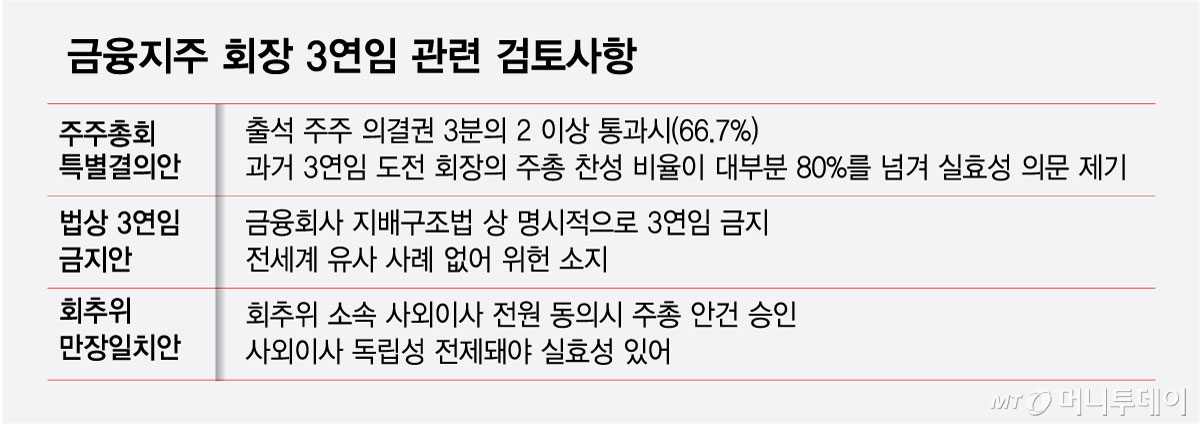
Under the proposed changes, a chairman would need unanimous consent from all members of the Chairman Recommendation Committee to place a third-term candidacy on the shareholders' meeting agenda. Additionally, for re-election, a special resolution requiring 75% approval would be introduced. Currently, when the Chairman Recommendation Committee nominates a single candidate, there is no separate voting procedure.
Financial authorities initially pushed to legally prohibit three consecutive terms for financial holding company chairmen. This would involve codifying in the Financial Company Governance Act that once a chairman completes the maximum six-year term, their tenure cannot be extended. This was an "extreme measure" taken by financial authorities last December following criticism from President Lee Jae-myung, who asked, "People serve as bank presidents for 10 to 20 years, moving between roles while in power—do we have any measures to address such issues?" However, after this proposal was reported, repeated concerns were raised within the ruling party that it might be unconstitutional, citing the absence of any precedent for legally limiting the tenure of financial company CEOs.
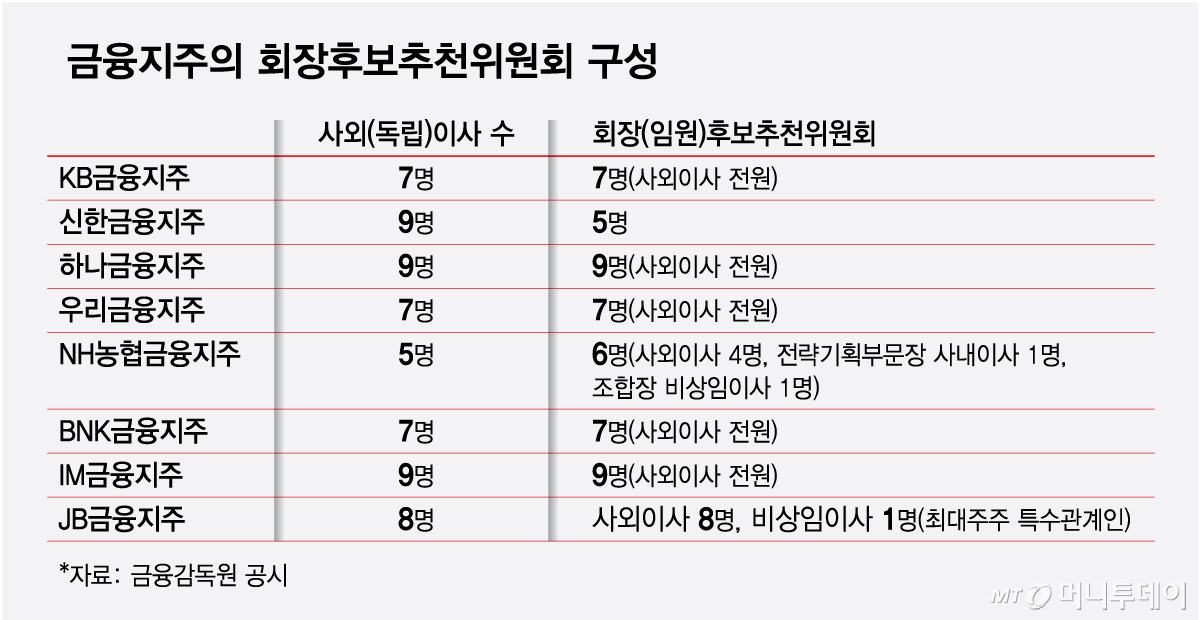
Consequently, the government and ruling party are seriously considering a measure to significantly strengthen procedures by requiring 75% consent from the Chairman Recommendation Committee for re-election and 100% consent for a third consecutive term. A financial holding company board of directors consists of Ji Ju (Chairman), executives, and outside directors. For example, in the case of KB Financial Group, the board comprises Yang Jong-hui (Chairman), Han Hwan-ju (President of Kookmin Bank), and seven outside directors, totaling nine members. The Chairman Recommendation Committee under the board includes all seven outside directors. If even one outside director casts a vote against a third consecutive term, the proposal cannot be placed on the shareholders' meeting agenda at all.
A ruling party official stated, "If re-election is legally permitted but a third consecutive term faces constitutional concerns or conflicts with global standards, we understand this as implementing a brake mechanism at either the shareholders' meeting or board level specifically for the third term." However, another senior ruling party official added, "Since unanimous consent means even one dissenting vote blocks approval, it remains uncertain whether the public would accept such a requirement. The matter is not yet finalized; multiple options are under review."
However, even if the conclusion involves strengthening the Chairman Recommendation Committee procedure rather than outright banning three consecutive terms, experts emphasize that enhanced board independence must be a prerequisite. There are concerns that if a financial holding company chairman has established an "insulated board" through outside directors closely aligned with them, strengthening the board's authority could paradoxically become a tool to rationalize long-term consolidation of power.
The financial authorities have included measures to strengthen board independence in this plan for advancing financial company governance. Specifically, they aim to diversify the currently closed system for recommending outside directors while enabling major shareholders such as the National Pension Service to directly recommend outside directors themselves. Given that the National Pension Service is a major shareholder in key financial holding companies, its enhanced role in recommending outside directors could become more active if the improvement plan passes.

 in FINANCE

