

With the National Pension Service launching a public trust service targeted at dementia care this year, it is expected to reshape the landscape of the will-substitute trust market, which has gained prominence amid an aging super-aged society. The banking sector, which has long invested in will-substitute trusts, is growing tense over the arrival of the "big fish" known as the National Pension Service.
According to financial industry sources on the 20th, the National Pension Service launched its 'Dementia-Safe Asset Management Service' in April this year. Within three months, by July, four contracts had been finalized.
This service is part of a pilot program for the public trust system promoted by the Ministry of Health and Welfare. It is Korea's first public trust product designed to support basic pension recipients who suffer from dementia or mild cognitive impairment and find it difficult to manage their assets independently, enabling them to stably manage funds needed for daily life. As this remains a pilot program, eligibility criteria and entrusted asset limits are in place. The scope of entrusted assets is limited to cash-like assets, with an upper limit set at 1 billion won.
The National Pension Service has signaled its intention to fully enter the market through public trusts via legislative amendments. To fulfill its role as a public trust provider, the National Pension Service requires new provisions in the Dementia Management Act allowing it to be entrusted with providing asset management support services, and an amendment to the National Pension Act to add public trust operations to the Korea Pension Corporation's duties. A National Pension Service official stated, "We are operating this as a pilot program based on government ministry approval while pushing for legislative amendments."
Concerns have arisen in the banking sector that this could encroach upon the private will-substitute trust domain. Until now, will-substitute trust services in Korea were exclusively within the banks' sphere. This service allows depositors to entrust their accumulated assets to a bank in advance, with the bank managing funds from initial administration through posthumous inheritance. Hana Bank introduced the first will-substitute trust in the financial sector in 2010, after which commercial banks gradually entered the market, launching diverse products such as Dementia-Safe Trusts, Disability Trusts, and Guardianship Trusts. Recently, some banks have established dedicated teams to offer consulting services bundled with inheritance and gifting services alongside their core offerings. Hana Bank operates a total care organization comprising legal, tax, real estate, and trust experts, while Shinhan Bank has set up a dedicated team within its trust division.
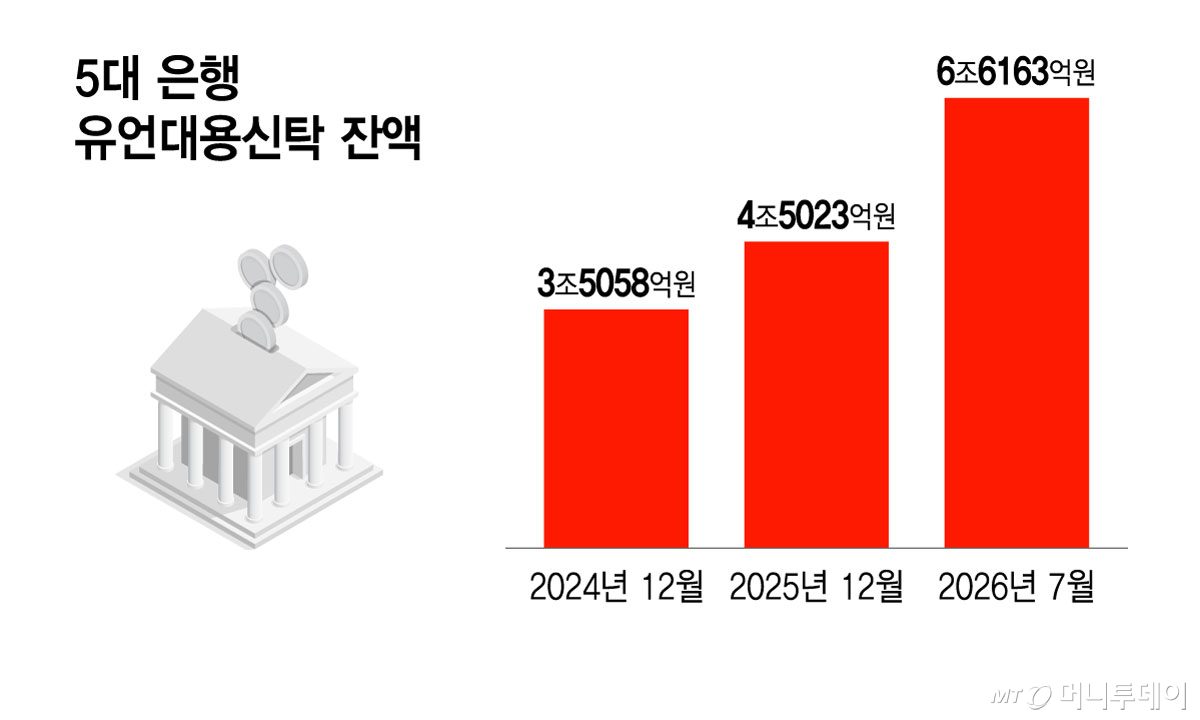
Consequently, the will-substitute trust market has grown annually, approaching a scale of 7 trillion won. As of late July this year, the reserve balance of will-substitute trusts at the five major banks (KB Kookmin, Shinhan, Hana, Woori, NH Agricultural Cooperative) totaled 6.6163 trillion won, an increase of over 3 trillion won compared to the end of 2024 (3.5058 trillion won).
While there is optimism that the overall market pie will expand with the introduction of public trusts, frontline banking departments express concern about intensified competition if the target audience for public trusts expands to include the middle class. A bank official stated, "The National Pension Service's public trust and financial institutional investors' Dementia-Safe Trusts may overlap in some customer segments and functions, leading to expected competition." Another bank official added, "Commercial banks will face pressure on their fee structures alongside social responsibility obligations."
Calls are also emerging to open public trusts not only to pension funds but also to private banks. The argument is that banks can leverage their accumulated operational experience to demonstrate expertise. A financial industry official noted, "If banks enter the trust business, it could serve as an opportunity not only to expand their existing customer base but also to popularize trusts and broaden the market foundation."

 in FINANCE
