

-Authorities Issue Interpretation to Strengthen National Pension Service’s Right to Recommend Outside Directors
-Chairperson of the Candidate Recommendation Committee Must Publicly Explain Reasons for Single Candidate Recommendation at Shareholders’ Meeting
-Basis for Chairperson and Outside Director Recommendations and Appointments Must Be Documented
The government and ruling party are considering a unanimous consent procedure within the board through the Chairperson Candidate Recommendation Committee (Executive Candidate Recommendation Committee) instead of limiting financial conglomerate chairpersons to three consecutive terms, due to concerns that such a ban could raise constitutional issues. There is no global precedent for legally capping the tenure of CEOs at financial institutions. However, if the independence of outside directors is not guaranteed, there remains a risk that this mechanism could be misused as a tool to rationalize the prolonged consolidation of power by Do Ri-eo (Chairman). In response, the government and ruling party are also considering expanding the National Pension Service’s right to recommend outside directors, given its status as the largest shareholder in financial conglomerates.
◆ Outside Directors’ Authority Over Three-Term Decisions Becomes Powerful… Chairperson of Candidate Recommendation Committee Must Publicly Explain Background of Candidate Recommendations at Shareholders’ Meeting
According to political sources on the 26th, the government and ruling party initially discussed banning three consecutive terms for financial conglomerate chairpersons under the Financial Company Governance Act but shifted direction upon facing constitutional concerns. The revised plan introduces a special resolution by the Candidate Recommendation Committee composed of outside directors: reappointment would require 75% approval during the second term and unanimous (100%) consent during the third term before being submitted to the board and ultimately to the shareholders’ meeting.
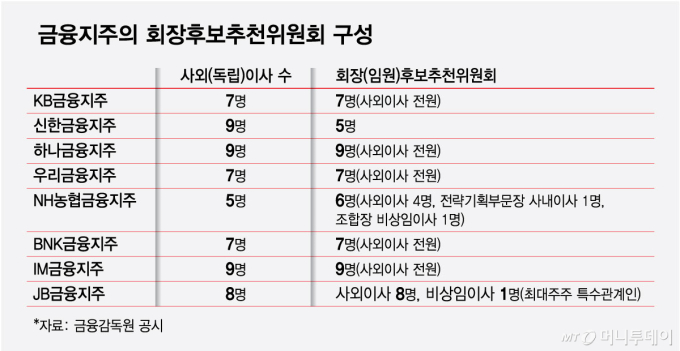
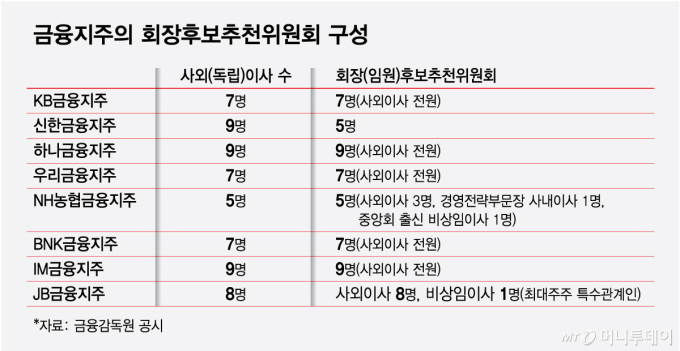
In most financial conglomerates, the Candidate Recommendation Committee is composed entirely of outside directors. At KB Financial Group (7 members), Hana Financial Group (9 members), Woori Financial Group (7 members), and BNK Financial Group (7 members), all outside directors participate in the committee and are involved in CEO appointments. At Shinhan Financial Group, while only five of its nine outside directors serve on the committee, an “expanded committee” is formed during chairperson appointments so that all outside directors effectively express their opinions. In the case of NH Nonghyup Financial Group, the committee includes four outside directors, one inside director, and one non-executive director from a cooperative leader background, totaling six members.
If unanimous consent by the Candidate Recommendation Committee is adopted instead of banning three consecutive terms to prevent prolonged chairperson tenure, fewer than ten outside directors could effectively determine Ji Ju (Chairman)’s term. This represents a significant expansion of outside directors’ authority.
The government and ruling party are reportedly discussing multiple approaches to strengthen outside directors’ powers while also significantly enhancing their independence and accountability. One proposal involves documenting and transparently disclosing the reasons for each recommendation at every stage during the selection of Woo Seon (Chairman) candidates or outside director candidates. Recording who recommended a chairperson or outside director and on what grounds could partially resolve issues related to “trench-building” (i.e., opaque decision-making).
Additionally, a new procedure may be introduced requiring the Chairperson of the Candidate Recommendation Committee to publicly explain at the shareholders’ meeting why they unilaterally recommended a specific candidate when submitting a three-term reappointment proposal. Currently, there is no formal process for the committee to publicly explain the background of candidate selections at shareholders’ meetings.
◆ Legal Interpretation Also Issued to Enable National Pension Service to Exercise Outside Director Recommendation Rights… “Effectively Equivalent to Banning Three Consecutive Terms”
Especially to strengthen outside directors’ independence, the right of shareholders to recommend outside director candidates will be significantly enhanced. Currently, shareholders holding 0.1% of shares in a financial conglomerate have the right to recommend outside directors, but this right is rarely exercised in practice.
The National Pension Service, which has become the largest shareholder by holding 6–9% of shares in financial conglomerates, is expected to see its outside director recommendation rights expanded. Financial authorities plan to issue a legal interpretation allowing the National Pension Service to actively exercise these rights. The interpretation would clarify that if the National Pension Service holds more than 5% of a financial conglomerate’s shares for general investment purposes, exercising its recommendation right would not be considered management participation. Consequently, the National Pension Service would not fall under separate disclosure obligations (5%) or short-term trading profit recovery targets (10%), enabling it to exercise its recommendation rights without burden.
A financial industry official stated, “It is practically unimaginable for a board to reject an outside director recommended by the National Pension Service, which holds the largest stake in a financial conglomerate.” The official added, “If one of the National Pension Service-recommended outside directors casts a vote against Ban (CEO)’s three-term reappointment, it would immediately block the reappointment. Therefore, introducing a special resolution for the Candidate Recommendation Committee could achieve an effect similar to legally limiting three consecutive terms.”
Meanwhile, discussions on amending the Financial Governance Act have officially begun in the National Assembly. The National Assembly’s Political Affairs Committee today considered a bill to amend the Financial Company Governance Act proposed by Democratic Party of Korea lawmakers Kim Hyun-jeong and Park Hong-bae. Following further discussions between the government and ruling party, a plan for advancing financial company governance is expected to be announced as early as next month.
-KB Financial to Finalize Candidate Selection on the 11th, Already Proceeding with Enhanced Transparency Procedures

The long-delayed announcement of a financial governance improvement plan is imminent. While full implementation will require time due to the need for legislative passage in the National Assembly, the plan is expected to have immediate practical effects starting with chairperson elections at KB Financial and iM Financial.
◆ KB Financial Narrows Chairperson Candidates to Three on 27th… iM Financial Refines Chairperson Qualification Criteria
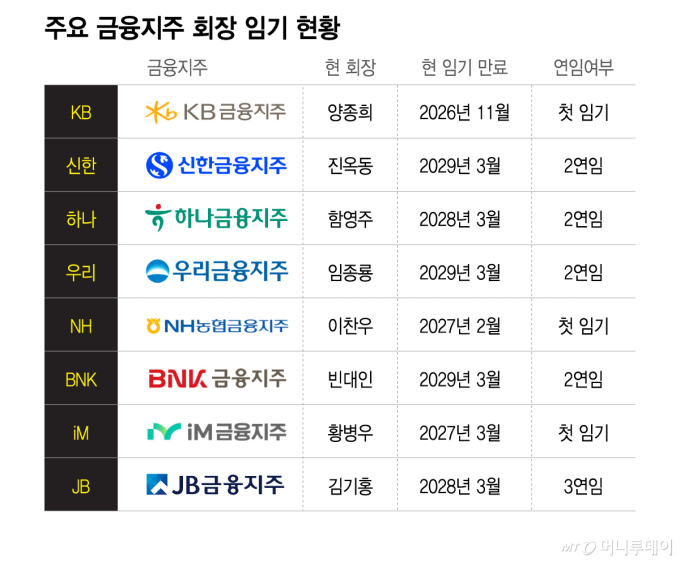
According to financial industry sources on the 26th, KB Financial’s Candidate Recommendation Committee will conduct first-round interviews with six potential chairperson candidates on the 27th and narrow the shortlist to three. A second in-depth interview will be held next month, followed by a vote to finalize the ultimate candidate. With approximately three weeks remaining until final candidate selection, the process will conclude at the November shareholders’ meeting when the next chairperson is officially appointed.
The current pool of candidates includes four internal nominees and two external ones, totaling six individuals. Internally, Yang Jong-hui (Chairman), along with Lee Jae-geun and Lee Chang-kwon (KB Financial division heads) and Lee Hwan-joo (KB Kookmin Bank president), are among the nominees. Externally, former Woori Bank President Kwon Kwang-seok and one individual requesting anonymity are included. The committee has set qualification criteria for chairperson candidates including leadership, work experience, expertise, ethics, ability to ensure long- and short-term sound management, and alignment with KB Financial’s vision and values.
In the financial industry, Yang (Chairman) is considered highly likely to be reappointed due to having established a solid foundation for “leading finance” through record-breaking performance during his tenure. KB Financial entered the “5 trillion won club” for the first time in history in 2024 and recorded net profits of 5.843 trillion won last year, achieving consecutive annual net profits exceeding 5 trillion won for two years. In the first half of this year alone, it posted net profits of 3.8846 trillion won, setting a new record for semi-annual performance.
iM Financial, whose chairperson Hwang Byeong-u (Chairman)’s term expires in March next year, has begun preparations for chairperson selection by refining qualification criteria. Under the revised criteria, candidates must have at least 20 years of work experience in domestic or foreign financial institutional investors and hold a position equivalent to chief executive officer or deputy president/vice president at a domestic or foreign financial institutional investor within the past five years. An age requirement of under 67 years old as of the time of appointment by the shareholders’ meeting has also been included.
◆ Governance Improvement Plan Primarily Affects KB Financial
The financial industry initially expected KB Financial to be the first case subject to the government’s governance improvement plan. However, as the plan—originally anticipated for release at the beginning of the year—has been repeatedly delayed, applying it to KB Financial in a timely manner is now difficult. While some aspects of the government’s plan can be implemented immediately, most measures require amendments to the Financial Governance Act. Even if the government releases its improvement plan in early September, applying it directly to KB Financial, which plans to finalize its final candidate on the 11th next month, is practically impossible.
Nevertheless, KB Financial cannot proceed with its procedures without considering the government’s improvement plan due to potential burdens. Financial authorities have previously indicated the direction of the governance improvement plan and requested voluntary adoption even before legislative amendments are completed.
KB Financial is also incorporating issues pointed out by financial authorities into its chairperson selection process. It has advanced the management succession timeline by one month compared to past practices, allowing more time for candidate vetting. Sufficient internal data has been provided to external candidates to ensure fair competition, and interview preparation periods have been extended to approximately two months. Additionally, KB Financial is documenting all procedures of the Candidate Recommendation Committee, including the selection process and rationale for the shortlist.
As a result, measures to strengthen voting procedures at both the Candidate Recommendation Committee and shareholders’ meeting during reappointment are expected to be incorporated as much as possible. It is reported that KB Financial already operates on a principle of unanimous consent when finalizing candidates within the committee.
Since iM Financial has not yet officially activated its Candidate Recommendation Committee, it is expected to establish procedures reflecting the governance improvement plan as fully as possible once the plan is announced.

 in FINANCE


